When Sartre famously observed in his play Huis Clos that “Hell is other people” (I love the French, “L’enfer, c’est les autres), he nailed one essence of human existence that we, each one, live inescapably among other humans. More often than we care to admit (although it is daily easier to do so in this time of sadistic murderers like Putin, Netanyahu, and Trump), we wish to hell it were not so. One special friend, who daily and ironically lives her life through acts of mercy, hopes with all her might every day that a meteor with earth’s name on it will do a thorough job and spare the victims of humanity its endless cruelties.
Still, the fact remains that if you add one person to another, in any situation – be it in Beckett’s sublime En Attendant Godot or in the Biblical myth of Garden of Eden or in this year’s Amadeus at the Shaw Festival, an individual no longer remains the same in what they think, what they say, what they do, what they are. Each existence is now somehow a reference to another, it includes someone else as part of its own uniqueness, in a kind of “You are, therefore I am.”
Some of my favorite theatrical, or cinematic, or televised creations involve characters bound to one another. I remember three productions of Strindberg’s The Dance of Death – the first at Stratford Ontario with Jean Gascon and Denise Pelletier in 1966, the second with Alan Bates and Frances de la Tour in London, and the third with Fiona Reid and Jim Mezon at the Shaw Festival. Each pairing, brilliantly played, seethed with the despair of inescapable and destructive human connection and the impact of such productions remains, as you can see, for a very long time.
Fortunately, not all combinations before an audience, of two or more existences, are fodder for existential despair. Each other life can be cause for one to live enriched with new insight and thus more fully, blessed with possibilities of which one was unaware before. One’s world becomes new because one has been lured into new thinking and feeling, even new sensual experiences. I guess that’s why a creation of two, even three or four, intimately-linked characters is incentive for new perspective and refreshed imagination. You have character A and character B and as they interact they present a whole new alphabet for existential development before them as, in turn, they place it before us.
I recently watched, for the fourth time, Tommy Lee Jones and Samuel L. Jackson in The Sunset Limited, written by Cormac McCarthy and directed by Tommy Lee Jones. This short film is one to savour as the lives of the two characters unfold in the colloquially poetic words they speak. The encounter is congenial although the two characters live distinctly different lives in two different universes. Naturally, the dialogue is imbued with all manner of philosophical implications, brought to life in two masterful performances.
The film Daddio features Dakota Johnson as a New Yorker, here called Girlie, who takes a cab from JFK with Sean Penn being the driver, and it proved a gradually touching experience. I was surprised to read afterwords on IMDB, in a favourable review, that a long ride from the airport “at first glance it does not appear to be a great foundation for a film” since Daddio is a sensitive and realistic depiction of two people, though strangers, developing a meaningful connection in a confined space for a long while.
Allow me to intrude with a memory. My first book of poetry hadn’t been published as yet, so this was certainly before 1984. I got on a train in Paris bound for London and since there were only a few people in the car I entered, I claimed a two-seater facing another two-seater on which, in declaring my ownership of this space, I scattered my knapsack and sections of the Herald Tribune and the London Times and Guardian. Then I sat back and started the crossword in the Tribune.
At that instant, a woman, I imagine slightly older than I, entered the car and stood beside the seat which I had just scattered with stuff to ensure my privacy. “Is that seat taken? she asked, so I cleared off my self-protecting mess, although the car remained just as almost empty as before. But we hit it off immediately and I soon found out that she was an art critic from The Hague, now separated or divorced, but I never did find out what the heavy art book she was carrying contained. Also, she was dressed in breezy and flowing white attire with a white bandana.
We talked all the way from Paris to Calais by train, all the way from Calais to Dover by hovercraft, but from there took different trains into London. I remember her waving, smiling and vigorously, as my train pulled out of Dover, and felt lonely in a way. We had got more and more personal, without hesitation, as our conversation unfolded and I sensed an underlying sadness in her – or was it my own sadness I was projecting? In any case, the film Daddio felt unforced and real to me, so I do recommend it, after you have watched The Sunset Limited.
Of course, my soon to be published book of poetry, BONES TO BURY, did contain a poem about this mysterious art critic from The Hague. It was titled THE WOMAN LEFT A STRANGER and since, as always, I’m in a sentimental mood, here it is:
The fist: a stone
that separates
method from anger,
love
from everything else.
We stood on the sand
of Calais,
remembering lovers
and rock.
You held my body,
found the marrow
missing.
You touched me
with lamenting hands
and words
I could not shatter.
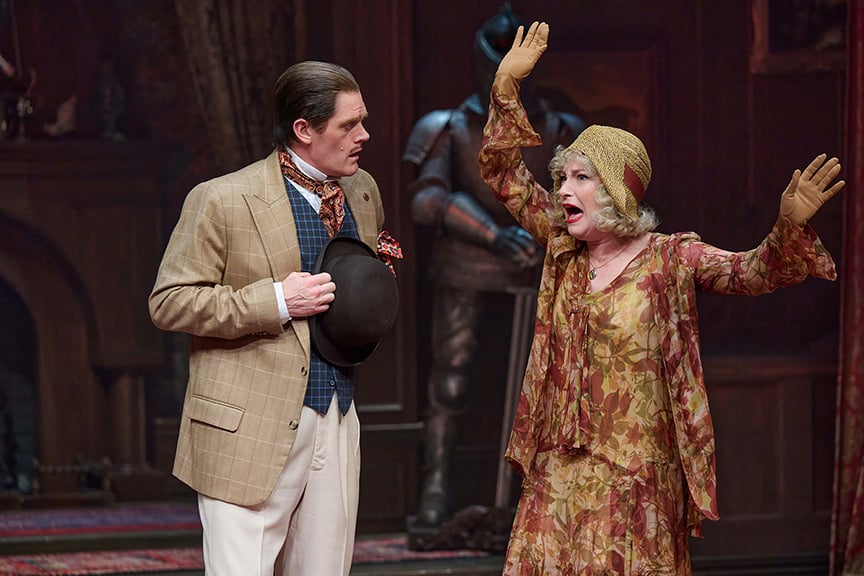
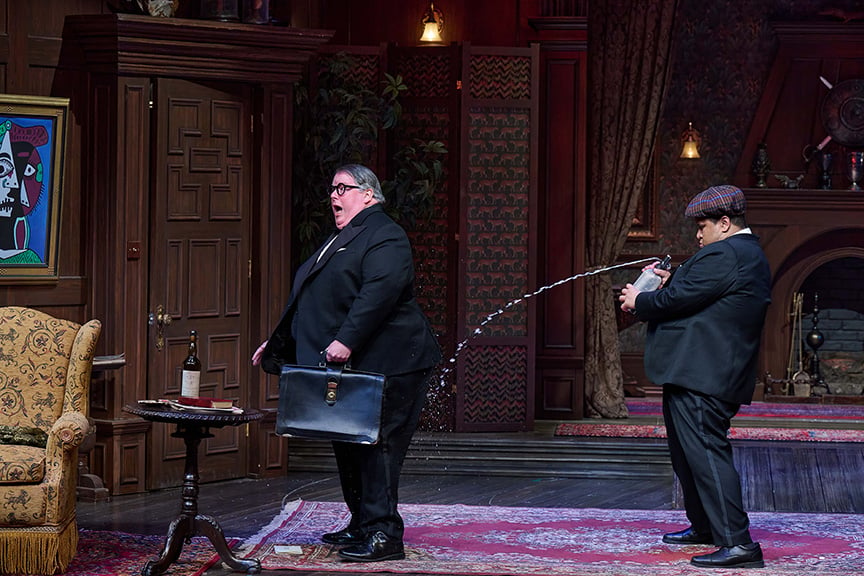
If I began this column with the existential down side of Sartre’s Huis Clos and Strindberg’s The Dance of Death, I must recommend, nay insist, that you now go see One for the Pot at the Shaw Festival and find yourself in one of life’s alternatives, a state of bliss in craziness with unending laughter as a natural bonus. This production of farce is brilliantly honed, as a musical masterpiece might be, by director Chris Abraham and his individually and collectively brilliant company.
One delights in the surprises that each passage offers, one thinks perfection because the frenzy of comedy here cannot be thought done another way. In fact, one doesn’t think at all, one feels pleasantly assaulted by absurdity, and one can do nothing but give in to the fun of it all. “I want to see this again,” said my wife, and I am now consulting the calendar for some indication of cooperation. By the way, be sure to read actor Neil Barclay’s very informative notes in the program.