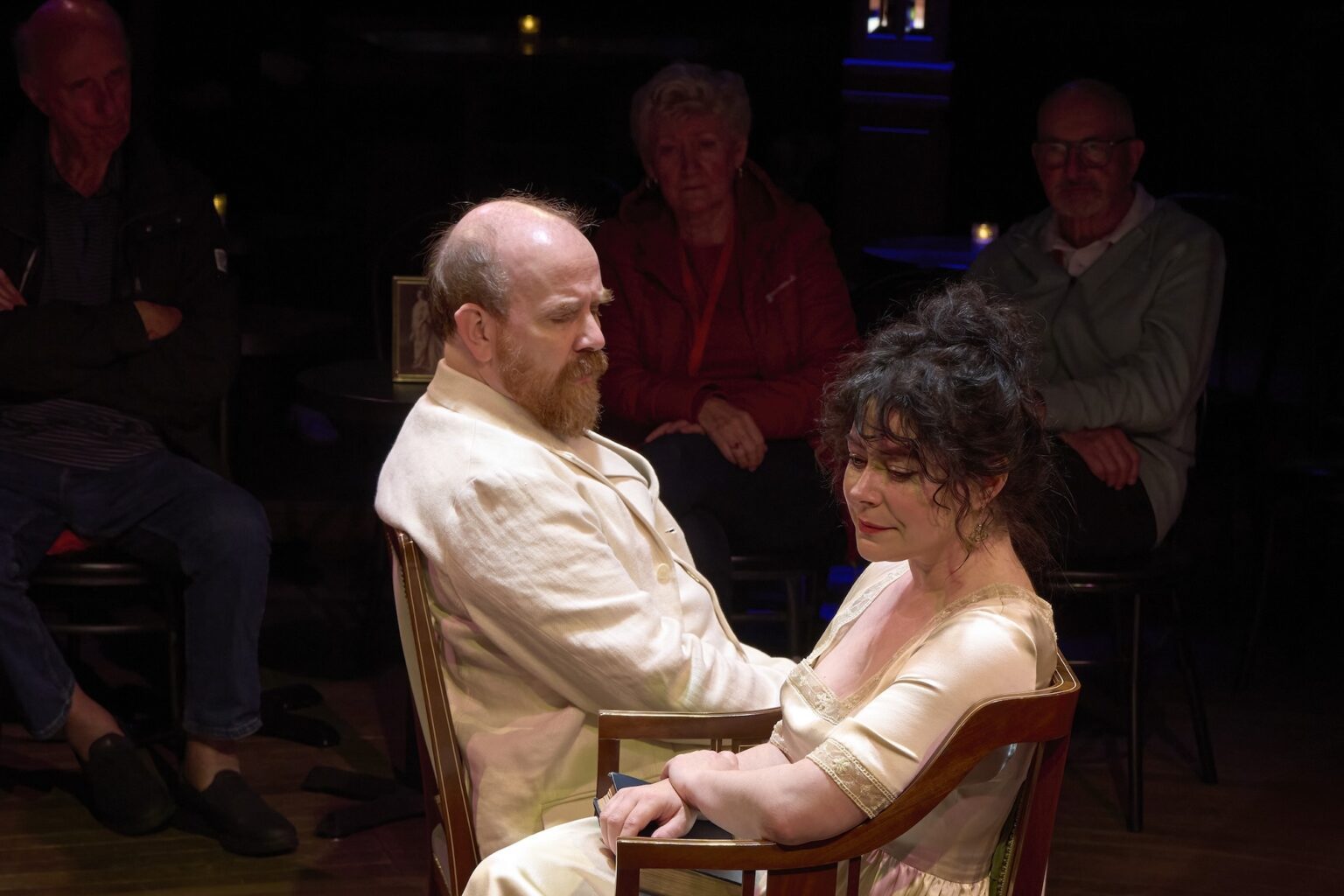
OLD TIMES BY HAROLDPINTER
Before the current run of Old Times at Toronto’s Soulpepper, the last time I saw a performance of a Pinter play was in 2018 at the former Comedy Theatre now renamed the Harold Pinter Theatre near London’s Leicester Square.
As usual the seats were very uncomfortable, but I still could see, aching bottom and all, a long-treasured play available only on DVD with Alan Bates, Laurence Oliver, Helen Mirren, and Malcolm McDowell. The more recent one I saw in London featured David Suchet.
I used to show Harold Pinter plays to my students at Sheridan College, partly to develop an experience of unsettled and involved unknowing in them, a method at which Pinter was an acknowledged master. Of course, on occasion, one could feel that Pinter was self-consciously trying to be Pinter, but the playwright was often brilliant at keeping an audience on their toes.
Pinter could also touch the human core in people. I remember showing one class Pinter’s The Homecoming and one student complaining about the stupid plays he was forced to look at. Other students disagreed and finally Student #1 burst out, “Those people, when they fight all the time, are just like my family.”
The Homecoming featured Paul Rodgers, Ian Holm, and Cyril Cusack, all memorable.
For the performance of Old Times at Soulpepper, I found myself scribbling notes in reaction, certainly not explanation. Here we go:
Feels like a string of idle thoughts which verify that if we talk we exist
As if to prove they exist because they once were
Language makes us quests in our own lives
Who owns my memories? Are they here or were they once here. Are they something only about to happen?
Everything is an issue but whose issue is it?
Every thing they do is something to prove….do we try or want to verify we exist?
We have thoughts so we can speak them
They have nothing to say as long as they say it
They have nothing to say and they say it
People exist only when they remember, but are they really remembering?
Yes, he matters, if it matters that he matters
A play to see when you are semi conscious
Three people trying to collectively explain or understand what they just saw ……all as ushers are trying to empty the theatre….” he said he was Ordon Welles” says one
Is this an accurate quote? “looking up your skirt in her underwear”
People find aggression to hire ??
Undercurrents of psychology are given direction in speech
Each character is a walking non sequitur
People the way they now are post COVID
What truth does anyone speak?
DEAR LIAR
My love of George Bernard Shaw has been fuelled by many experiences. No doubt, having the annual Shaw Festival forty miles from my home offered me annual opportunities from the early seventies on to become repeatedly acquainted with the Shaw canon.
But what of Shaw the writer, the mind, the personality, the human being? Decades ago, the CBC ran The First Night of Pygmalion, a drama which featured William Hutt as GBS plus Elizabeth Shepherd and the always inimitably glorious Paxton Whitehead, once the artistic director of this very Shaw Festival, and I started to wonder then about all these matters.
Then, once in London, I saw that John Gielgud was sharing the bill in what turned out to be a very entertaining and touching play titled The Best of Friends with Wendy Hiller and Patrick McGoohan as GBS. Gielgud always had some influence on my feeling for spoken language as I wrote my poetry, and so I saw The Best of Friends not one but three times.
In time I corresponded with Gielgud on several occasions and always marvelled at his miniscule handwriting always on a marked slant on a blank page. I also later had the opportunity to interview Michael Holroyd, Shaw’s biographer in four meticulously detailed volumes of which I got to read just one. Suffice it to say, Shaw has long been a person of interest in my life.
So, I enjoyed and was moved by Graeme Somerville as Shaw and Marla McLean as the actress Mrs. Patrick Campbell, stage name for Stella Tanner, in Dear Liar, a two-character play that uses for text the correspondence between the two. And I was left wondering about playwright and actress almost as much as with characters in a Pinter play.
Shaw and Mrs. Pat are both compelling users of words, very articulate in their declarations and most adept in their ability to play with others through the language they use – and to simply play most of all. Play is a most delightful aspect of their connection but play, when it is true to play, is always in motion and instinctively reinventing what is taken for reality. Play blended with intelligence is irresistible.
The two actors here convincingly imply qualities in Shaw and Mrs. Pat that in a way we are not allowed to understand too deeply, since each character is doing an involving and distracting verbal dance as a means to protect oneself. And this is tricky turf for any actor, to reveal a character who doesn’t want to be revealed too much, although that same character loves to play, loves to perform a role.
So, at the end of Dear Liar, I was asking as many questions as I did at the end of Pinter’s Old Times.
If you really want to mess with your head, try reading Bernard Shaw and Mrs. Partrick Campbell: Their Correspondence Edited by Alan Dent. I bought my used copy in London years ago and throughout this performance I kept having aural déjà écouté.
In any case, you should see this engaging production for its delightfully fresh perspective on GBS and Mrs. Pat.