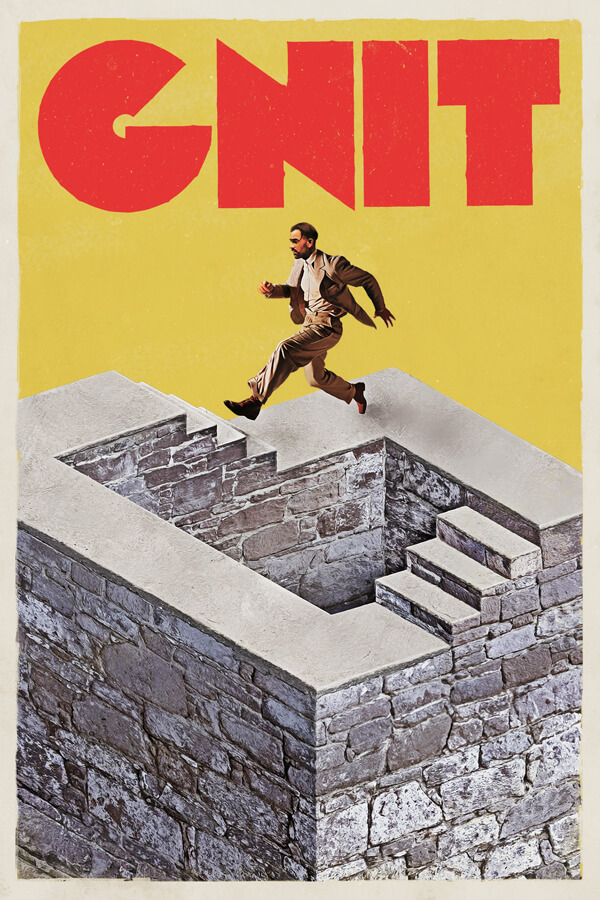
It is typical of playwright Will Eno’s writing in Gnit, now at the Shaw Festival, that in but a few words he can evoke the pulsations of each character’s state of being. He is also most able in capturing concisely the subtleties of each relationship, of each whole lifetime even.
Every declaration feels poetically infused, a construct that is loaded with meanings, although if you savour one too long you will miss the next – especially at the unbelievably nimble pace of this production created by director Tim Carroll.
Moreover, not only is every dialogue crisp and concise, but it repeatedly evokes complete realities for us to inhabit. Eno is very adept in negotiating through our imaginations with the outpourings of his. As a result, this production becomes a very real place for us to take up residence.
Right at the outset, in a scene between Gnit and his mom, we have a brisk dialogue of quick turns and penetrating trains of thought that veer sharply, reverse, and maybe even reject themselves. It’s an invigorating experience to keep up with exchanges that may be challenging or even confrontational, and to try to decipher the human element within. Hearing such encounters is always engaging, since our growing understanding of the characters becomes one essence of our experience.
We try to keep up with sentences that, like the workings of an impressionist’s dabs and brushstrokes, accumulate into a shape of some kind, be it a characterization, an event, an emotion. We are compelled to constantly pull things together and celebrate language as we do.
Eno’s writing is consistently poetical and compact, to be sure, and we happily find that humour is another given possibility. The text is sprinkled with truisms about existence and although Gnit may wax eloquent, he can hear in response, “How wordy.” I still smile at that one.
This production of Gnit is both intellectually and physically propelled. It is directed by Tim Carroll for the dynamic potential of each line, the nuances of each conjured reality, and the concise potency of communication between people. And certainly, of the physical reality lived by them. The choreography of movement is here consistently dynamic and exciting as it takes us along like hitch hikers into our own fantasies,
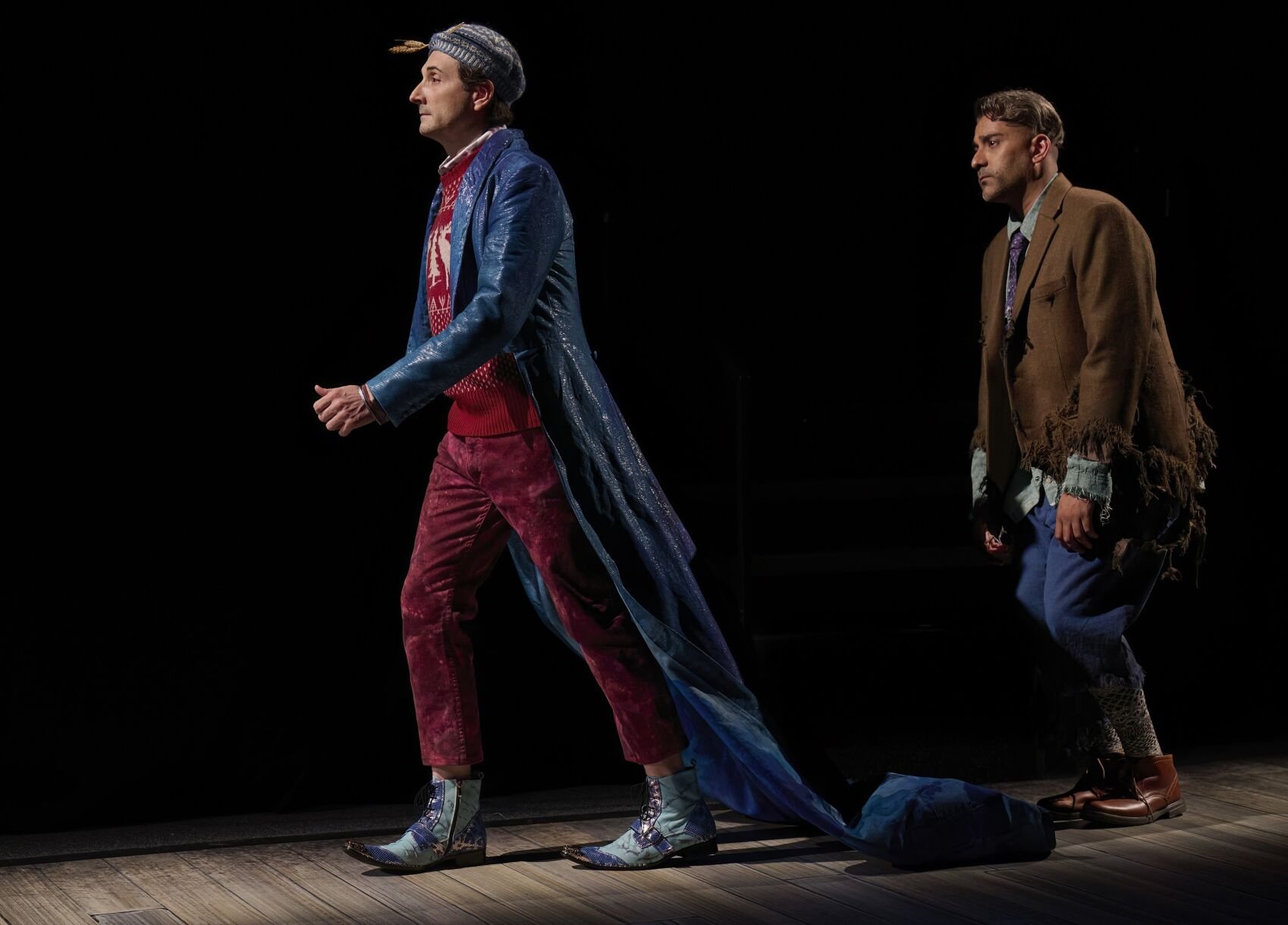
Hanne Loosen’s costume designs, with their arbitrary extensions of robes or pants seem like delightful whims of imagination. They are fun. Kevin Lamotte’s lighting simultaneously enhances both the presence and the essences of each character. Darkness and light are effectively seductive elements in this production and our minds are always giving personally workable form to the sources of the words we hear. We are engaged.
Indeed, director Carroll has created an exhilarating continuum of vibrating theatrical instances within this blend of light and motion. In each scene we are compelled to ask not only where but what we are. The dialogue doesn’t necessarily guide us but seems to point with us and we wend our way through whatever understanding of life we each have achieved that is here awakened in us.
One quietly thrilling aspect of this production is the choreography of its moving parts, its characters. If they are the hues made of lifetimes and if their psychological colours blend in interactions with one another, they also live an existence of motion, both physical and psychological.
When Gnit realizes that his mother has died, he lets out a quiet “Oh, no” but with a “Bye mom” he reverts to a functional and superficial Peter, all tellingly paced by actor and director, all back in motion. Perhaps if Peter stops, he may not exist, who knows?
The opening of part two is both functional and thus hilarious. The bartender played by Julia Course asks of Gnit how it’s going and in response receives a summary of the play thus far, things we knew and things we didn’t. Gnit, it turns out wants to “talk about the nature of self” and we sense he is out of his depth.
The writing, however, is so full of human experiences that it cannot help but reach our individual lives as we watch. But we are not, as usual, on quite familiar turf with a given speaker and hearing “You don’t have to go home but you can’t stay here” is one of many lines that leave one wondering why it was said and also why it was said the way it was. Yes, we are engaged.
When Gnit says, “I don’t know how a person is supposed to make it all the way to his death” we hear the playwright’s inner poet and his ability for concise and precise and evocative simplicity. Often with Eno, each spoken line has the quality of occasion and it resonates with existential truth.
At other times, the very self-aware writer deliberately plays with dialogue that, as a result, feels like something of a shorthand code for undergraduates who have not really been bruised by experience. Eno certainly knows what we can be in all our moods and because he is a well-honed craftsman of his art, he can understate with irony at will. He loves writing so much, it seems, that he does what it asks of him.
No more than five minutes into the performance of Gnit I attended, it struck me that this production of this play with these people was possibly one of the most artistically realized that I have experienced in many decades of attending performances of plays, most often as a reviewer. I realized that something very special was going on and that I was lucky to be there.
And yes, we can count some of the ways. The writing touches brilliance in its concise poetic simplicity, its sense of effective placement, its editor’s wisdom. The direction is so unobtrusively brilliantly-keen that we may take for granted both its perfected theatrical smarts and imagination in realizing each actor’s and the playwright’s potential for consummate theatricality.
The acting company is ripe with individual brilliance in using human depth – or shallowness – as a resource of reference. The abundance of technical skill on display feels like a repeatedly-right outlet of imagination. Individual eccentricity delights throughout as an effectively employed tool of the actor’s trade. I found myself eager to see each new entrance, to see what each actor would now do.
Lighting, set design, costume design, movement and music direction – how often did I hear Grieg? -all augment tantalizingly, in their own ways, the intentions of playwright and director. There’s many a force of inspiration at work and play here, in the process from page to production. The result is that we can’t help but inhabit a world which vibrates with life, imagination, and theatrical artistry at every turn, and we find ourselves vibrating with it. The play begins, sets our involvement in motion, and consumes us long past the end.
Indeed, I did one thing after seeing Gnit. I bought us two tickets for another performance.