OPERA HAMILTON: IL TROVATORE &THE 2012-2013 SEASON

Some years ago, when I asked Jonathan Miller about directing opera, he declared outright, “I wouldn’t touch historic kitsch like Trovatore with a barge pole. It’s got wonderful music and beautiful arias in it, but the story is just Madame Tussaud rubbish.”

And certainly Il Trovatore, though often polled among the most popular of all Verdi operas, merits its many parodies. Where else can you find, in a mere few hours, revenge, a threesome of lovers, much premonition, identities mistaken, suicide, murder, concealed truths, poison, kidnapping, beheading, undying devotion, burning at the stake –have I left anything out? And where else such deliciously melodramatic lines like these: “Have you come down from heaven or am I in heaven with you?” or “I had burned my own son!” or “Rage is seething in my breast?”

Still, since I first experienced Il Trovatore as a lad many years ago, the over the top inner logic of the plot, expressed through sometimes equally improbable Verdian musical devices, has always been easy to accept on its own terms. It’s not psychologically sophisticated stuff, to be sure, but it does border on the mythic and it is delightfully, unrelentingly melodramatic in a gripping way. So I must confess that I very much enjoyed the opportunity to experience Opera Hamilton’s recent production which offered many pleasures.

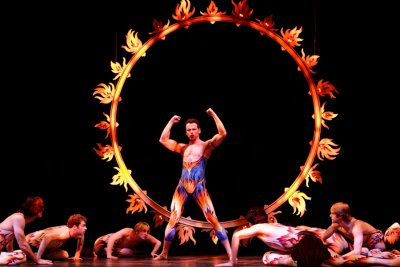
Opera Hamilton’s Il Trovatore opened with five flame bearers and helmeted soldiers gathered to hear about “a child’s bones half-burned and still smoldering’ and “a dark, despicable Gypsy hag,” an “evil hag” as it were, who was burned at the stake and whose cursed daughter seeks vengeance. Michael Ganio’s spare but evocative setting –two crosses suggest a convent- and Valerie Kuinka’s assertively unsettling projections -including a moon, fog, bare trees and branches- gave the goings-on a dark and foreboding context. The prison setting, with its rear-lighting by Steve Ross extending shadows toward the audience, created a dramatically oppressive atmosphere that was most unnerving. The only distracting visual gaff was the group of nuns garbed, so it seemed, like extras from Lawrence of Arabia.

Conductor David Speers leaned more to supporting and enveloping his singers rather than driving them, and from a balcony seat one could enjoy the collective presence of orchestra and voices as one. The necessarily reduced orchestra, though not big scale as some might prefer their Verdi, offered a sense of intimate urgency that was most suited to this frenzied tale directed with efficient insight by Valerie Kuinka. The male chorus was consistently gentle and delicate in sound and very pleasing to the ear, although they did not seem like men ever bloodied in battle or especially desirous for loot in declaring, “There will be much treasure today.”

Each of the four leads contributed distinctly in voice to the dramatic thrust of the story. As Leonora, Joni Henson offered a full fruity wine of a voice in mid and lower registers although, in the first half, the roundness of tone became narrower in higher passages and even seemed a different voice. Later the upper register did prove a natural tonal extension of the lower. To Azucena, mezzo Emilia Boteva brought compelling vocal powers that seemed naturally infused with drama, so much so that she seemed to have otherworldly connections. Her tormented, judgmental and driven facial expression added to her commanding intensity of voice and presence, and one hardly noticed that, with a six by six beam on her shoulders, she still managed much flexibility in her fingers. She was one scary woman.

In Count di Luna, James Weston offered a voice of grace, authority and warmly resonant sound, quite seamless and fluid with the pleasing ease of air, a deeply rooted lyrical instrument. More than a concise and reacting villain, this Count was a touchingly obsessed human being of some inner complexity. His presence brought dramatic texture to the production. After a few initial bigger notes that seemed pushed, perhaps the result of a bad wig day and errant hairs breathed in, Richard Margison’s Manrico was delivered throughout with a creamy ring in softer passages and benign energy and magnitude in his heroic moments, consistent always with high notes that thrilled. To experience such a potent vocal resource, one that fills the world’s major opera houses and now within perhaps eighty feet, is an opportunity offered by Opera Hamilton’s recent move to the Dofasco Centre. One felt the tingling effects of grand opera.

So a final word about next season’s offerings: another quintessentially theatrical masterwork from Verdi’s “middle” period in Rigoletto, Bizet’s The Pearl Fishers with its eternally heart-touching duet Au Fond du Temple Saint, and the always celebratory Popera PLUS! with its usual quartet of opera stars of today and tomorrow, always a revelation. These are difficult times for the arts to survive and to have a regional company buck economic constraints and consistently produce freshly realized productions of impressive standards, especially in an intimate theatre like the Dofasco Centre, makes opera lovers in the Hamilton region a lucky bunch indeed. Subscriptions are available at 905-527-7627.

Posted in Uncategorized | Leave a comment

SOULPEPPER’S HOME BY DAVID STOREY

John Gielgud once recalled that, when offered the play Home by David Storey in 1970, he was “quite taken with it but didn’t understand it.” Yet, he added, “there was something very fascinating about it. It’s one of the most beautiful plays I’ve ever been in……it symbolized the modern world and its horrors and it was compassionate and touching.” Gielgud co-starred in Home with Ralph Richardson and the two appeared again five years later in No Man’s Land, by another “new writer” Harold Pinter, in which we heard, “All we have left is the English language…can it be salvaged?” The answer? “Its salvation must rest in you.”

With Beckett’s immense influence looking on, the use and value and meaning of language were up for grabs. Thus, the early seventies were certainly a fruitful time to be visiting London and taking in the new energy in theatrical offerings, anything from Pinter to Stoppard’s wit-bulging Jumpers and Travesties. I also saw David Storey’s Life Class and his The Contractor, always aware that the language was incisively current, that subtext prevailed, and that implications within the playwright’s text led ultimately to our needs, in the audience, for the world to somehow make sense.

Take this exchange between Jack and Harry in Home, now running until June 20 at Toronto’s Young Centre for the Performing Arts in a delicately heartbreaking production by Soulpepper Theatre: “He is disappointed… ……..Oh, yes….Heartbreak…..Oh, yes…..Same mistake, why make it twice?…..Oh, no…..Once over, never again.” The writing, like human lives, is full of non sequiturs, ambiguities, implications, and dead ends. People co-exist, perhaps have temporary effect on one another, their sentences begin and just stop, and then they fade back again into the solitude of their own worlds and their own words.

You might think that the experience of Home is perhaps like logging in nowadays to Facebook and its loads of arbitrary information -some of it profoundly disturbing and relevant, some of it self-serving drivel- as people hurl their endless offerings into indifferent space. But, in either situation, is anyone ever listening? Does anyone even care? Some maintain that the Home under scrutiny in Storey’s play is a mental institution, but the context here is much, much larger than that. Home stands for the world in which we are not articulate and we are not rational. We are existential fumblers who realize the futility of opening our mouths, but need to do so anyway.

Home is also an actor’s goldmine of potential for implied character and implied personal histories, but it does not allow for, and here does not make, one false step in realization. No wonder Oliver Dennis, who plays Jack, remarked after one recent performance: “It took us the whole six weeks of rehearsal to figure out all the beats in the play.” But under director Albert Schultz’s finely-tuned awareness, all the notes in this production ring restrained and true. Moreover, my sacred memories of the performances of Gielgud and Richardson as Harry and Jack can happily co-exist now with those of Michael Hanrahan and Oliver Dennis. The Soulpepper production is distinctly its own thing and certainly memorable in its immediacy, poetry, impact and beauty.

Schultz’s sensitive direction balances the quiet inner sparkle within Jack and Harry with the inner torment from which each man might explode or collapse and which each man contains through inane and evasive conversation. Harry is sad, wearied, ever so slightly hesitant in speech, with hopelessness in his eyes. Jack is made of eagerness, but when interrupted or intruded upon, collapses into his own hopelessness. He assumes a prominence that is not his and rules conversation with anecdotes. These are not mentally secure men, albeit their occasional gossipy, even catty, tones and their animated facial expressions. They weep a lot.

Of the ladies, Kathleen, played by Brenda Robbins, is louder, unbearably tight in facial expression, and constant in annoying laughter as she sits short-skirted with her private regions not so private. Marjorie, played by Maria Vacratsis, is suspicious, fussy, naturally aggressive, and obsessed with being right. The attitude and conversation of the ladies can be very bitchy. Alfred, played by Andre Sills, is abrupt, driven, given to blank stares and jerky expressions like, “Wanna fight?” No wonder Marjorie declares, “You go mad here if you don’t watch out.” Or this Harry and Jack exchange: “Another day…..Yes, in shadows.”

The Soulpepper production of Home is a compassionate and entertaining excursion into human hopelessness and we find here, in these outstanding performances by all, that there is much beauty in human endurance of emotional pain. Again we realize that one does what one must in order not to collapse, that illusions are not necessarily lies if they help one to endure. And always it’s small details –a scowl, a tear, a wounded glance, a nervous laugh- that suggest intense inner lives as their origin, although the production’s special strength is that so much of these lives, though unspoken, speaks very loud in silence throughout.

Posted in Uncategorized | Leave a comment

SOULPEPPER’S YOU CAN’T TAKE IT WITH YOU

In Soulpepper’s current production of You Can’t Take It With You, by Moss Hart and George S. Kaufman, you won’t find anyone hooked up to Twitter, Facebook, LinkedIn, email or other media of incessant and obsessive connection. After all, these of late have been considered ironically, in publications like The Atlantic Monthly and The New Yorker, as facilitators of widespread social isolation and loneliness and not a deep human connection that the play celebrates.

You will find instead a subtly rewarding production, under Joseph Ziegler’s sensitively judged direction, that treats individual eccentricity as a positive and necessary human characteristic -and not a theatrical cliché to be used for easy laughs. It’s a production that also treats love as a praiseworthy passion coexistent with vulnerable dignity in people -and not a theatrical cliché that inspires easy and shallow sentiment. It’s also a production that draws appreciative laughter from the heart as it proves how genuine love needs more that a “send” button to be received.

Without straining to broadcast the essential human values inherent in the play, Ziegler and his finely tuned company accomplish a celebration of some of life’s essential values as they unfold in an everyday context. As a result, we come to care about these characters because we discover, through their unobtrusive focus on the basics of human existence, what we all care about, in others and in ourselves. It’s “lighthearted comedy” that takes the heart seriously.

The Sycamore household is certainly a busy place in which individuals do their own thing, always accepted and somehow in harmony with the others. Mom writes plays because one day a typewriter was delivered by mistake and now, in frustration with creative process involving her “war play” and her “sex play” and her “religious play,” she wonders aloud, regarding the latter, “You’d think that with forty monks and a girl something would happen.” Dad, who reads Trotsky in the bathroom, and permanent visitor Mr. De Pinna concoct fireworks in the basement, along with house-filling smoke and occasional explosions.

Of the younger folk, daughter Essie practices ballet, with self-indulgent dramatics, throughout the living room while hubby Ed, “who came for me one day and just stayed” plays a xylophone. Meanwhile, the broadly Russian Mister Kolenkhov supervises her lesson and, in summary, declares candidly, “she stinks.” An energetic black maid Reba, spiced with a touch of earthy femininity, coasts about in overdrive like the rest and keeps the household functioning, while her not so energetic boyfriend, on relief, complains that he must wait a whole half hour in line.

The play has two theme-defining centres and the performance of each one strikes a special note. Krystin Pellerin, as other daughter Alice, glows with purity of heart and urgent vulnerability and her declaration that she couldn’t “break away” from her family because they have a “nobility” to them rings true. Pellerin’s pivotal Alice is a distinct presence -think early Shirley Jones- and she is girlishly feminine with charm rooted in human decency and firm values. Inevitably she must be tested –think Joseph Campbell- and with her marital dream on the verge of collapse, blurts out, “Why can’t we be like other people….a place where you can bring your friends to?”

Eric Peterson as sagacious Grandpa begins the saying of grace with “Well, Sir…….” and doesn’t pay taxes because he “doesn’t believe in it”. He long ago dropped out of the business world, “just stopped” actually, and now seems open to any delight that life can offer. He can therefore question Alice’s potential father in law about his life in business with “Where’s the fun come in?” since the latter’s career is sustained with “bicarbonate of soda.” Of course, Grandpa, with his preference for enjoyment, is accused of communism and being un-American, but, since he seems so easy and wise, the ways of Wall Street seem even more lifeless, pointless, and inhuman as a result. The play was written in 1936….or was it yesterday?

The Soulpepper cast here achieve a balance of rightness and surprise in each characterization –too many instances to mention- and create an overall atmosphere in which the coexistence of idiosyncrasies and an unforced familial bond seem natural. There is much to enjoy here: the common folks decide to offer the Wall Street aristocrats a dinner of canned salmon, beer, frankfurters and Campbell soup; a house-calling internal revenue officer is utterly confused by questions regarding the raison d’être of taxes; the Grand Duchess, related to the Czar and now a waitress in a Times Square restaurant, still maintains values of a dead class system; a totally drunk actress who seems a dead weight with every move sleeps on the couch; the Wall Street exec’s wife carries both her snobbery and her unhappiness in the most vertical and unbending spine you’ll ever see. And always, one is touched by the undercurrent of loving acceptance, of life being fun if only we’d get out of the way and let it be so.

Yes, this is populist optimism circa 1936: idealization of family life that faces only resolvable problems and somehow always finds food on the table; a celebration of social equality (black, Italian, Russian, rich, poor, young, old) in a country with racism and economic inequality at its core; an experience of human warmth that for two hours puts aside a world in which humans are killing and will kill one another by the millions. Yes, of course, Frank Capra made a film of You Can’t Take It With You and, yes, in the wrong hands a play like this might seem anachronistic and quaint, even cloyingly innocent. But in a perpetually cruel world, our hopes for love and decency and kindness always seem innocent and naïve, just as these same hopes nonetheless remain crucial to our wanting to be alive. In an excellent production, the Soulpepper company makes this point very contemporary and very clear.

Posted in Uncategorized | Leave a comment

OPERA ATELIER: ARMIDE AT TORONTO’S ELGIN THEATRE

As the curtain descended yesterday to end Opera Atelier’s performance of  Lully’s systematically evolving Armide, what came to mind, of all things, was music certainly from another musical era, Sviatoslav Richter’s sublime recording of the first movement of Schubert’s  Piano Sonata in G, D 894. With its sense of all-encompassing continuum through worldly elements in time, Richter’s recording requires one’s submission to inevitability that contains climaxes but not resolution, contains a permeating undercurrent of destiny in which human lives play their part.  

 Such ruminations were short-lived, however, as I met in the lobby an acquaintance who enthused, “What did you think of the flaming cock on Hatred? And the blue buns? And the flaming testicles?” Didi had been seated intimately close for such observation in Row B and continued, with sadder voice, “Love had super wings but was otherwise not well-endowed.” So, as you can already imagine, this production appeals to both mind and body, fuels mental and physical passions simultaneously, and throughout proves to be a very sexy show.

 Allow me to quote the program notes to introduce the plot: “The action primarily concerns the Muslim warrior princess Armide and the Christian knight Renaud. Despite her virginity, Armide’s greatest power lies in her sexual allure, which eradicates the aggressive instinct in men. Armide is protected by the fact that she herself has never experienced desire. Renaud also draws his strength from an almost mystic virginity which renders him impervious to Armide’s allure.” But, yes, you have guessed correctly: things heat up and are never the same again.

 There’s too much of special merit in this production –directed by Marshall Pynoski, conducted by David Fallis, choreographed by Jeanette Lajeunesse Zingg, set designed by Gerard Gauci, costume designed by Dora Rust D’Eye, lighting designed by Bonnie Beecher- to sing its praises adequately. Each one brings abundance of imagination to an organically and richly realized whole and, as a result, a sense of freshness prevails throughout. If Lully’s operatic idiom lives and breathes poise, composure, and propriety, Opera Atelier’s production proves that such decorum possesses a very hot centre ready to burst.

 This Armide is unmissable, partly because it is superbly theatrical, partly because, like all art of substance, it penetrates the zeitgeist of its time and in turn achieves universality. But let us count the other reasons, at least some of them. That orchestral gem that is Tafelmusik offers many masteries we now expect of them: a blend of individual resonances and collective lightness of touch, the coexistence of soufflé and storm as it were, an inherent lilt, an acute awareness of potential for tonal shapings and compelling phrasing, an approach to playing that vibrates with commitment. And this time we also have dueling –well, complimentary- theorbos on either side of the pit

 Armide is here directed with a knack for precision and clarity in defining individual beings and the opera’s narrative purpose, always with easy touches of charm and comedy emerging as needed to please. The chorus, and occasionally soloists, inhabit upper box seats and thus draw the audience into this, yes, alluring world in which the sets are ornate, richly textured, and of eye-commanding hues that facilitate theatrical magic. The elegant script on the scrim provides an exotic and layered effect that seduces.  Flat surfaces, with stylized floral, tree and mountain motifs do indeed seem sculpted. Costumes blend bold simplicity of hues and simple lines with ornate and fluid elements that make flesh and garment one entity. Women’s dresses are low cut with results that are lusciously woman while, as Didi noted above, the men are noteworthy in sinew and suggestion of genitalia.  

 Voice and dance are of equal value in realizing this Armide, and sixteen dancers serve as narrative continuation or as  juxtaposed metaphorical commentary. Grace in movement informs both singers and dancers in a manner that, whatever the dramatic intensity, is not melodramatic but beautifully stylized. Sometimes soprano Armide seems also a dancer, and always the stage is densely populated and fluid with flesh that is guided ahead by a compelling linear momentum in the music.  

The precision of Lully’s writing features minute points of articulation that all the singers deliver in a manner both declarative and poised. Lully’s music, via Tafelmusik, proves rousing or stately in its delicacy, with, as in the singing, ethereal and poignant musical lines. Still, a tension remains between Armide’s sexuality and the graceful musical context in which she dwells, especially when she moves, stooped, about the stage like a caged tiger going every which way but into freedom.

A comic duo from Renaud’s side of the war provides diversion, all to Lully’s now slightly flippant tempo. Albeit the occasional “O, ciel!” emotion is an unforced given, not something that psychologically builds, in this straight ahead tale. Each aspect of this delicately balanced opera is a necessary component. A bass is a bass, a soprano is a soprano, and each represents a psychology that is more archetypal than simply cut and dry. Hate, after all, like love, is as  much a character as an emotion and with each characterization here, we believe both the emotion and the person as a physical presence.

Lully’s opera is never showy for its own sake and, happily, there is singing here, from all quarters, of seamless strands in vocal lines and of elegance in sound, and each voice possesses an inherent and distinct individuality. These vocal sources of much pleasure belong to Aaron Ferguson, Joao Fernandes, Vasil Garvanliev, Carla Huhtanen, Olivier LaQuerre, Meghan Lindsay, and Curtis Sullivan (he’s La Haine/Hate). This solid company reveals many instances of theatrical and musical distinction. One delight in this erotic, exotic, and sometimes ecstatic show is the trio of Armide and her two ladies which, as well as being a vocal delight, is something one might remember as a trio of cleavages.

Colin Ainsworth is “invincible” Renaud who, before he is “beguiled” declares, “I cannot be idle. Only glory attracts me.” Appropriately, his tenor voice, scored mostly in upper levels, possesses a virginal purity of tone that, as it seems immune to the world, is hypnotic in its beauty. In the title role, the dramatically and musically assertive Peggy Kriha Dye, with a compelling timbre and a physically expressive presence, is Armide. Through crisply defined gestures and a tonally bold voice that combined make Armide a compelling vehicle of varying emotion, she a rich creation of inner tension and succinct expressions of passion. She is boldly forward in warrior confidence that imbues her sensuality, a blend of martial authority and barely controlled sensuality. She seems genuinely torn between a need for vengeance and the beckoning of love. One rarely finds a performance of such unwavering female potency, one which balances the polarities of being. She is a thrilling centre for memorable production.

In May, Opera Atelier takes this production to the Opera Royal de Versailles and this summer to the Glimmerglass Festival in Cooperstown, New York.

Opera Atelier’s Armide in Toronto Post image for Opera Atelier’s Armide Opens in Toronto + Video
Posted in Uncategorized | Leave a comment

BECKETT: FECK IT! -QUEEN OF PUDDINGS MUSIC THEATRE

   Lead image

In some ways, the plays of Samuel Beckett are as much an artistic tuning fork of one’s existence as, say, the late quartets of Beethoven which are also, at once, profoundly spiritual, playful, poetic, and uncompromising expressions of resolution to life in this world. In fact, I find that being present at a production of a Beckett play can be much like a musical experience with poetry distilled into pure and essential sounds that resonate with one another without any redundancy.  No wonder, then, that a friend and I sometimes burst spontaneously into quotation from Beckett or Harold Pinter too, a playwright influenced by Becket, as if we are singing a duet. More to the point of this review, I was glad to recently experience a number of revelations in Beckett: Feck it!, a current production of the Queen of Puddings Music Theatre Company that I urge you to see.

I once walked out of a production of Waiting for Godot on which the director had imposed all manner of vaudevillian side effects and other stage business, because such intrusive elements violated both the inherent theatrical magic and meticulously realized poetry of this unique masterpiece. Around the same time, give or take a decade, I discovered the Irishness of Beckett and his Godot at the Old Vic. This production was attuned to both the underpinning of humanity in the play and the musicality of Beckett’s distinct voice. It was entertaining and moving, a spiritual eye-opener in some ways, and a beautifully rendered reminder of, as we struggle to be in this world, just how putrid we are. But as we breathe and decay, we are still human and food for music and poetry.

Beckett: Feck It! is another challenging evening of theatre from Queen of Puddings, one that offers four of the playwright’s short plays alternating with composer Andrew Hamilton’s specially commissioned take on the lieder of Schubert, Beckett’s favourite composer, and two trumpet solos from composer Gerald Barry. One might instinctively question the juxtaposition of any music or any additional elements of sound at all with Beckett, a writer who once declared that “every word is like an unnecessary stain on silence and nothingness,” but such innovation is here both logical and theatrically gripping, not an intrusion but something of a a mirror in sound that seeks to reflect Beckett and say what he says another way.

Beckett is certainly existentially minimalist, a literary and literal purveyer of reductio ad absurdum, one who says more with less and eschews redundancy with incisive passion. But the musical selections here seek to serve as an echo to Beckett’s existential concerns, as a musical context for the musicality of Beckett’s words, as a supportive atmosphere for the playwright’s theatrical imagery, and as something of a co-creator’s amen to the path Beckett has chosen to follow.

Thus the Drei Gesange, performed with unsettling conviction, dazzling technical elan, and interpretive sensitivity by soprano Shannon Mercer, like the agile and assertive trumpet solos of Michael Fedyshyn, demand that we deal with silence punctuated with almost brutal declarations, repetitions, crude sounds, assaults on both romantic notions and fluidity, pinched and eerie cries, fragmented idioms, plus implied and explicitly delivered breakdown of musical form and by implication of the human psyche, all simultaneously. Mercer’s rendition of Cearbhall O Dalaigh’s 16th century Eleanor a Run, delivered a cappella with slides and fluid descents provides a lovely coda to the evening’s Irishness. 

My very few concerns involve director Jennifer Tarver who might have stressed more the urgency and acidity of gossipy pettiness in Come and Go, stressed more the need for one’s words to have effect. Beckett’s texts are most poetic and effective when treated as a ritual of colloquial expression, very human but poetic through pointed and clearly pronounced delivery and unobtrusive projection, but this threesome of ladies seemed to come and go without leaving sufficient impact. In this vein, Michal Grzejszczak in Ohio Impromptu, also seems a tad too  inward in delivery and thus reduces his balancing presence somewhat in a play of only two characters. Ironically, his inwardness does add a poignant touch to the atmosphere of sadness where one can offer no real solutions.

Otherwise, Tarver has shaped an evening of fluidity from one visually striking hopelessness to the next and elicited some striking moments of human character. In Act Without Words Michal Grzejszczak is a hilariously basic concoction of ass and scrotum barely held in by his underwear as he proceeds to yawns and prayers until Tom Rooney replaces him with a pathetically enthusiastic routine of smiles and vigorous exercises and brushing of teeth and eating of a carrot, all with an idiotic smile. Come and Go is haunting in its concision and brevity of only 121 words and visually threatening with its three ladies uniformed in long brown overcoats and helmet-like hats. They are actively before us but we feel left out, and so playwright and director have established a compelling tension in us

Ohio Impromptu is striking in how Grzejszczak as the Reader seems humanly adequate and Rooney seems wounded beyond bearable grief as he punctuates the Reader’s words with a fist to the table. Play, with Rooney, Laura Condlin and Sofia Tomic buried to their necks as they embody an emotional mess involving a man, wife and mistress, has the three deliver their words and burps in rapid shots that almost defy one’s ability to follow what they say, and it is a stroke of genius in conception and here both frantic in performance and strangely hypnotic in effect. The spotlight switches from speaker to speaker and the lighting cues are therefore grueling in their demands, and the speed of articulate delivery required here always amazes me.

One aspect of Beckett’s genius is how he can say more of the same so uniquely so many times and this production is, in total, a rare opportunity to explore Beckett’s theatrical and philosophical mind and also the creative minds of those who dare to so ably interpret him. If you love Beckett, Beckett: Feck It! also offers a challenging and creatively fresh opportunity to see the lesser known works in his canon and to re-assess where Beckett  stands in your life and in the lives of others who also find him essential. As with every substantial evening of Beckett, one doesn’t simply ask questions afterwards; one asks why one asks questions in the first place.

February 17 – 25, 2012
Berkeley Street Theatre Downstairs

26 Berkeley Street, Toronto
www.canadianstage.com
416.368.3110

Posted in Uncategorized | Leave a comment

INTERVIEW WITH JAMES SOMMERVILLE: WORLD-RENOWNED HORN SOLOIST AND CONDUCTOR OF THE HAMILTON PHILHARMONIC

James Sommerville is a French horn soloist of international reputation and the current principal hornist for the legendary  Boston Symphony Orchestra. He is also the inspiring and inspired conductor of the Hamilton Philharmonic Orchestra and thus a major force in classical music of the city. The date of this unpublished interview is December, 2009.

1) You are James in published biographies and Jamie too when you are talked about, and each name suggests a distinct personality. Which do you prefer? Why?

Jim, I’d like to say there’s a deeper, psychological significance to it, but the truth is really just haphazard. I grew up being called Jamie – like a lot of WASP households, it was a normal diminutive – and it has more or less stuck, but “James” crops up, especially in more formal situations.

2) You have been a member of several orchestras, as a French horn player, including the Boston Symphony, the Montreal Symphony, the Chamber Orchestra of Europe, and others. Please evaluate the skills and unique qualities of conductors James Levine, Seiji Ozawa, Charles Dutoit, Richard Bradshaw, Jukka-Pekka Saraste, and any others you found to be of major musical significance or influential on your conducting.

One thing that I have found to be very interesting about Music Directors is how each time one leaves a long-held position, the one who follows is so clearly different from the last. In many cases, there is a clear, diametric opposition. So the TSO went from Gunther Herbig, a very traditional, kappelmeisterisch leader, to Jukka-Pekka, who is very much a conductor ‘ in the moment’ I would say, with an extremely varied, quicksilver, expressive baton technique and then to Peter Oundjian, who again is more traditional, physically, but expressive, intelligent, and knowledgeable. In Boston, we went from Seiji, who showed everything with his hands – probably the most fluent and musically clear technique I will ever see – and said very little about the music; then to Levine, who consciously eschews a lot of traditionally demonstrative flourishes, but rehearses very verbally, and has clear ideas of what he wants musically and how to articulate them to the ensemble. All of these approaches, of course, can be very successful in the right hands and setting. I guess the overarching lesson I’ve learned is that you need a sophisticated and objective self-knowledge to conduct well, to know what kind of musician and communicator you actually are (as opposed, perhaps, to what you would like to be), and then exploit your strengths, and avoid your weaknesses!

3) I like so much about your conducting, such as the way you give compositional details presence as, at the same time, you create a dynamic sense of balance in the orchestra’s playing. Now I don’t mean you put you on the spot, but please discuss the attitude, skills and goals you bring or try to bring to your own conducting.

It’s hard to steer clear of clichés with a question like this! I think the key ingredient in every conductor’s approach is thoroughness of preparation – knowing every aspect of the score as well and deeply as he/she possibly can. And of course, the only way to be motivated enough to do all that hard work (at least for me), is to have a deep love for the repertoire you are studying, a profound respect for the composer’s art, and an awareness of the responsibility that we musicians hold in presenting these works to the public. Because, of course, a painting, a sculpture, a novel, exists independently, of both its creator and its interpreter, in a way a musical score does not: It is the task of the performer to (I would say literally) bring the music to life for the public.

4) Why do you enjoy conducting, as you so obviously do?

I find it gives me a new perspective on the masterpieces I have been performing for so many years. I have used the analogy before, that playing an instrument in an orchestra can feel like walking through a darkened church or palace, knowing what lies around you, but shining a powerful flashlight on the one direction that takes you where you are going. Conducting is like gradually (through study) illuminating for yourself the whole structure, in all its details. As such, the nature of performance is also less sharply focused, but hopefully with more scope and sense of the proportion and content of the gestalt.

5) What do you like about the Hamilton Philharmonic Orchestra?

The greatest thing about the HPO is it’s most important resource, the musicians. They are such an amazing group. Many of them have been through a lot of hardship and sacrifice with this ensemble, and yet they continue to invest themselves in its present and future with a passion that, in my experience, is completely unique. That and, of course, there is so much talent and musicality on the stage, that it makes conducting much easier than it sometimes is elsewhere!

6) The French horn is certainly an instrument of distinct and appealing tonal qualities and it is uniquely essential in countless compositions. So what should a listener know about this special instrument in order to appreciate it and you as a soloist?

I think what attracts me still to the horn, as you point out, is its amazing range of sonorities. The horn is considered a member of both the woodwind and the brass sections, in part for that very reason: That the sounds and dynamics possible on the horn can blend perfectly with both groups, and indeed with the strings as well. Added to that fact (or I suppose because of it), the horn has a solo and chamber music repertoire that, although not the equal of that for the violin or the piano, I would say comes in a strong third, in terms of the breadth and quality of the music written for us over the centuries.

7) What can tell us about French horns with the two kinds of valves and those without as in Mozart’s time.

Essentially, the valves, which were developed around 1815 and came into common usage a couple of decades later, allow the player to instantly lengthen or shorten the horn, whereas before that we had to use the right hand and the embouchure to change pitches. While these techniques allow for great virtuosity and expressiveness (as evidenced by the masterpieces of Mozart, Haydn, Beethoven etc. for the solo horn), the new technology allowed hornists to more easily play in the styles which were evolving in the Romantic period: more extensive and faster modulation to distant keys, a generally longer, smoother approach to melodic line, a greater emphasis on extremes of loud and soft playing. All of these attributes were easier to achieve with the valve horn, and musical technology always has a way of changing with the demands of the art of the times.

8) I remember reading a laudatory review of your recording of the four horn concerti by Mozart in the British press and you were compared as equal to the legendary recordings that Dennis Brain made with Von Karajan. You also played one of these famous concerti recently as a soloist with the Hamilton Philharmonic. So please tell me what it is about these four compositions that a lover of music would appreciate and enjoy.

Mozart’s Horn concerti certainly demonstrate Mozart’s effortless mastery of melody, of drama, and his amazing understanding of the capabilities of the instrument. What continues to draw me to them is the personality contained in the writing. Mozart always composed solo music (and solo song and opera for that matter) with a particular player in mind, and he tailored the demands of the piece to his soloist. The concerti were written for a dear old family friend, Ignaz Leutgeb. Leutgeb was also the butt of many of Mozart’s practical jokes, some of which are contained within this music – scatological annotations in the score in Italian, witty little musical jokes scattered everywhere. But with all this tomfoolery, they remain so beautiful and generous, and it is clear the Wolfgang really admired and loved Leutgeb, in spite of the pranks!

9) It’s obvious at any given classical music concert that grey hair prevails in the audience, so I have several questions here. First, please give me some ways that young people would benefit from hearing a live concert by your orchestra? What’s in it for them?

I think the same thing that is ‘in it’ for anyone: It is emphatically not true, in my experience and belief, that young people are incapable of understanding, or appreciating, or responding emotionally to great art of all kinds. It is arguably true that we have not done enough to demystify what we do, and there is undeniably an aura of snobbery and stuffiness around art music that we need to do a better job of dispelling.

10) You introduce many compositions from the stage in words of great sensitivity and passion, so name five composers (yes, only five) whose music you could not live without and in each case please tell me why.

I’d like to answer this a bit differently if you don’t mind. There is one composer who I appreciate more deeply than before as a result of having taken up conducting: That composer is J S Bach. This may seem odd on the face of it, since we don’t play a lot of Bach in the HPO, but we do as much as I can squeeze in to our programs appropriately. Although I have, of course, studied his works for decades, and performed many of them, I have above all been startled by the depth of emotional response that his music creates in me whenever I conduct it. I think it is the perfect marriage of intellect and emotion that he brings to every major work; The incredible mind behind the music is visible on the page, but to perform a Bach concerto, a cantata or a mass brings you into direct contact with the passion, with the depth of feeling in his music, and it is often an overwhelming spiritual experience.

11) Would you name a few, as they say, underrated or not too well known classical compositions you like and explain why they should be given wider attention.

I think I would rather say that we all tend to stick a bit too closely to the “canon” as it were, the few hundred standard orchestral works that march through the concert hall regularly. Although there is no denying that the greatest masterpieces always have something new to show us, I think everyone (and I include musicians in this) would benefit from expanding their horizons and listening to the new and untried. Most particularly, I feel that many listeners have fears or preconceptions about contemporary music, music by living composers. Although it is true that some of the languages today’s artists use in their composition are unfamiliar, there is great beauty, passion and energy in the concert hall now, coming from young composers who have articulate, fresh artistic voices with a great deal to say. Any listener, with whatever amount of experience, who brings open ears to a concert of new music, should be able to find something inspiring and moving there, if we as performers and programmers are doing our jobs well!


Posted in Uncategorized | Leave a comment

MULTI-MEDIA BAUDELAIRE: RÊVE DOUX-AMER/BITTERSWEET DREAM: AN INTERVIEW WITH SOPRANO STACIE DUNLOP

-Stacie Dunlop (above right) performs Rêve doux-amer/Bittersweet Dream with pianist Krista Vincent (above left) at Toronto’s Gallery 345 on February 2nd

1.First of all, what personal reasons compelled you to decide on an evening of Baudelaire set to music by a variety of composers?

Where should I start?  Let’s see…I fell in love with Debussy’s Cinq poems de Baudelaire the summer I coached them in public master classes with Rudolf Jansen at Calgary’s Mountainview Music Festival, and then decided, after putting in all that hard work learning them and performing a couple of them in concert, that I needed to perform the complete song cycle.  This led me on a quest as to how I should program these fabulous yet problematic songs, as they are often not done in recital because of their length and low tessitura, which can make listening to them in a concert setting quite challenging to an audience. So I planned to program them on a concert that would be entirely based on poetry from Baudelaire’s Les Fleurs du Mal, as well as take them out of the standard recital format and stage them theatrically. And so the search for music began.  While I came up with a few amazing pieces, namely the Carter, Silver and Harvey, there seemed to be very little else that interested me, so I decided to commission the rest of the works on the program. 

2.Why did you decide to go the multi-media route with projected images? 

I have always loved art and theatre, and there is something about “setting the scene” or “creating the atmosphere” through a visual stimulant that greatly appeals to me.  I believe that I was first inspired when I saw a production of Ravel’s L’Enfant et les Sortilèges at City Opera in NYC, and they used a front screen to project the scenery on, and played behind it. This almost made it animated, and I found the idea thrilling.  In Rêve doux-amer, I like the way the images start out in light and then gradually get darker as the idea of death/sleep is approaching. And then with childhood and sexuality, we explore colour and warmth in the images, which later become dark and static as they once again approach death.  I believe the images also make it more accessible to an audience, helping to tell the story with the addition of colour and light.

3.Along with compositions of, say, Debussy and Carter, you have also commissioned several composers who are Canadian to set Baudelaire to music. Who are they and why did you choose them and what do you feel about the results?

I commissioned three Canadian composers, Juno nominated Newfoundland composer Clark Ross, Tawnie Olson (who is Canadian, originally from Calgary, but now lives and works in Connecticut) and Scott Godin who is back at home in Castlegar, BC.  I met both Clark and Scott while I was at Memorial University, completing my Master’s degree in Vocal Performance and Voice Pedagogy. 

I really loved the quirky/jazzy nature of Clark’s music and knew that he had a lot of experience writing for voice, so I asked him if he would be involved in this project and he jumped at the opportunity.  Clark wrote an extremely lush song for the show, well, for me I guess, based on the poem Le Léthé, which means Oblivion.  In it you feel a sensual longing and I get a warmth in my guts when I sing it that feels as if it taps right into the depths of my soul.  There is actually a new commission for the upcoming shows of Rêve doux-amer as the Newfoundland Arts Council gave us some money for a second piece from Clark, so the poem Les Bijoux, another one of the prohibited poems from Les Fleurs du Mal, will be an addition to our program. It will be premiered at the Newfound Music Festival in St. John’s, Newfoundland on January 26. Needless to say, I am so excited to be able to have a second work by Clark on the program.

I had become good friends with Scott Godin while in school, and we had talked about a future collaboration, so when this opportunity arose, he was also thrilled to be involved.  Scott’s instrument is the piano, and he wrote this intense piece for Krista Vincent, my good friend and fabulous collaborative pianist, based on the poem La Destruction and it is all of what the poem describes and more:  Et jette dans mes yeux pleins de confusion, Des vêtements souillés, des blessures ouvertes, Et l’appareil sanglant de la Destruction!  Translated this means: And thrusts before my eyes full of bewilderment, Dirty filthy garments and open, gaping wounds, And all the bloody instruments of Destruction!”  The rhythmic intensity and creepy thematic material that Scott uses in his piece is just bone chilling.  It plays during a stage of transformation in the show (that’s all I will say about that!) and let’s just say it really helps set the mood for the piece that follows it.

Tawnie Olson was introduced to me back in August, when we were workshopping the show and realized at that time that we were a little short on material. So Roberta Barker, the theatrical director of the show, suggested I contact her, as they were close friends, and it turned out to be an amazing collaboration.  The piece came together over two very short weeks and we communicated by Skype on a regular basis.  Tawnie asked me what I wanted, and I said, I wanted something to end the show with a bang…and it does just that. I don’t want to spoil it for the audience, so that is all I have to say about Tawnie for now.

4. What are the positive and the negative aspects of having a poet’s work set to music, especially poems as famous as those of Les Fleurs du Mal? How can a poem serve both literary and musical masters at one time?

When you set great poetry to music, you have to do it as to capture the idea and enhance it, but without overdoing it.  Not an easy task…

Sometimes composers are successful with this task, other times they are not.  I like to think that all of the composers, living and dead, who are represented in my show, Rêve doux-amer, have been successful at achieving this. 

I think the balance is found when the composer really understands the poetry and that they give it the respect and love it deserves when they breathe new life into it by transforming it into a new medium with their music.

5.  The clips I’ve seen of you performing Pierrot Lunaire are quite exciting theatrically, so please tell us all that goes into a topnotch theatrical performance such as this.

Pierrot Lunaire is an amazing work and the poetry is incredible. Once you get inside of the text, it makes the drama come alive inside of me. How can you not be inspired by the image of a person’s head being smoked like a pipe, or terrified by the idea of beady red eyes staring back at you in the dark?  It is creepy and the music is so intense, and I actually feel as if I’ve just begun my exploration of Pierrot since there are so many more layers to delve into and the dramatic possibilities are endless.  I have an affinity for Schoenberg’s music and was in fact just at the Banff Centre for a six-week residency focusing on two other works by him, the String Quartet #2 (Litanei and Entrückung) and Erwartung…but that is for another time.  As for Pierrot Lunaire, it is the piece itself that is theatrical, and once you get into it, it is like being inhabited by the spirit of the work. The theatricality just happens…flows out of me…I don’t really know how.  But one thing I can say is that a difficult work like this takes plenty of preparation, and I work with amazing coaches and have a great teacher who helps me refine my craft to bring works like Pierrot to life in my body and soul.  That performance was also an incredible collaboration with fabulous musicians living in the Halifax area and Berhard Gueller, the conductor of Symphony Nova Scotia. It was inspirational just to be able to work with them.

6. What do you find enjoyable and what do you find difficult about the texts you have sung in the past and also the poems of Baudelaire?

If I have to sing something that doesn’t move me, it is difficult. That is why I like to be involved in the process of selecting text, but it is not always possible when you are involved in the creation of a new work.  What is enjoyable is when you sing something that really speaks to you, that you can encompass and relate to as your own life experience.  There is a line in Chanson d’après-midi that says: “Mon âme par toi guerie, Par toi, lumière et couleur!  Explosion de chaleur Dans ma noire Siberie!:  My soul, healed by you, By you, light and colour! Explosions of heat in my black Siberia!” This is how I feel sometimes. I am a passionate woman and certain experiences make me come alive with an explosion of heat and colour, especially so when I have been experiencing a bleak period in my life.  Yes, the texts are very important to me and the only thing that I find difficult about the Baudelaire is perhaps not knowing the poetry intimately enough. But it is coming.

7. Likewise, which composers do you enjoy singing and which do you find difficult? Why?

Ah, this is a mean question!  Whose music do I love to sing?  Well, Arnold Schoenberg, György Kurtág, R. Murray Schafer (perhaps one of my favourite composers, and someone who knows and has written so wonderfully for my voice), Alban Berg, Claude Debussy, Francis Poulenc, Olivier Penard (a wonderful young composer from France), John Harbison, Benjamin Britten, Jonathan Harvey, Elliott Carter (who I also find difficult, but that is why I love him), Igor Stravinsky, Samuel Barber, Charles Ives, Xavier Montsalvatge, Gustave Mahler, Maurice Ravel, Henryk Górecki, Kaija Sarriaho

Massenet, Floyd, Puccini, Strauss, Leoncavallo, Mozart and Bellini…I love to sing this music too, but it is somewhat unnatural for me. I seem to have a certain affinity for new works, I want to do it all, because sometimes it is just so satisfying to get out a nice juicy opera aria and honk away. But in reality, my soul does not shine through when I sing more standard repertoire. That is something I have just learned lately about myself.

8.How would you describe yourself as a singer and how have you changed over the years?

I am a singer with an adventurous and passionate spirit, who has a lyric weight voice with a dramatic soul attached to it.  I like anything with a challenge, the more the better, and I want to be moved and move others with my voice through the music that I choose to perform.

I have always been this singer, but in my youth I was not really sure how to deal with all of this. I have this need to create/perform/push myself to the edge, but the voice was not always ready to do this, and the soul didn’t always know what I wanted because sometimes, as I said before, I have been torn by the want and need to be mainstream, and yet the voice inside of me, and the passion in my soul, will only speak through the energy of new works.  I know this now.

9. You seem to like a challenge and by implication you seem to like to challenge your audience, so what are you asking of your audience for the Baudelaire poems set to music?

It is simple, to step into the music with me, follow the story and enjoy the experience.  I am certainly not trying to challenge my audience with this show. This is not an intellectual quest or a lecture but this is entertainment, pure and simple. Mind you, it is high-art entertainment!

10.Which of your personal qualities go into performance and which do you hold back? How do you surprise yourself sometimes when you perform?

I think you always need to hold a bit of your emotions back when you perform, which is not always easy to do. Take Maria Callas for example, she never held back, and so the vocal quality was not always wonderful.  I try not to sacrifice the voice for dramatic intent, but in the heat of the moment, you sometimes just let it take you where it wants to go.  I had an experience once while singing the fourth song from Requiem for the Beloved by Kurtág -it is such a sad but beautiful piece- and as I sang the last note, tears began to role down my face.  I guess to be so “in the moment” that you may not remember what has happened on stage, or to have an emotional experience overcome you, is a wonderful surprise when it happens. It is also rare and I wish that it could happen more often. It is a wonderful feeling to be completely immersed in the music making experience.

11.What’s the cultural value of this Baudelaire production and why should one come to it?

Let’s see. You get great music, combined with art, new creations combined with old, music and theatre, poetry and drama. What more could you ask for?  It is a great show and I hope that people will come and check it out and experience it for themselves and draw their own conclusions as to why this might be of cultural value.

12.What other works will you be doing over the next year and where? 

I sing the role of Tamara in a concert version of Rubinstein’s The Demon with opera Nova Scotia in March.  In April I have a CD release concert with Land’s End Chamber Ensemble from Calgary, in which our all-Schafer CD “My life in Widening Circles” is being released on the Centrediscs label and includes the self-commissioned work Six Songs from Rilke’s “Book of Hours”.  In the fall I will be premiering a new work by Peter Togni with Blue Engine String Quartet in Halifax, and after that I hope to head back to the Banff Centre for a residency that will include Pierrot Lunaire, Kurtág’s Kafka Fragments and further exploration of Schoenberg’s Erwartung, and I also hope to have a performance of Pierrot Lunaire on the 2012/13 concert season at Memorial University’s School of Music.

13. So, as a last word or two, why have you gone this interesting route?

 I was sick and tired of the same old boring “recital” format.  I wanted to do more and to give the audience more, to tell a story. To weave all the poetry together and live a life,  show a life lived, lovers loved, to revisit the memories of a life and re-explore childhood, adolescence, adulthood and death. It’s life lived and experiences experienced through the words of Charles Baudelaire, a poet whose words are as relevant today as they were the day he wrote them. His sensuality is still as fresh and passionate as ever.

Art, music, theatre and poetry are complimentary to each, so why not use them all at once to enhance the experience? Why not weave a story together by following a life through poems written over time, add colour through art and expression to the music through theatre. And by projecting the translations, we also get a bilingual experience (and save a few trees by not having to print up the translations in a program!). 

I guess that I want to add that I feel lucky every time I get up on the stage to bring music to life. I love being able to have the opportunity to perform and to share some of my soul and passion with the rest of the world.  That’s it. I am a very fortunate person that I have a musically passionate life and that I am lucky enough to be involved in the creation of some pretty amazing works.

Rêve doux-amer/Bittersweet Dream at Toronto’s Gallery 345 on February 2nd
Posted in Uncategorized | Leave a comment

SOULPEPPER AT THE YOUNG CENTRE: PARFUMERIE

Christmas cheer this year –or cheering, rather- finds its source in the enthusiastic audience for Miklos Laszlo’s Parfumerie, first produced by Soulpepper two years ago and now in a return run at Toronto’s Young Centre for the Performing Arts. The cause? Because George Asztolis and Rosie Balaz, mutually nasty co-workers throughout the play and, unknown to themselves, the unidentified and passionate lovers by anonymous year-long correspondence to each other, have finally, finally kissed. They have resolved their ironic situation.  The program notes explain that the play is “an  insightful exploration of longing,” so it does indeed warm the heart that loneliness and emotional wounds, of other characters as well, are here given a healing touch. Thus, in a standing of this year’s potential feel good experiences, this production of Parfumerie ranks near the top.

 A number of positive elements from the original production I reviewed remain happily in 2011. Characterization reveals a distinct sense of style, so much so that, in this production set in  Budapest, the actors speak English and actually seem to be speaking Hungarian. The deliberately paced direction of Morris Panych feels leisurely, refreshing, and unobtrusively imaginative. One notices repeatedly a richness of precise human touches in the acting, with unforced depiction of human nature in a phrase here, a word there, as complete human beings emerge. The balance of formality and intimacy in the characterizations, with the ongoing subtle depth of feeling that slowly takes hold of one’s heart, remains constant. We have here performances of notable acting, including Joseph Ziegler who is electric with humanity in his understatement. The imaginative set of Ken MacDonald, with its casually wild art nouveau design that is also assertively symmetrical, is visually compelling.

And the 2011 remount is perhaps even better. For one, a heartwarming tone of human kindness prevails within the staff’s mechanical efficiency to serve the frenzy of customer needs. These characters let us know, ever so subtly, that they have lives, yes longing lives, elsewhere, even as they declare en masse to each customer departing through a revolving door, “Thank you for shopping at Hammerschmidt’s”. On the other hand, Kevin Bundy’s Stephan Kadash seems even more inherently smarmy this time around, a self-centred hustler. The humane pragmatism of Michael Simpson’s Louis Sipos and his fear of financial insecurity both seem rooted in almost haunting previous life experience. Jeff Lillico’s finesse-lacking, charmingly boyish and pleasantly blundering Arpad Krepus reveals, two days into his promotion, a disturbingly bullying edge –he even goosesteps- when he is promoted. Finally, few actors can carry the weight of the world more poignantly with complex subtleties than Joseph Ziegler, and his Hammerschmidt is played with a fine balance of overt detail and shadings of implication.

As George, Oliver Dennis aces the simplicity of an ordinary man who, though textured with limitation, is able to find dignity through dedication, sincerity, and a loving, if anonymously declared heart. Patricia Fagan’s Rosie is as subtle in her femininity yet sexy because she’s a woman of an inherent passion seeking a worthy place to go. Like George, Rosie seems diligently aware and one achievement of this pairing has each conveying how an intimate knowledge of the other is required in blind and ambiguous warfare. This warfare, of course, might be merely the need to direct one’s intense feelings somewhere: “She’s a girl who irritates me,” says George, to which Sipos knowingly responds, “Sounds like a marriage to me.”  

Perhaps the tradition-imbedded stiffness of manner, decorum and propriety one might expect of these folks in a lingering Austro-Hungarian class system is not as severely rigid as required, although a Hungarian lady in the audience informed me that the depiction on stage was quite accurate as it was. Certainly, some of the broad physical comedy seems out of place and an arbitrary violation of these societal restraints implicit in the play. It is likewise alien to the sophisticated lightness of touch otherwise achieved by director and cast and to the delicately shaped tone of this insightful and carefully realized production. These matters aside, we have in this Parfumerie a genuinely human and delightful production that no one who even remotely celebrates the potential of the human heart should miss. Highly recommended.

Posted in Uncategorized | Leave a comment

COMPANY THEATRE PRESENTS THE TEST AT BERKELEY STREET THEATRE

With an L-shaped sofa, a counter holding both sink and stove, and a large coffee table, it’s a neutral, modern setting, sterile and uncluttered. It is made of functional, meaningless elements and inherent corpse-like stillness and, no doubt, resembles many monotonous apartments in high rise Toronto. Such setting is appropriate since, in Act II, a corpse does indeed lie at centre stage, sometimes the focus of attention, sometimes not. The five characters of The Test -by German-Swiss dramatist Lukas Bärfuss, with compelling, often humorous, and accessible translation by Birgit Schreyer Duarte-  as much sink inwardly into their respective confusion as speak to the seemingly indifferent ears of others.

They speak of lies lived and told, of affairs and illegitimate offspring, of wounds given and received, of motion in human lives without matter. They do not scream with the madness they imply, so maybe five or six times an explosion of sound shakes the theatre’s foundations. Otherwise, classical music or jazz linger almost inaudible in the background. All this sound which, when loud, can unsettle and disrupt one’s psyche also punctuates the play’s atmosphere. The sound is the creation of Richard Feren and, when it is loud, one feels pressured and hopeless and hears with one’s bones.

The Test is a horrifying play, actually, because it so accurately depicts humans unadorned in the landscape of modern life and does so in meticulously paced yet quite casual measure. Characters often speak with implied deep feeling, but at the same time show no signs of any feeling. The driving issue in the plot, at least on the surface, is this: who is the father of the child and who is the father of the father?  It is resolved in many ways, one being scalding water poured upon Simon’s feet by his son. This resolution is countered by Simon resting his bandaged feet beside the corpse of this same son. Another resolution is the sound of a gun offstage. Is this a suicide? Why is the baby crying as Simon sits in a Beckett-like immobility?

Some, like Liisa Repo-Martell’s Agnes, swing, vocally and physically, between primal and cooly present, the latter usually being the turf of Sonia Smits’ Helle.  Agnes speaks with hesitating, slightly staccato, punched out words and phrases. In two sentences she repeats the word “we” eight or nine times, as if speaking in search of realization. She seems pounded. Sonja Smits’ Helle is, like her husband, implicitly dismissive. She pronounces her judgments in a haughty remote manner as she determines the nature of her next battle ground. She seems elegant and graceful with indifference. She has just arrived from an ashram but here she seems numbed.

Eric Peterson’s Simon is a man of weathered folksiness and slightly pinched and ungiving delivery who, with his gradually revealed insight, also becomes more and more dismissive. Simon becomes the play’s center because, though sometimes in the dark, he conveys authority, deeper understanding, and a gradually building vileness, so much so that we expect him to spit at any moment.  He seems to choreograph some painful effects of his lifetime on his being as he speaks. He voices the play’s guiding irony with “We no longer have to be considerate of others”.  One never knows what to expect of him and one waits uneasily.

Gord Rand’s Peter opens the play with a tirade against “bitches” in a casual, quietly edged rage that is understated and contained. The language is unrelentingly violent. Already we have a feature of the play, a counterpoint of casual chat and self-urging ferocity underneath. He declares “my life is a lie” and, because Peter seems to be bleeding to death emotionally, it is a draining opening. He continues to bleed with feeling until he later actually dies and remains as the already mentioned corpse.

Philip Riccio’s  Franzeck  is a walking well of irony, an indifferent catalyst in the lives of others.  He is so many things: casual, robotic in speech, aggressive with understatement, delicately meanspirited, infused with a touch of prissiness , much in his own world and thus unreachable, implicitly egotistical, and calm to the breaking point. Franzeck seems to have Teflon on both sides of his skin, so even his own feelings don’t stick to him. A modern Iago, he plants seeds of doubt, waters them, conjures menace and danger out of mere possibilities as he wills his own reality onto the world. He is most adept at finding ways to damage.

The play offers enough gaps in exchanges to compel the audience to fill in these gaps with their own histories. Dialogue is sometimes delivered from wing to wing and people speak with controlled ease but also suggest they are would-be savages who could easily chop each other up with axes. We in the audience are constantly trying to figure out the psychological facts of each character, each one who seems to say so much but remains unreachable. Each character seems clinically involved with others and with their own lives. Each one offhandedly sullies everything. Who are these people?

Director Jason Byrne of Dublin, as in Festen and the Shaw Festival’s The Cherry Orchard a few years ago and now in The Test, a co-production with Canadian Stage, grants his actors much leeway. Blocking and approach to dialogue may vary from performance to performance under his direction. His characters convey who they are by words, by manner of delivery, by physical movement or lack of it, and most of all by simple resonating presence that declares a potentially volatile center. Each performance is destined to be different since each actor, in delivery and movement, is not following a preconceived notion necessarily, but instead finding the truth of the present situation through the person of the character they inhabit.  

In Byrne’s world, these splendid actors inhabit each evolved moment and push it into the next evolving moment. What comes next depends upon creation from the potential of the present moment. Each dialogue –this is no doubt much the playwright’s doing-is a musical statement of varying development, of arbitrary recapitulation, of brief compact intensity not yet quite within one’s emotional grasp as one remains moved without quite understanding why.

As such, this collaboration of playwright and director and actors is extremely potent theatre, often ineffably disturbing, a brilliant blend of given text and freedom to discover in reconfigured reality what the text can be. This approach results in theatre of process on the part of all involved. It is not theatre to be passively observed, but one that seduces complacency into troubled psychological waters where one is compelled to swim. The Test is a deeply haunting production and, as a result, one soon feels implicated and haunted by oneself.  


Posted in Uncategorized | Leave a comment

SHELBY LYNNE RELEASES REVELATION ROAD CD AT TORONTO’S HUGH’S ROOM

Shelby Lynne’s CD launch tour last week passed through Toronto’s Hugh’s Room where she featured the new Revelation Road in its entirety for the first half of an almost two hour set. Grammy-winner Lynne then gave the second half over to selections from her past, and usually highly acclaimed, catalogue and many of these songs were welcomed with delighted reactions that denote familiarity from repeated listens.

Since Hugh’s Room is one of the most welcoming, almost cozy, of venues, Lynne and her devotees were of one vibe from the opener Lead me Love.  Lynne, live, brought more of an elongated purr to her singing of this song which on the CD also features a hip swaying rhythm and a vocal touched by Jobim and Dusty respectively.  This cut caresses and warms like a clean spirited offering form one’s heart and one senses a confident intimacy in lyrics like “I’ll be courageous this time/Won’t turn to stone/ I’ll give a deeper love than you have known.”

Woebegone offered a punched out, deliberate rhythm for its introspective lyric and was delivered with a big vocal edged partially gospel and partially soul and totally committed.  As a southern gal, genetically attuned to quintessential hurtin’ songs, Lynne pushed her hopelessness and passion gradually toward a wailing sound. She sang “I should drive off of the road/ I’m in a war I cannot win/ I can’t explain the worth of cryin’/ I thought I had a thicker skin.”

The title track, Revelation Road, both live -and recorded- had much going for it: a voice of solid delicacy, the sense of a life experienced and reflected upon quite deeply, all with a shuffling, subtly fatalistic tempo. On the CD, produced with discretion and an acute ear for freshness in effects, the percussion track and solo guitar and mandolin display an understated and simply punctuated assertiveness, one that is not showy but does contribute to a haunting result. The vocal hangs back slightly, almost as if taken against its will.  It is a potent statement that sounds deceptively relaxed as it backs existence into a corner. Lynne’s lyrics are concise and evocative: “I don’t know what happened/ I was acting on my passion/ Wearing latest fashions I wandered in the cold.” Also: “ Doing unto others is a farce, a laugh, a joke/ Remember when the black veil falls/ We all stand alone/ Barefoot on the gravel man/ We’re on Revelation Road.”

Lynne then explained that in writing a song she likes to “keep an idea around and let my heart take me where it needs to go”. The next song, I’ll hold your head, took her back to Alabama with her mother driving her and her sister to school at a time when she “was learning about being a girl and about life”.  The song concerns a painful childhood that is depicted with gripping restraint, especially since both the lyrics and gently compassionate delivery sound like one wounded heart consoling another with confident vulnerability. The concise depiction of an inescapable alcoholic childhood is painfully beautiful: “It ain’t fair for a youngun’ all this hurtin’/Battlin’ the blues and the beer and the bourbon/ Come on Sissy let’s close the door/ Don’t want to hear the noise no more.”

I don’t need a reason was delivered, as on the CD, with a deliberate and irresistible beat as Lynne strummed an acoustic guitar that gave a casual back porch dimension to the performance. Lynne vocally stretched the melody into upper registers in a manner that reminded me of Maria Muldaur at her oasis. The lyrics have a tell-the-world feeling to them and sounded resolved about being down, as if solitude was a fact of life. And who is more concise about solitude than Shelby Lynne?  Try “Maybe I’m just better off alone/Nobody wants to make a cave a home/ I got misery to share/ With anyone who cares/ I even got a tear or two to spare.”

Lynne introduced Even Angels by informing us that “we all have angels around us” and that “sometimes those you love most are the ones that hurt most, but it makes for good songwriting.” The song featured a tonally more rounded sound, a more declarative style and, with its ever popular major minor shifts, seemed an idiomatic “girl song” that many would cover. “Even angels fall down sometime” was a slightly generalized depiction of a given truth to a solid beat and it made for, and perhaps was intended for, a catchy listen.

I want to go back was wistful and reflective. The acoustic guitar and the melodic line had a drifting feel to them, as if emotion and thought were each carrying the other off somewhere. It was an uncompromising take on the connection of song writing and the life that feeds it and touched on how life’s pain fuels itself: “ Oh why does it feel so right to hurt so long/Is it just what I’m used to/ Does my heart need these scars to keep me alive/Oh and every time I pick up my guitar/Aw the sweet chord and memory/I just add to the collection of my broken dreams/ And I want to go back so I can run away again.”  Also: “Singing don’t always suit my every need/ Aw it’s a necessity/ So I won’t fall to pieces in my empty room.”  The song’s performance received a number of murmured “wows” from the audience.

For The Thief, Lynne switched to a 1968 Fender 12 string because “it adds to the depressing quality of a song”. Again Lynne made the listener feel almost like a voyeuristic intruder who overhears the tension in a delicate song that involves the unresolved relationship of two lives.  The song began with “Cold on a Friday afternoon/ You’re on the other side of the room/Even with the fire going strong/ It’s chilly when I think about us/Living all alone.” The song ended with “As we sit parted listening to the wind/ I think of you and hope you’ll want me/ once again” and was delivered with painful understatement that was gripping.

Toss it all aside was performed with only voice and guitar, a format in which Lynne can seem sometimes too emotionally close. The song offered a counterpoint of an exquisite simplicity in performance and an undercurrent of suicide-leaning emotional pain. Its intimacy was compactly-expressed and lyrical: “Loving on your body/ loving you love mine.” But an emptiness that could not be filled or remedied prevailed: “Those dishes in the sink I can hardly think/ It’s like you’re almost standing there/ My heart is full of holes and I can’t find my clothes/ And my mind is feeling faint it tells no lies.” The reference to suicide was casual and thus doubly believable: “That cannon in the closet calls me over there/ Begging me to use it and dispose of my despair.”

Before she sang Heaven’s Only Days Down The Road, Shelby Lynne reflected “When I was seven, my daddy had a guitar like this. I’ve heard a lot of guitars and, yes, I’ve had a love affair with a Gibson.” The song, sung in the person of her father, who shot her mother and then himself, was an intensely personal “revelation”. It moved from “I won’t be afraid because my soul’s been set free” to a man who describes himself thus: “Been insane since I was nine/ never was the crying but the fighting kind”. It showed that a man who can feel and say “Lost all the faith a man can own/ My hopes are empty and so is my soul/ Heaven’s only days down the road”  can do thus: “Can’t blame the whiskey or my Mammy’s ways / 2 little girls are better of this way”. At the song’s conclusion Lynne declared “You’ve listened to the whole album and that has taken a lot of courage”.  

Actually she left I Won’t Leave You as her pre-encore finale which she introduced this way: “We can’t choose our family, but we are lucky enough to choose our friends and this song is about friends after your family has black sheeped you to death…… The closest people to me don’t have my DNA.”  Her realistic remarks received many knowing nods and grunts and laughs of understanding from the audience. The song was poignantly gentle and comforting in word and voice and Lynne showed her artistry as one who can take the complexity of life’s pain and recycle it into profound simplicity. She conveyed that she knew from experience the profound value of what she said: “Sleep now rest your pain/Sleep again/When you play/In your dreams safe to see/It’s your time we got time//I won’t leave you.”

The rest of the program included favorites like I’m Leavin’ and Why Didn’t You Call Me? and a song “for all the old dogs in the audience” and Alabama Frame of Mind. The latter was introduced with “Y’all wanna sing with me?” and that’s indeed what the audience wanted to do. I’m Leavin was introduced with “I wanted to write songs and here’s the first one I wrote on a 40 dollar guitar.” Elsewhere we learned of a creation “that started out to be a poem and turned into a song” and later, since Shelby Lynne played Johnny Cash’s mother in the film Walk the Line, that “It was like meeting a mountain when I met John R. Cash.” Several of the songs allowed Lynne to belt out at substantial volume in upper registers and still maintain her ability to subtly shape an emotion in each word.

Shelby Lynne is an outstanding presence in contemporary music. On Revelation Road she is the sole singer, writer, musician, and producer and over and over proves that she can take her songs from inklings of ideas through to exceptional recordings and always on her own terms. Everso is Lynne’s own label and her first three recordings have, without outside intrusion, been gems of individuality, especially because she has both finely-honed taste and sufficiently diverse talent to achieve consistently high standards. Shelby Lynne is above all a vocal stylist who, instead of sounding mannered or preconceived as too many singers do, instead sounds genuine, uncompromisingly intimate, and spontaneous.  Without affectation, her vocals seem full of emotional truth like direct lines from her heart to those of her listeners. She’s a gifted singer for adults, an important artist, and I suspect that her gig at Hugh’s Room was taken by many in her audience as a privilege.

Posted in Uncategorized | Leave a comment