TORONTO’S OPERA ATELIER: DON GIOVANNI

Wilhelm Furtwängler, in a letter to Dimitri Mitropoulos, once wrote: “The question of tempo in Don Giovanni has been raised by amateurs and music critics who feel that it is their duty to be my adversaries on a dogmatic basis. Principally, in my opinion, one can dwell on the tempos, accepting or rejecting them, only in connection with the overall conception of making music. A tempo is not a question of taste, but the natural expression of a particular work. Furthermore, the tempo in many cases is ductile, elastic.”

The “natural expression” of Mozart’s masterwork, as it is conceived and splendidly realized by director Marshall Pynkoski and conductor Stefano Montanari for Opera Atelier, requires tempi that seem madly and supernaturally propelled toward the libidinous Giovanni’s famous demise. Such momentum adds to the desperate or fatalistic tone inherent in Mozart’s and Da Ponte’s opera since this Giovanni- cocksure (intended, sorry), defiant, and unrepentant to the end- seems willingly destined to hellfire and determined to get there as fast as he can.

While Da Ponte treated his libretto as a then popular dramma giocoso which combined  serious and comic elements, Mozart catalogued Don Giovanni as an “opera buffa,” a comedy, and Pynkoski and Montanari have opted decidedly for the latter, doing youthful and funny in the fast lane. Before the performance, Pynkoski introduced the opera as an “outrageous comedy” in which “speed and youth” are essential in this tale of the “world’s most incorrigible lover.” His take on the opera proved brilliantly theatrical, a production I will long treasure for several reasons.

Still, speed aside, the Tafelmusik Orchestra, under Montanari’s elegant two arm style of conducting, supported the cast of visually-appealing singers throughout with an orchestral underpinning that was detailed, deliciously textured and nuanced, even as it hastened them through their arias, recitatives and ensemble groupings. Already in the overture one sensed a frenzied madness in the ease with which the strings tossed off ascending and descending runs and a restless momentum in all of it. A breathtaking finale to Act One, where speed enhanced the urgency of the goings on, proved that such choice in tempo could yield gripping vocal results.

 Even at a rapid clip, Pynkoski’s staging too gave discriminating attention to evocatively defined and character-revealing details and also to freshly executed touches of delightful stage business.  I’ve rarely seen borrowed Commedia dell’arte style as quite alive and clownishly well, thank you, as in Opera Atelier’s buffa context. People roughed up one another, felt up one another, all with big gestures, and throughout it was a very physical production with much slapping, tugging and pulling and skipping about. Declarative poses where physical presence matched lyrics and music were de rigueur and there were some reality-shifting touches too with the Don ripping off a guitar from the orchestra pit and Leporello consulting with the Maestro.  There was little time for the audience to check out the surtitles lest one miss a delightful directorial touch zipping by.

And what of the opera’s potently dark side, made seemingly less ominous in cosmic import here by the emphasis on comedy? Certainly there was a tragic edge in Donna Anna’s mourning, for one, but any sense ultimately of divine powers involved in teaching the Don a lesson was much softened by the sometimes balletic form of movement of both dancers and singers, one that was pleasingly fluid, and the hilarious bold physicality of the company. There was even a stylized fight scene: during the Commendatore’s murder, the Don easily handled four servants, giving one a foot in the crotch before giving the Donna Anna’s father a knife in the belly. All in all, this was a production that scored high on physical entertainment alone.

The director had chosen tricky turf to negotiate here since, however comically Mozart and Da Ponte regarded their story, both gave definite indication in music and word that their opera wasn’t simply a light entertainment without roots of metaphysical substance. Indeed comedy works best when one knows real issues are on the table, be they human or supernatural, and that something is at stake. Don Giovanni here is an opera of much human insight, for one. It also demonstrates that we have no option but to laugh with our vulnerable existence in this impossible world that offers only nothingness at its end, since laughter is a cosmic counterweight to man’s hopelessness. Folks here, as they speed through their lives, also speed to their death.

Ricardo Muti recently observed that operatic voices nowadays tend to be of a lighter quality and it was so in this production. That consideration aside, this was a remarkable cast, individually distinct in vocal beauties and deftly able to run with the extreme demands of the tempi. Phillip Addis offered firm tonal shadings and pleasing elegance in his phrasing, as the sexy rascal Don Giovanni. With a rock solid though not huge and extroverted voice, one more aptly suited for characterization than pronouncement, his was a case where sometimes sound determined the weight of character and he seemed more an everyday fellow than a heavy symbol, one of the bunch, one more helplessly driven by libido than inherently evil in attitude.

His solid, fluid voice and sharp enunciation were most evident in Finch’han dal Vino which, as with several other arias throughout the opera, seemed a tad too rushed by the tempo du jour to have full dramatic impact. This Don was pathologically self-centred , not a force of nature but one forced on by nature, very contemporary in not acknowledging the needs or very existence of others. The sharp edge to his baritone enhanced his characterization beautifully, as if it was meant to cut off his deeper connection with humanity.

Vasil Garvanliev’s Leporello was a man of insinuating persona, quite animated in gestures of arms and fingers, almost inhumanly light of foot, and cheeky and sassy to the max. This Leporello’s assertively juicy presence in voice, his defiant and mischievous manner, and his quickness of mind and agile antics certainly drew our attention to him as an inhabitant of a magical reality.  Garvanliev’s Leporello anchored the production in comedy and at the same time, like the whole cast, offered many vocal pleasures like security in range, subtle manipulation of emotional and tonal colours, pleasing confidence and graceful flexibility though each register. This Leporello was, theatrically, a wondrous creation who defined the world.

After a self-indulgent entrance, with melodramatic sighs and dagger in hand and ever breathless manner, Peggy Kriha Dye’s Donna Elvira established herself as a temperamental and complex presence who drove the action. Hers was an effectively etched “ no fury like a woman scorned” characterization that, while dramatically and musically over the top, subtly focused her vocal resources in doing pathos, fury, caricature, indignation, gentleness, and the list goes on as long as Leporello’s. She deftly walked the line between genuine feeling and human absurdity that perfectly suited the general ambiguity of the production. She was richly exciting.

Meghan Lindsay, as the grieving but assertive Donna Anna, offered dramatically infused singing that rang bright and clear.  Hers was a voice that was tonally round and firm, one that suggested a constant and perhaps unreachable undercurrent of feeling and also some emotional authority. It was clear that she wore the pants in her relationship with Don Ottavio, though one doubts she would have them on with Don Giovanni around. Bass-baritone Curtis Sullivan’s very human Masetto seemed a man of humanly tentative presence, as one might expect of one linked to the mercurial Zerlina. More virile sounding than the Don in day to day matters, he was, in doubling as the Commendatore, not so otherworldly, not one to make ice of one’s blood.

A caressing and speed-stopping Dalla sua Pace by tenor Lawrence Wiliford as a reflective Don Ottavio revealed a gentleness, a clarity and finesse in meticulously negotiated cadences. His was an appealing tenor who suggested human depth and willing introspection to find it. He also overtly stated the opera’s political undercurrent by asking “Could a nobleman be capable of such a crime?” since nobility’s abuse of privilege had and would cause many a revolution.

Soprano Carla Huhtanen presented a sweetly lyrical Zerlina, one with bright presence in her voice and manner, from comic melodramatics to pinpoint plaintive sighs to screeches, all with perky lightness and staccato enunciation. She was coy and flirtatious, full of feminine wiles, kittenish and chirpy with indignation. One knew that Masetto would have his hands full with her and sometimes tied.

 The curtain at the Elgin Theatre featured a giant silhouette of Mozart and behind that set designer Gerard Gauci, costume designer Martha Mann and Lighting Designer Bonnie Beecher created an ambiguous and somewhat muted world of melancholy. Here the director could mine musical cues for physical action, since there seemed to be several in each bar of Mozart, and do a quite modern take on Mozart’s opera in which the Don is a morally-challenged sexual everready who, as they say, goes with the flow wherever it takes him, which is usually a woman’s bed. Please see Leporello’s catalogue of the Don’s conquests.

 Pynkoski brought the performance full circle when, after we were firmly told by the sextet that “sinners will come to an evil end,” the curtain rose on the Don quite content in hell. He’d been brought there by male demons -bare torsos each one since this is Opera Atelier- and he smiled and toasted us. No doubt this gesture revealed the reason he was so popular a lover with the ladies, because he could make the best of absolutely any situation. That was also perhaps the lesson of this speeding ticket production in which a whole magical world was masterfully created by all involved –we are doomed and we do what we can to handle that blunt fact of our existence. Thus, comedy and tragedy, like the Don and his servant, are inseparable twin energies that weave through our lives and, as this production showed, they are hard to tell apart sometimes.

To end, here’s my favorite concise story about the fundamental importance of theatre. One day, the great Harlequin Giuseppe-Domenico Biancolelli, who lived from 1640 to 1688 and was known as Dominique, was suffering what we now call neurasthenia. It’s a condition that involves symptoms of fatigue, anxiety, headache, neuralgia, and depressed mood. The doctor did not recognize that his patient was the celebrated comic actor Dominique and, to remedy his unfortunate condition, advised him “go see Dominique play” Perhaps the doctor was unintentionally but wisely telling the depressed comic actor to laugh at himself.

Posted in Uncategorized | Leave a comment

OPERA HAMILTON AT THE DOFASCO CENTRE FOR THE ARTS: IL BARBIERE DI SIVIGLIA

Hugh Russell will portray Figaro in Opera Hamilton's production of The Barber of Seville.

Hugh Russell as Figaro in Opera Hamilton’s production of The Barber of Seville.

 
In Opera Hamilton’s latest Il Barbiere di Siviglia, director Brent Krysa has created a freshly imaginative and hilariously detailed theatrical realization of Rossini’s comically exhilarating score. No opportunity for humour, no musical cue for entertainment implicit in Rossini’s masterpiece, is taken for granted and, as such, I, like most in the audience, found myself constantly laughing and sometimes convulsed in laughter throughout.

Happily for us, the keenly focused cast of this production are most adept at keeping comic details organically true to both plot and character and seemingly effortless.  In some noteworthy productions, we sometimes find singers “doing” comedy and consciously reaching for humorous effect, but here, under Krysa, we have characterization of folks whose actions and words happen to cause laughter. They are not caricatures but characters and this production thus sparkles with inherent and truthful levity.

If you’re accustomed to a Rossini with massive tongue-in-cheek chords and full throttle momentum, you’ll find conductor Gordon Gerrard’s twenty-five member orchestra concealed in the pit of the Dofasco Centre for the Arts a constant revelation of the composer’s mind. The orchestra has a chamber dimension to it and thus we become more aware of Rossini’s methods in construction of effects.  Interaction of instruments, contrapuntal surprises, placement of distinct tones, subtle shaping of lines all make the band in the pit, through characterizing specifics of orchestration, into an organic character as much as those on stage. We get to hear exactly why Rossini is musically such a fun guy.

If the orchestra seems a participating character in this operatic comedy, such as well are we. Larger stages like the previous Hamilton Opera home at Hamilton Place can sometimes create the undesirable impression of oppressive dead space around the stage, but in the much more intimate Dofasco Centre, we sit extremely close and feel like confidants of Dr Bartolo, Figaro, Rosina, Berta, et al. as they send asides our way. Moreover, voices here have human life and not the remoteness-making character of amplification. Vocal shadings feel natural, rooted in the ebb and flow of human breath, and each emotion has a body and not a soundboard as its origin.

Hugh Russell’s Figaro opts for theatrical as much as musical values in his performance and alternates between potent vocal resonance and a more subdued and seemingly spoken urgency. He actually comes across as a scheming troublemaker, given to sneaky glances, and because he appears to conceal as much as he reveals, one might suspect he has underworld connections. When Figaro enters with his barber shop on wheels, he begins Largo al Factotum with a megaphone, when he remarks that “customers line up night and day,” an elderly fellow appears in the middle of the night and sits for a shave as Figaro flirts with his wife. Russell and the director share a broad take on the role and Figaro serves as a dynamic anchor to the proceedings because this he is certainly a catalyst of theatrical energy.  

Lauren Segal’s Rosina is sexy, commanding, feisty, petulant and obviously in need of opposition and contradiction so she might vent her pent up anger. When she sings “but if my anger is aroused…” and then hurls her guardian’s coat to the floor, her fury is pointed like the knife she holds in her hand. Whenever she glares into the audience, one feels the need to duck. Vocally speaking, her embellishments feel organically and comfortably right. Hers is a clear, agile full-bodied and piercing mezzo that gives the production a huge dose of feminine spicing.

The Almaviva of Edgar Ernesto Ramirez has a hearty and deep sounding lower mid range and a ringing finesse above that, all with solidity of presence and robustness in his lyricism. Such fullness of tonal reserves, delivered with poise and masculine security, serves well as a balance to his volatile Rosina and an ever agile Figaro. He sings with ardor of love but also seems an emotionally confident fellow, which one must be among this hectic bunch. Ramirez ably negotiates a number of funny routines: Almaviva as a drunken soldier enters as Napoleon, later as a blind music teacher wields a white cane like a sword at Bartolo’s peril, and after that sits at the keyboard as a hybrid of Ray Charles and Stevie Wonder.

Alexandre Sylvestre’s Dr Bartolo is a thoroughly conceived characterization that delights in every minute detail without any flaw in consistency. This not too elderly Bartolo is a strutting and foppish fellow, self-congratulating and elegant in a silly way, one who sneers with a dash of slime in his asides to the audience. What could be a stock character, as it was in Commedia dell’arte, here makes standard stage business dynamic and fresh, and is beautifully sung with resonant tones. His irritations are palpable and delightful each time.

Don Basilio in the able hands of Giles Tomkins is also a creation of new and surprising qualities, at least a far as I’ve experienced. Here is a man with constantly startled eyeballs who lays on his innuendo like sticky jam, which is doubly funny in a beautifully sung bass-baritone. He glides as he walks and is hilarious as an understated presence. Wendy Hatala Foley’s Berta is a maid with animated elastic facial expressions, rich mezzo voice, and the hots for her boss Bartolo. She does the physicality of her humour with spontaneous sexy ease. James Levesque, as Fiorello and the sergeant, brings vocal honey and delicacy to each scene.

Many details of stage business, either given or implied in the music, are delivered with concise and unforced élan and director Krysa demands that one pay diligent attention lest a humorous touch go unperceived. At one point Rosina implants a needle in Bartolo’s coat and later he is pricked by it, and each is a brief instant gone in a flash. Almaviva takes a swig before serenading and needs his lyrics turned in mid line, both quick touches. Dr Bartolo and Almaviva briefly tug at Rosina’s arms as suggested in the music and Rossini’s frenzied tempo is often given physical form that seems natural and like a quick brush stroke of humour. Another passing touch has Figaro leading Bartolo into kissing him. In Act I. Figaro and the Count trade flamenco progressions on the guitar and each tosses in an “ole!” and another skit are done. On a dramatic level the relationship of Figaro and Rosina suggests familiarity,  mutual insight, and –who knows?- perhaps previous intimacy, since neither plays by society’s rules.

This production is treated as comic theatre as much as opera and through its strong characterizations we experience the intermingling of almost defiantly self-centred wills and the comic combustion of their connection. The orchestra with its subtly effective presence is like guiding voice of delicate and impish placement that accentuates the sound and meaning of the singers. Robert Little’s detailed and slightly stylized set of hot pastels suggests both a hot summer street in Seville and the heated atmosphere of exquisite operatic comedy. A careful balance of many contributing elements makes this a theatrically bubbling production.

One of the hardest things to achieve in comic theatre of any kind is the spirit of a given work, the energy that keeps true to the work’s content and style and infuses every idiomatic detail with a magical dimension that makes one experience life anew with fresh perspective. Thus, driving home from Il Barbiere di Siviglia, I remembered Dr Bartolo at Queen Street and laughed, at Dundurn I remembered Don Basilio and laughed, at Aberdeen it was Figaro who made me laugh, and at our front door Rosina’s glowering stare caused my laughter. When I awoke the next morning I thought of the hilariously sizzling finale and laughed and now, as I write these lines with the whole opera in mind, I am laughing still. What more can I say?  This production is a true celebration of enlivening comic spirit.

Lauren Segal as Rosina  in Opera Hamilton’s production of The Barber of Seville.

Posted in Uncategorized | Leave a comment

TORONTO SYMPHONY ORCHESTRA

A good part of my musical lifetime flashed before my eyes recently at Roy Thompson Hall as I contemplated the cover of the Toronto Symphony Orchestra’s program. Of the ten conductors on display, I have experienced nine in live performance, Luigi Von Kunits being the exception, and hearing the TSO has involved many, many treks to Toronto over the past five decades. My first experience of this world class orchestra, however, was during a school trip to the Palace theatre in Hamilton of the 1950s.

Sir Ernest MacMillan conducted Scheherazade and the violin solo, and indeed everything else in the program, so enchanted me completely that the symphony orchestra remains a cornerstone of my aesthetic life to this day. Since that concert, although I can imagine the world a qualitatively more elevated and desirable place without, say, Rob Ford or Don Cherry, I cannot envision life without the Toronto Symphony Orchestra. This recent TSO feast of an appetizer by Beethoven and two main courses of Brahms masterpieces reminded me why.

After opening remarks from conductor  Peter Oundjian, delivered in his usual warm, welcoming, and quick of phrase manner, there was much that pleased in Beethoven’s Romance in F major, featuring the Orchestra’s new and towering concert master Jonathan Crow. Soloist and orchestra proved compelling with their elastic dynamics, tonal shadings, and a sense of ethereal line that they created together. Equally compelling was the balance of structure and lyricism. Crow’s violin with its round tone in the higher register and full bodied richness below created the impression of a dense but subtly textured bouquet of sound. The performance in all, with the ebb and flow of interaction between soloist and orchestra, seemed made of air.

The first orchestral showpiece was Brahms’ Piano Concerto Number 1 with Emmanuel Ax as soloist. After the opening emphatic rumbling of the tympani and the luxurious attack of the strings, Oundjian proceeded to keep us subconsciously aware of a drama unfolding throughout the Maestoso first movement. Ax’s articulation and momentum in this massive context also presented a counter presence of assertive lyricism and tonal beauty that seemed to charm even the orchestra’s potent forces into a delicate response via the winds.

The previous TSO performance I had attended of Brahms’ First featured Evgeny Kissin as soloist in a performance that left me surprisingly frustrated with the pianist’s seemingly willful lack of integration with the orchestra. Here Ax and Oundjian’s orchestra seemed of one mind, capable of large scale effects that seemed metaphysically menacing and unresolved, thus feeling their way into meaning. This was a most engaging experience.

The Adagio, with the orchestra speaking in fully textured sound, with each orchestral effect organically emergent from the music itself, maintained this sense of ongoing search and discovery. Ax seemed spontaneous yet aware of proportion, and never deliberate or forced or subservient to concept, while the wind section seemed especially realized and compelling as a unit of musical intention.

In terms of impact, the Rondo seemed to offer a potent sense of warmth in its cosmic resolution while, in musical terms, there was much that also satisfied. Thrilling runs were handled adeptly by the strings who overall also displayed a tonal warmth and confident delicacy of touch. Ax seemed a completely present energy in this performance, one of decisive impact like the orchestra, as both, in completely integrated statement of the score, found new dimensions to reveal in Brahms’ often recorded concerto. This was a revelatory and memorable performance on all counts.

Likewise, Brahms’ First Symphony, which opened with its famous insistent and unrelenting beat and featured throughout both a sensitive blending of orchestral textures and careful attention to the effects of solo instruments and combinations in each section. Oundjian skillfully maintained its forward propulsion, skillfully created an effective sense of tension between orchestral momentum and contributing textural specifics. He was especially masterful at inner logic here, how one thematic instant blended into the next, masterful with each intimate or fragile moment, gracefully shaped, that implied a more massive orchestral statement and development.

Thus, the famous theme of the finale had the quality of realization, of serenity, of self-releasing joy. Oundjian’s interpretation, with its careful negotiation of undercurrent and restraint, and also his realization of emotional range through careful articulation of orchestral parts, all structurally laid out by Brahms, made fulfilling sense. A masterwork such as Brahms First, be it Symphony or Concerto, always has more to say, more to be heard and understood, and Oundjian so often takes a composer’s cues for new insight and realizes them to refreshing and enlightening effect. Fortunately, he has, in the TSO, resources who are capable of giving definitive voice to new discoveries in musical classics. The Toronto Symphony is indeed a national treasure.

Posted in Uncategorized | Leave a comment

CANADIAN OPERA COMPANY’S RIGOLETTO

In the Canadian Opera Company’s cerebrally insistent production of Rigoletto, now at the Four Seasons Centre in Toronto, Quinn Kelsey in the title role asserts a commanding physical presence and a dynamic voice. Be he mean or gentle or haunted, this Rigoletto sings with bottomless resonance and an inherent sense of drama as he conjures subtle shapes of meaning in his sound. When malicious, as with Ceprano in Act I, he sneeringly twists his words, with a baritone that is piercing, like a blade. With Sparafucile the assassin he is ominous and later, before his tormentors, his impotence proves heartbreaking.  Dramatically and musically, we sense a carefully realized musical intelligence in Kelsey’s conception.

 Ekaterina Sadovnikova’s Gilda conveys an air of openness, innocence, and vulnerability. Hers is a sometimes meaty full bodied delicacy and she easily slides into intimate shadings or dramatic frenzies. She negotiates her coloratura with some agility, richly textured sensitivity, and incisive placement of dramatic effect. Her soprano provides a beautifully unforced and unaffected display of pleasing voice. David Lomeli’s Duke sings with a ringing edge to his tenor and spontaneously blends musicality with dramatic smarts. His is a voice of richness and flexibility and like the other soloists he does leaps and runs of scales with ease that allow the music to serve both characterization and the narrative. As the Duke he is bluntly self-satisfied, he is a most unpleasing fellow, as he should be.

 In an excellent supporting cast of briefer but striking moments, mezzo Kendall Gladen gives a variety of human shadings and distinct sexiness to Maddalena, while Phillip Ens as Sparafucile is rich with threatening darkness in both voice and presence. Another fresh touch involves Gilda’s maid, Giovanna, in the person of Megan Latham, having the hots for the ever ready Duke. The chorus, fully present in body and voice, certainly creates a strongly challenging environment, thus adding to the atmosphere of tension throughout. 

 The orchestra under Johannes Debus is distinctly supportive of the each singer’s musical intentions and incisively present in dramatic details. When required, Debus is quite adept in the creation of intense Verdian atmosphere or narrative momentum or lyrical emotional colorations to support these singers. When seen from an elevated position, the too large setting of a men’s club, by Michael Levine, is very deep, almost with the expanse of an open range. It is a beautiful setting, however, especially with the acute and evocative lighting of Duane Schuler, of rich wood surfaces, carpets, and elegantly carved chairs and tables, plus a working fireplace.  We are definitely in the presence of longstanding wealth. This is a very big and dwarfing space.

 The production’s main and quite undermining flaw is that the director, Christopher Alden, is consistently obsessed with the imposition of concept to the detriment of Verdi’s inherently theatrical masterpiece. He constantly strives for dramatic impression and overdoes each opportunity for visual impact to the point of overstatement and sometimes of cliché. The heavy handed visual effects definitely undercut the inherent drama and sometimes the very music in Verdi’s opera. The director always distracts us, always forces us to analyze his effect, always grandly makes points already made in the opera as it is. Sometimes in this production the symbolic becomes almost silly.

The opera’s action, although it requires Rigoletto to escape home to his sanctuary with Gilda, and away from the cruel world and his cruel self in it, all takes place in the duke’s court –or is it in Rigoletto’s mind?- here a Victorian men’s club. Alden likes to make bold arrangement of bodies, likes to have used women strewn upon the floor to prove this a cruelly patriarchal culture, likes the opera’s characters stationed at the ends of the stage’s vast expanse in a drama-diluting fashion. He chooses to have Rigoletto exiled for seemingly long stretches on a chair downstage and remote from the action, opts for the lilting Questa o quella to be delivered by the immobile duke sitting with his smoking and brandy sipping cronies. His bizarre staging includes a maid who walks slowly and ritualistically from up left to down center and it is a very long walk. The director messes around with explicit dramatic potential and Cara None is sung with competing distraction upstage. Did I mention that the onstage lynching of Monterone in the club?  

 After the abduction we have bodies, some partially dressed, strewn all over the men’s club in disarray and the mother’s portrait is now slashed, no doubt symbolically. When the duke states that for Gilda he would change his ways, he takes a substantial swig from a bottle and no doubt we get the point that he is a hypocrite. As Rigoletto passively sits at the fire with his back to the proceedings, of all things, the men of the club surround the couch upon which the duke does what he does best with Gilda. Yes, Rigoletto can do nothing, we are told visually, but we already know that. When Gilda’s last breath comes, strangely again in the same setting, she does not just die but she wanders off to an open door upstage with blinding light before her making her into an angelic silhouette. Effective, certainly, but also unnecessary and clichéd.

 We are constantly made aware that this is the director’s gig but, of course, it proves repeatedly absurd to try to make the most theatrical of composers more theatrical. Verdi has a censor-defying and humanly dramatic tale already set up and Alden seems intent on messing it up. As for meanings, one very soon feels nudge-nudged to death with points already made by composer and his libretto. If all this sounds like a clutter of devices, it sometimes is. In Verdi the drama is direct and the criticism of royalty and sexism are quite explicit, but here, under guise of making a statement, the director constantly forces us away from Verdi in order to decipher his directorial devices. There is so much here, granted, that is interesting to watch and experience, and much beauty of setting to behold, but unfortunately there is much that is unnecessarily distracting and self-indulgent. 

Posted in Uncategorized | 1 Comment

CANADIAN OPERA COMPANY’S IPHIGENIA IN TAURIS

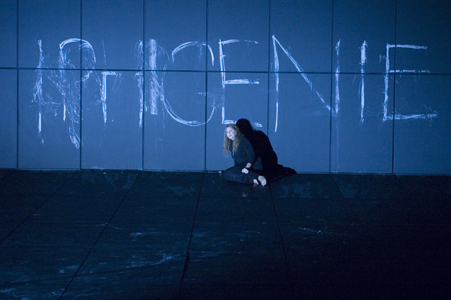
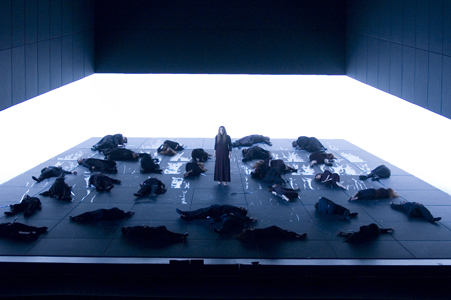
As one might anticipate, after the COC’s stunning Orfeo ed Euridice directed by Canadian Robert Carsen last year, Gluck’s Iphigenia in Tauris, with Carsen again at the directorial helm, is equally bold and haunting in concept and realization. The minimalist set of Tobias Hoheisel is formed of unadorned and isolating expanses that, in turn, are enhanced by the intensely focused or subdued lighting of Robert Carsen and Peter Van Ptaet. Each lit character or grouping in turn seems almost accused into existential solitude. In surrounding hues of ungiving blues and blacks and browns, without chromatic variety, one is aggressively defined in glaring light. One is reduced to mere existence. It is clear, at a single glance, that Carsen, like the opera’s composer, is getting down to basics and means business.

 Existence is a perilous state, as Carsen notes in the program: “Iphigenia in Tauris is as near as we can come to experiencing Greek drama in opera….Its plot is the stuff of nightmares….and in this opera we are constantly in the presence of death.” In this severely bleak setting, human existence, whose only worth seems to be the brief shadows it makes, is literally boxed in. Costumes too are fundamental with no adornment and whatever mark a life makes in this cold universe, as we are shown, will be through statements of voice and movement. Because “the characters are continually pushed to the limits of human endurance” it is through inner resources that they will make their mark and, if at all, survive.

This sense of existential isolation is especially dramatic in scenes that use footlights. The opera opens with the riveting Susan Graham as Iphegenia progressing downstage and creating an enlarging shadow behind her. About twenty dancers frenzy about and represent, we soon realize, both a chaotic inner state of these characters and their threatening outer world. Dancers run to the walls and try to climb them, as if to escape. The death black set suggests now a cell and now an altar and the dynamic ambiguity of the place is quite unsettling. Later, Iphigenia will again project a shadow while holding a sword and this time the sword’s shadow will descend upon the actual body of her brother Orestes who awaits his death by her hand. Talk about menacing shadows!

In a signature role she has sung in a number of major opera houses, mezzo Susan Graham reveals a number of qualities of voice that, taken together, make for operatic gold. Her voice is ripe in tone and, with a secure linearity in phrasing, is able to enlarge into an explosion of emotion or recede into a whisper with no break in her vocal thread or beauty of sound. Graham’s many shifts from nuance to nuance are graceful without lapse and at times, in gentler moments, her voice has the quality of watercolour. Her Iphigenia seems infused with a cosmic purity that seems alien to this world of blood, although she is certainly an active part of it. Moreover, each emotional detail is given its due by Graham.

As King Thoas, Mark S. Doss proves to be a rock solid presence in both voice and figure. There is neither front nor back to his voice where colourings might linger and, as such an unrelenting and ungiving force of immovable aggression, he contributes an archetypally firm dimension to the tale. The pairing of tenor Joseph Kaiser as Pylades and Russell Braun as Orestes proves convincingly intense in gentle passions and poignantly heartfelt when the two become more vulnerable. Both singers accommodate each arising emotion with implied but quieted grandeur and they negotiate their relationship through increasing peril with appealing humanity. Their voices are firm and vibrant, and handle emotional specifics, in the vigorous and sensitive writing by Gluck, with meticulous and seemingly spontaneous ease and poised intensity. “What joy that my death will save my friend’s life” sings Pylades. So much touching agony over amitie!

Conductor Pablo Heras-Casado handles abrupt shifts in volume, tone and tempo with pointed sensitivity and makes Gluck’s score almost a complex and commenting character to the dramatic unfoldment on stage. His orchestra’s sound is economical yet quite potent, moving from cloudlike lightness to frenzy and back again. Gluck’s music can be lunatic with activity and also formalized in acknowledgement of inner intensity that wants to burst from containment. His intention was to create opera of “beautiful simplicity” and thus his music is effective with its discretion in creating musical and dramatic effects through intriguing groupings of instruments, intelligent selectivity in musical devices like staccato motifs, and compelling interplay and juxtapositioning of voices.

In this production we are gripped in watching individuals and groups physically isolated into themselves. The choreography by Philippe Giraudeau effectively uses a suffocating sense of confinement in the setting to enhance a desperation to escape in the dancers. Having the Chorus off stage adds an otherworldly echo to the atmosphere and also to Iphigenia’s presence. The opera ends with the massive side and rear walls rising partially to slowly reveal a pure blinding light against which Iphigenia and Orestes and Pylades are silhouetted in another stunning visual display. We feel such effects in the gut and are moved by the evocative, beautifully human singing of the cast throughout. A main strength of this production is that it unbalances our conscious expectations and moves below our awareness where we have no choice but to react. Thus the world of Greek tragedy, recreated exquisitely operatic, is made to be our own.


Posted in Uncategorized | Leave a comment

RAMBLIN JACK ELLIOTT AT HUGH’S ROOM IN TORONTO

“We come with the dust and we go with the wind” is one of the most haunting lines in the folk canon. It was penned by Woody Guthrie when he hitched a ride on the melody of Pretty Polly to compose Pastures of Plenty, his tribute to migrant workers. It’s most appropriate that the line mirrors the quintessence of Ramblin Jack Elliott on whom, since their first meeting in the late 1940s, Woody Guthrie has been a profound and diverse influence. “Jack sounds more like me than I do,” Guthrie once quipped and each man from square one was famously made of wanderlust.

 Ramblin Jack Elliot is an elusive constancy who comes and goes according to the dictates of some calling that only he knows, a calling that roots him in the essential magic of each life he encounters. If he finds no magic, he creates it, for he is the story teller who embodies the story he tells and remakes it anew. In turn, we become part of the story he tells and that is how it should be. He is the unbreakable thread in the fabric of folk culture he embodies, an everyday guy who seems to find new substance in life to quietly enchant him every day. He belongs everywhere and nowhere specific that might hold him down. We belong everywhere with him as he tells his tale.  And then he is gone.

 I first met Ramblin Jack around 1961 at a club, one with a pretence of sophistication, in Hamilton. “The guy has manure on his boots,” said the owner disparagingly, trying to summarize an entertainer with a cowboy hat who didn’t subscribe to a slick and shallow image of what folksingers were taken to be at the time. But does anybody really care to remember The Limelighters or The Brothers Four? “We met fifty years ago,” I told Jack last year at Hugh’s Room in Toronto, but you didn’t have time to talk much because you were waiting “for your woman from Toronto.” “When was that?” asked Jack. “1961 or so” He reflected for a minute and answered with an undercurrent of surprise in his voice, “You know, I married her,” as if that union was a lifetime of wandering ago, and it was.

 I’ve tried to interview Jack a couple of times since the sixties and on each occasion he has talked about everything but my questions. His words like the man tend to wander away when any imposition is sensed.  They don’t like to be corralled and confined, but instead like to take off and riff until they are spent. Part of it might be a need for self preservation in Ramblin Jack, who knows? Every man is a paradox, after all, and doesn’t owe his accessibility to the world. In return, from Ramblin Jack we get a priceless and unforced stream of consciousness full of surprising connections that are profoundly delightful. Jack didn’t answer my questions, to be sure, but I did learn about Rick Danko, tying knots, Rod Stewart, and especially Jack’s beloved dog.

 Ramblin Jack was back to Hugh’s Room last Saturday, a genuine legend with a National Medal of Arts from Bill Clinton and two Grammy statues back home and a flat pick in his pocket here in Toronto. Hugh’s is a perfect venue for warm human connection and you find that conversation oozes around the room with ease.  It’s a good place for Ramblin Jack, who is now eighty and as always likes to meet people. He hangs out in the audience before and after his set and meets many who want to make affectionate connection with him. At one point he drops an imitation of Bob Dylan, who many say copied Ramblin Jack down to the last detail in the early days, into the conversation and then smiles with enjoyment. The raconteur takes delight in himself –and he should, because he is funny and without guile.

 A ten song set that takes an hour begins with Jesse Fuller’s San Francisco Bay Blues, moves on to The Cuckoo -with its haunting descending scale in a minor chord and learned from buddy Derroll Adams who learned it from Bascom Lunsford on Folkways- and slides into the Carter Family’s Engine 143. “I was nineteen and Woody was thirty-nine when I hung around with him,” reminisces Jack and then, to explain how he ended up on a weeklong trip by car to California without a change in clothing, declares “My motto is to never say no.”  Then he backtracks, telling us “I ran away from home when I was fifteen to join the rodeo……I made only two dollars a day…….so I ended up eating my horses’ oats.” And then forward in time again to Guthrie’s Talking Columbia, with the explanation that Jack’s mentor wrote twenty-six commissioned songs in thirty days for the Department of the Interior.

 Ramblin Jack’s unique flat picking style, one which I’ve long considered a musical wonder, remains beyond the emulation of mere mortals. It has a conversational feel to it with distinct punctuating bass notes that stand assertive and immaculate in their placement. Meanwhile, a subtle brushing of one or several treble strings has each note or partial chord sounding like a remote echo to the bass note runs that drive each song’s momentum. Jack’s magical touch produces sounds of crisp delicacy and clarity while the seemingly perfect balance between bass and treble notes is one I’ve heard nowhere else. Part of the secret is the way Jack holds the pick with the tips of his thumb and index finger, I’ve come to believe, but who can account for the incredible lightness of being in his sound?

 Next comes the Stones’ Connection whose chords Jack once realized are not too far off Jesse Fuller’s in San Francisco Bay Blues. He does Don’t Think Twice It’s All Right in a wistful and personal manner whose mood he demolishes in the last verse with an exaggerated and slurred emphasis on a few words. Then “another Woody song” in Ranger’s Command, then Bedbug Blues from “was it Bessie Smith or Ma Rainey?” We also have, along the way, a tasteful but evocative accompaniment from Stan, a veteran guitarist from Yorkville years, who has climbed on board for the second half of the set. He shines in Jack’s Arthritis Blues by Butch Hawes which enumerates many aches and pains in an ironically pulsating tempo. Who ever heard pain sound like so much fun?

 There are asides and anecdotes throughout about the authorship of Diamond Joe, about  Jack getting a shot at flying a plane with Jerry Jeff Walker sitting behind him, and about Winston Young, who I saw at the second Mariposa Folk Festival, allowing Jack to operate his crane and move a girder to the 40th floor. A requested I Threw It All Away gets a caressing intro and then, because Jack hasn’t “done it for years” it goes unsung. Jack leaves the stage, strums his way through the audience, and then sits down for the many conversations that are to come before he heads off to his next gig in Virginia, a man unowned yet open to the hearts of all.

Posted in Uncategorized | Leave a comment

RICHARD THOMPSON AT KOERNER HALL IN TORONTO

One day, I think it was in the late 1980s, I was walking down London’s depressingly commercial Oxford Street and suffering from exposure to the garish blend of unforgiving gloss and inhuman shallowness that seemed an echo of the reigning prime minister of the time. No doubt, my subconscious, in turn, was trying to keep me connected to some substance in human reality. As a result, I found myself singing Richard Thompson songs under my breath, since they are often haunting and consummate creations that one likes to keep on call.

When I looked ahead, – and I claim no magical powers of conjuration in having caused what ensued- it was Thompson himself walking toward me.  “I was just singing your songs in the socks department of Marks & Spenser,” I exclaimed, laughing in surprise.  He took this unusual exclamation of celebratory appreciation in stride, we chatted, and each continued walking. I’ve seen his live performances maybe seven times since then.

Thompson’s recent concert at Koerner Hall at The Royal Conservatory in Toronto was a four encore, four standing ovations gig that proved immensely satisfying and genuinely memorable on several counts.  The guitar playing, first of all, featured his expected trademarks –breathtaking speed in the service of musical purpose, a sustained alternating bass undercurrent, and imaginative exploration of contrapuntal patterns.

His left hand touches included double pull offs, string-bending on multiple strings, extended runs of surprising construction, and discretion in the placement of vibrato, all with an accumulative breathtaking effect. Moreover, Thompson endlessly explored tonal values, dynamics of sound, counter rhythms, assertive muted strings, and seemingly endless sustains in the treble regions. As an experience of musical atmospheres alone, this concert was unforgettable. This was not only superb guitar-playing; it was rich orchestration on six strings of an amplified acoustic guitar.

As a singer Thompson effectively employed an assertive thrust in delivery, as if he was hurling the harsh realities of human existence back into the complacent lives of those who might otherwise pass by, unaffected by them. Sometimes he seemed to spit out his lyrics, as if to rid himself of the toxins that acknowledgment of the world’s true nature brings. On the other hand, he was also capable of gentle and poignant understatement, more as an acknowledgement of human vulnerability than anything sentimental

Thompson also proved once again a refreshing entertainer, dry and wry in wit, almost impish in manner, quick to respond to his audience, sharp as a razor. He seemed to gently laugh at himself, and by implication at us, with affection. “Anyone in the audience have a capo?” he asked. “Or else everything else is going to be in D.” He seemed able to place the high regard felt for him in context, seemed always bemused, seemed aware of larger stakes in this world.

Thompson offered twenty songs at the Koerner Hall, including encores, that ranged over his entire career, from the groundbreaking and genre-setting Fairport Convention of the sixties to his recent Dream Attic CD set. He began with “When the Spell is Broken” which contains the line “Love letters you wrote are pushed back down your throat,” moved on to the wistful and poetically evocative Waltzing for Dreamers, and then to Valerie, a male suffering from women’s ways song that reminds one of Brel enduring the same fate.

Thompson’s imagery can be blunt –“Northern girls will leave you empty….like a fish on a slab”- or humanly resolved as in Wall of Death” or quietly desperate as in the classic “I Want to See the Bright Lights Tonight” from his days with then wife Linda. In any case, he offered an open-eyed consideration of the abrasive world where people meet one another, wound one another, and then move on. Whatever the lyric’s subject, each song seemed to denote an intensely felt life. His humour at times seemed like Samuel Beckett with a beat.

You’ll often read that Richard Thompson was ranked not too long ago as number 19 in a Rolling Stone survey of the Greatest Guitarists of All Time. Of course, such need and tendency to make creativity in the arts a competitive sport is an asinine exercise. Why? Because Thompson, as far as I can tell from several meetings with him and from gladly following his career, is a man of artistic humility, genuine spiritual inclination, realistic human perspective, and talent of integrity that sets its own standards and wants to know how it can further improve itself.

I suspect that Thompson’s too good at what he does to be a superstar in a culture that too often lives by marketing alone and craves “idols” no matter how hollow they are at the centre. Thompson is a master at his multi-aspected craft and an artist of complex singularity in his creative life.  He cares too much about what he does not to be the best he can be.

As such, Richard Thompson is genuinely unique, quite simply so damn good, and far beyond more popular artists who are masters of angst and poetic diarrhea and amplified catering to the masses. Thompson makes “one of a kind” a designation of honour among creators.

Posted in Uncategorized | Leave a comment

SHAW FESTIVAL 2011: MARIA SEVERA

Apparently. according to Jay Turvey and Paul Sportelli, Maria Severa’s creators, hand-to-mouth poverty in the slums of 19th century Lisbon was certainly a happy gig to live. No matter the survival through prostitution and the humiliating class structure, it was like an MOR heaven where nothing challenges, nothing offends, and singing takes care of any trial of existence.

 In their melodically pleasing score and their evocative and carefully conceived lyrics, there isn’t much that conveys the idiomatic spirit of Fado. One feels that any story about anything could fit in and replace the account of Maria Severa about whom, in truth, not much is known.  On the other hand Maria Severa offers a good number of musically compelling songs that allow for characters to project their quirks and hearts. 

 Unfortunately, the fact that each character gets an extended solo to explain who they are structurally weakens the show.  The story is of Maria Severa, the mother of  Fado, but we get life enumerating solos from Jasmine, Clara,  Armando and a café  performance from Maria’s Mama. The icing on the cake of safe and secure is the death of Fernando who goes down singing. So add death to the list of feel good experiences.

 The book does offer a number of touching moments and the peppy dialogue throughout sounds fresh.  But the show seems more made for the stage than made from the streets and we never feel dirty.  Yes, raunchiness is intended, to be sure. “Where are you, you horny husbands, where are you, you filthy bastards” asks Maria who, later is described as “just a whore who can sing”.  When Mama says, “Clara looks like she never smelled a bad smell in her life,” we get the point. But when Maria philosophizes “the world throws shit at us….but we have to choose,” she has not been written or directed as a woman whose hard experience has learned this truth. It sounds like a good line.

 Maria Severa is very entertaining, very accomplished as a creation, but not very believable. Nevertheless, both production and cast provide a number of pleasing experiences. Sherri Flett’s wealthy Constanca is an icy manipulative bitch, albeit with her own fear of poverty driving her on.  Neil Barclay’s Father Manuel is rotund, humanly wise, kind and likeable without effort.  Jacqueline Thair’s solo as Clara, like her whole characterization, is heartfelt and it lures one into its underplayed charm.

 Jasmine, played by Saccha Dennis, is a creature of show-stopping athletic presence at every turn, a physical agility and an expressive face, dynamism through and through. At times she does seem too big for this chamber setting. As Fernando, Jonathan Gould covers his aching love for Maria with a wounded sneer and brings some complexity and unresolved nuance to the production. As aristocratic bull fighter Armando, Mark Uhre has a warm ring in his voice and is endearingly unpretentious, though not too grandiose or intense in his passion

 The problem with this production is this: its immaculately realized but too polite style is simply not in tune with the raw nerves of its subject. If Julie Martell’s Maria is foolhardy in defiance, feisty, street smart pragmatic, and sexy, if she is forward in manner in order to survive, she also has too unblemished a shine to her and she doesn’t sing from an inner darkness. She has a facial scar, we are told, but her manner doesn’t reveal deep emotional scars. As a result, we feel that the book and the lyrics are pretending, slumming, out of their depth, for they do likewise.

 Of course, any attempt to depict a female singer who happens to be the soul of a musical culture is very tricky business, especially because the art of these singers is rooted in their guts. For example, listen to Edith Piaf, La Nina de Los Penes, Chavela Vargas, Soteria Bellou, Billie Holiday, Om Kholthum, Bessie Smith, and, yes, Fado’s own modern deity Amalia Rodrigues, and you won’t be able to take this well-crafted show all that seriously.

 Although several people have enthusiastically recommended this production to me, I offer the following account in desperate response. About ten years ago, the Fado singer Mariza explained to me that “Fado is like breathing, a way of living.  It’s not me here and Fado there, separated, because we always walk together.” I wonder if anyone who buys into Maria Severa can understand Mariza’s meaning that Fado is life itself and not just a pretty diversion.

Posted in Uncategorized | Leave a comment

STRATFORD SHAKESPEARE FESTIVAL 2011: HOSANNA

Gareth Potter (foregrount) as Hosanna and Oliver Becker as Cuirette in Hosanna.

At the end of Michel Tremblay’s play from the 1973, Hosanna stands before a nine foot three-sided mirror and declares “ Cleopatra is dead”  as she removes her makeup. Hosanna turns in full frontal nudity as Claude and is embraced by lover Cuirette. Afterwards a young lady outside remarks, “It was great. I’m waiting for it to unravel a bit before I know why I think so.”

Although Tremblay’s groundbreaking exploration of sexual ambiguity now seems prolonged, seems a subtlely preaching two acter waiting to emerge from a theatrical closet in a more compact one act format, it is still decidedly relevant in the real world. Sexual identity and sexual relations are certainly contentious issues in the morally simple-minded and inhumanly discriminating rigidity of North America’s social climate.

 There is much talk of stink in Tremblay’s play and set designer Michael Gianfrancesco  heeds this cue with a set that looks worn and cluttered in dirty hues and cheap furniture. Some of Tremblay’s devices, like blending a dialogue into Hosanna’s second act monologue are quite effective. At the same time, the lengthy monologue starts to feel like a Taylor Swift cosmetic commercial on endless repeat of points already made -or perhaps that is a point the play is making.

 Tremblay does want to teach his audience about the transvestite world and, if the play’s humanity seems too forced at times, we do have many subtle shifts both internally within these two characters and in their dialogue, and also the potent use of implication. Tremblay’s mot du jour is “shit” often repeated and its use adds despair to this theatrical brew.

 Gareth Potter and Oliver Becker inhabit their characters with unobtrusive skill and in turn with and touching results. Potter’s Hosanna speaks with a lispy precision and almost elegantly negotiates his ass wiggles, cross legged posing, wrist flicks and graceful use of limbs.  He complains about makeup that runs down his cheeks, a broken nail, and that it takes three hours to put “shit” on his face to look like Elizabeth Taylor. Oliver Becker plays Cuirette as a less overtly present fellow who implies in fewer words but as much as Potter an unstated complexity and richness of human life.  

 Their sharply played relationship has the give and take nuances of any pairing of two people, with alternating moments of submission and aggression, rituals of belittlement, control games, tenderness, and attack.  “Every night for two years you have done exactly the same thing” says Hosanna/Claude. She/he also says “I need you to stay; I don’t want you to stay” so, yes, this is a very relevant play and under Weyni Mengesha’s sensitive direction, deeply moving. It asks who and what a human being is, gives us clues, and leaves us to resolve ambiguities.

Posted in Uncategorized | Leave a comment

STRATFORD FESTIVAL 2011: THE MISANTHROPE


Like all great comedy, Moliere’s The Misanthrope, with its incisive take on social hypocrisy, amorous complications, and ensuing disenchantment, explores humanity’s darker side. Appropriately, sound designer Jim Neil introduces David Grindley’s production with the darker tones of viols, while John Lee Beatty’s setting of ornate and metallic brownish shapes and Michael Walton’s subdued lighting all indicate that Moliere’s levity will dwell to some degree in darkness of spirit.

 Grindley maintains a competitive and sometimes hostile undercurrent and he allows hypocrisy and meanness sometimes diluted into mere nastiness to spice Moliere’s text, though some might prefer more sparkle in the language, more indication of the unspoken, more going over the top. Nonetheless, it is a pleasure to hear translator Richard Wilbur’s rhymes spoken with confident emphasis on each speaker’s meaning, to hear these rhymes so ably support the thrust of conversations and the inner momentum of situations. Grindley’s production is  full-bodied and unforced, and the comedy arises naturally.

 Ben Carlson’s Alceste has a face of substantial crabbiness and brows furrowed deep. He includes “all mean in one dim view,” wants to “break with the whole human race,” and wants to live in “some desert land unfouled by human kind.” According to Alceste, “man’s villainy is too much to bear” and among others Alceste is constantly self-indulgent in his misery. Carlson does disenchantment with a solid, natural ease that makes his plight quite involving.

 On the other hand, his pal Philinte, a compelling a charming creation by Juan Chioran, is a man of benign levity and slightly wrinkled elegance who “takes men as they are.” Philinte is a flexible foil for the variety of humanity about him, a peacemaker whose glances bind others together, and although he agrees with Alceste’s view that “man’s a beastly creature” he also asks, “must we abandon their society?”  The pairing of Carlson and Chioran is an appealing combination that gives the play its philosophical centre.

 Alceste’s love, Celimene, is played with some reserve in social bite by Sara Topham. She is petite and snippy, like a feisty crystal glass, and digs into her dismissals of others with enthusiasm. She loves to verbally demolish others but at times she seems just too nice and not a threat.  Kelly Fox as Arsinoe, on the other hand is a worldly woman of well brewed bitchiness who is haughty is her dismissive manner, stabs with nuance and proves to be the most polished game player on the block. 

 Peter Hutt fills in with distinction for the ailing Brian Bedford as Oronte. This poet of mediocre verse is self-consciously correct, boldly average, surly and unmovable.  Hutt is especially funny with his trademark scoops and dips of the text for comic effect. Brian Tree as Dubois adds variety to the show with some effective rough edges in manner and voice. All in all, this production gives the issues presented a compelling human form. Robin Fraser Paye’s striking costumes are each one sewn together into elegance and beauty.

Posted in Uncategorized | Leave a comment