DANCAP’S SOUTH PACIFIC AT TORONTO CENTRE FOR THE ARTS

South Pacific’s lead characters, ensign Nellie Forbush and Emile de Becque, originate conspicuously from two distinct worlds. She is from Little Rock and exudes an aura of everyday small town folk. She is twangy, good-willed, innocent in the ways of worldly culture, and yet she is solidly herself, secure in her life even when an inner insecurity about love nags her toward doubt. Emile, on the other hand, has the quality of a quietly heroic sophisticate. He is tall, deep-voiced, and polished with an appealing continental savoir faire. He has poise and dignity. He reads Proust and Gide; she doesn’t.

These two characters, each one realized with sensitive theatrical smarts by Carmen Cusack and David Pittsinger respectively, don’t ask for our affection but they certainly win it in minutes. They are appealing, via the two leads, because they speak openly through emotional bruises and make us care along with them about their difficult love affair. Each one implies an inner turmoil, yet a gradually deepening connection with the other, and they tell us who they are by suggestion as much as overtly. They are likeable by seeming natural and not broadcasting likability.

This wonderful production of South Pacific begins magically and so it ends. There is no guile in the air, no mean-spiritedness, but a lightness of being that is unselfconscious about romance while acutely aware of how war touches and deeply changes lives. To open, the two charming kids sing Dites-moi, the servant supervises them in French in an atmosphere of implied sophistication, and through the large window the sea is made of soft blue enchantment. The world is good. Next comes a flawless transition from home to beach where a chorus of sailors celebrates the entrepreneurial Bloody Mary. Already, this production brilliantly combines stylized fantasy and the gritty realities of war, for these sailors seem sweaty and worked over by the hot climate.

The story concerns interracial relationships and ultimately the southerner Nellie must acknowledge, of the seeds of racism in her, that “I can’t help it…. This is something that was born into me.” Lieutenant Cable, whose love for Polynesian Liat makes him face his own submission to racist barriers, sings, “You’ve got to be taught to hate and fear.” The fact that the tall and meaty Cable on his knees is as tall as the ultra petite Liat also provides a blunt metaphor for superpower USA’s dominance over helpless colonials. But Cable comes to realize, albeit too late, that he must forsake his racist homeland in his love for Liat, just as Nellie must change her inner self to love Emile. Thus, one of the great scores in musicals doesn’t shirk reality.

There is so much to cheer in this thoroughly conceived and imaginatively directed, by Barlett Sher, production. The stage feels full and vibrant with only one character or with twenty on it. Transitions from scene to scene overlap like filmic dissolves and, if you want seamless, look here. The realities of war are conveyed here in a small gesture, there in a vocal cadence, there in a nuance that speaks loud and clear. The singing at any volume, sotto solo or robustly choral or in between, is grand yet rooted in human complexity where feelings are ambiguous, unspoken, and uneasy in the world. The clever choreography bursts with dynamic human ingredients and individual energies and always accentuates character.

The magically subtle sets by Michael Yeargan prove gradually hypnotic and, without fail, seduce one’s imagination. Flexible stage size screens provide several vertical layers of depth and the physical blending of scenes, from one enchanting hue to the next, creates a subtly magical continuum. The sets are fresh with stylization, be they the commander’s office with a wall-size map of the east pacific islands or a subtly tranquil beach that suggests sand vibrating with both heat and mystery. Donald Holder’s equally subtle lighting is carefully attuned to the dramatic potential that these visual patterns provide and his combinations of colours shift with the narrative moods. The lighting not only sculpts the settings and characters into theatrical definition, but gives them a blend of psychological and magical resonance.

Carmen Cusack’s Nellie is, of course, the production’s heart, an almost permanent presence on the stage for the show’s running time of almost three hours. She is believably small town, feisty yet vulnerable, dynamically girl next door, and a character of slowly revealed unknowns. Cusack’s voice is startling with versatility, ranging from comic twang to resonant poignancy, often in one breath. She is conversational yet operatically- tinged, undeniably enthusiastic, able to do a Diana Shore clone and move on before the dust has settled. Especially beguiling are her slow drawls that ease her into new realizations, and especially in “A Wonderful Guy,” with its tiptoe choreography, she embodies comic lightness which she tosses off with ease.

In “This Nearly Was Mine” David Pittsinger sings with a deep ocean of a voice
that here and throughout the show reveals inherent nobility and sounds majestic even in everyday feelings. “Some Enchanted Evening” is delivered in a voice that is solidly operatic yet accessible, rich in resonance with, no doubt, much in reserve. Pittsinger warms the heart with his manner, thrills with his ringing tones, and in presence and voice remains something of a mystery, like a volcano that asserts itself by doing only what it needs to. Jodi Kimura’s sharply played Bloody Mary, on the other hand, is very much a person of the streets. physically hefty, savvy in dealing her wares, like a boars tooth bracelet, and a slightly menacing blend of street smarts and exotic other worldliness. She is likeable, if mostly on her own terms, and, with the slightly lunky, boyishly sincere, jock-leaning Lieutenant Cable of Aaron Ramey, rounds out this world onto itself that is South Pacific.

Add to this theatrical abundance the unforgettable male and female choruses, both sexually vibrant, both sexually friendly and inviting, both suggesting a kind of sexual fun that isn’t desperate to take itself seriously. The male voices are firmly masculine and their physicality bursts in mass energy. These men are implicitly rowdy, especially in “There is Nothing Like a Dame,” which here becomes an anthem of collective horniness as they stock around like caged animals. One pelvis thrusts, one hand fondles a breast; these guys need women fast. The delightfully chirping female chorus, meanwhile, displays, like their sailor friends, a variety of timbres in strongly individual voices that in turn makes for detailed harmonies and full-bodied groupings of sound. Moreover, their leggy look and pleasantly substantial derrieres are far from anorexic, packaged in coyly modest bathing suits like almost risqué forties pin ups.

This award-winning South Pacific is memorable and a must see. It offers thoroughly entertaining and moving theatre and is a splendid mounting of a classic that you’ll want to see again before the run ends on April 10.

Posted in Uncategorized | Leave a comment

SAINT CARMEN OF THE MAIN AT CANADIAN STAGE

The slowly ascending curtain reveals 70s-ish high heels, then some leg, then high hemlines, then fourteen garishly attired members of the Chorus, some of indeterminate gender. These are whores and cross-dressers of every sexual persona, a loud bunch of aggressively conceived types imbued with despairing lifelessness. “My shoes are killing me” complains one, “I didn’t turn a trick “ frets another, and the bra of the tall guy is level with the forehead of a short whore. But salvation is at hand, for they announce “This morning the sun rose at the end of St. Catherine Street.”

The “sun” turns out to be Carmen, a surprisingly diminutive presence. She too is garishly attired, not in blood red like the chorus, but in tacky, shiny silver. Sporting a wig of long and straight blond hair, she walks on pin-point high heels. Her whiney voice is one of limited expression, one that finds emphasis either in volume or physical gesture, an everyday voice one hears in city streets. We don’t sense the dynamic force we are told that she is; we can’t imagine her handling a rowdy crowd in a bar and being an inspiration to them.

To be sure, Carmen, in the writing of playwright Michel Tremblay, is as much a cause, the expression of Quebec’s spirit of its humanity, as a socially pivotal entertainer of Montreal’s seedy streets who can change lives as she sings. Be it Peter Hinton’s direction of the play’s central character or Laara Sadiq’s unimposing performance, it is hard to imagine what all the fuss is about. At times one feels unreached by this Carmen, at other times moved, but abstractly. She does seem appropriately sacrificial, but not all that fated.

The production, however, is theatrically gripping for the most part, with several stunning performances in this disturbingly red setting. The chorus charms, each one with an individualized humanity, each one ablaze with pain and palpable sadness for which there is little remedy. These people are touching in their hope, they are fun as they keep their lives above water in their grubby milieu. Most striking of all is their tightly grouped scene in which the Chorus chants what sounds like a hybrid of a rain dance on the Great Plains and Stockhausen’s works for voices. Because Tremblay’s inspiration is Greek tragedy, the chorus effectively provides, throughout, the production’s underpinning of fate doing its thing with human lives.

Among individual performances, Diane D’Aquila, dressed convincingly –or is it ambiguously- male in a suit, makes a fully conceived and realized Hairlip. This Hairlip is an individual of complex psychology revealed in subtle shadings of the voice, in deeply rooted nuances of facial expression, and telling bodily gestures. Thus D’Aquila’s performance provides the human core of the production and proves that one can be of both human and epic dimension at one go.

Jean Leclerc’s Maurice represents humanity’s unprincipled underbelly. He’s a scowly surly, cynical, implicitly aggressive, boorish , ungiving hustler of a business man. As one who has only a dollar sign as his guiding light, Maurice takes dim view of Carmen’s desire to sing the lives of her audience and be their “sun.” “You’re here to provide entertainment and get the guys all hot,” he says. “You’re just another cunt.”. Leclerc’s brutally realized performance makes one feel dirty in his presence.

As does Joey Tremblay’s Toothpick, a hit man who is ironically creepy and cowardly, a man who hates Carmen because she found much amusement in “ his tiny little cock”. The genitalially-challenged Toothpick eventually kills Carmen, offstage of course, tries to defame her as well, and we don’t like this character either. But Tremblay, via the pointed and extroverted translation of Linda Gaboriau, certainly makes the crucial point that those whom one would save are sometimes soon one’s deadly enemies. And that’s archetypal stuff again.

An imposing Jackie Richardson, made huger in her bountiful dress, plays Gloria who was once Carmen’s mentor and is now her envious competition on the Main. She remembers her prime in the good old days before the Main was “a large French fry stand” and is blunt, deeply unkind and decidedly mocking of Carmen’s existential claim to purpose as a saviour-entertainer. She can’t realize that Carmen’s destiny is not merely to entertain, but to save the lost souls of what Maurice calls “lowlifes, drunks and drug addicts” around her.

Carmen’s return to the Main has immense impact on the characters of this play, so we are told. “It feels like someone is taking me down the river, washing me clean” says the chorus. Why? Because Carmen, newly returned from Nashville and freed from its clichéd schtick, now sings in her own words, and not Nashville’s, the lives of her own people. One hooker responds with “Carmen said things in her songs that were actually my life”. Another says, “ She said that my story was beautiful.” But we are not shown the causal origin of this impact.

As a symbolic ritual of Quebec finding its voice, this play, when first produced, no doubt gave recognition and celebration to a people long demeaned for the unique individuality of their culture and spirit. The lives of a whole province, just like those of a seedy Montreal street, could claim inherent dignity and worth. Naturally, even in Hinton’s dynamic and concictently entertaining production, Tremblay’s passionate assertion of Quebec’s soul now resonates more in retrospect, at least in Toronto. Nevertheless Canadian Stage has again offered rich theatricality in a production of a work not often mounted locally. Thus, as a result, one has the pleasure of both (re)discovery and escaping the tried and true.

Posted in Canadian Stage | Leave a comment

OPERA HAMILTON POPERA

Allyson McHardy at Opera Hamilton's Popera

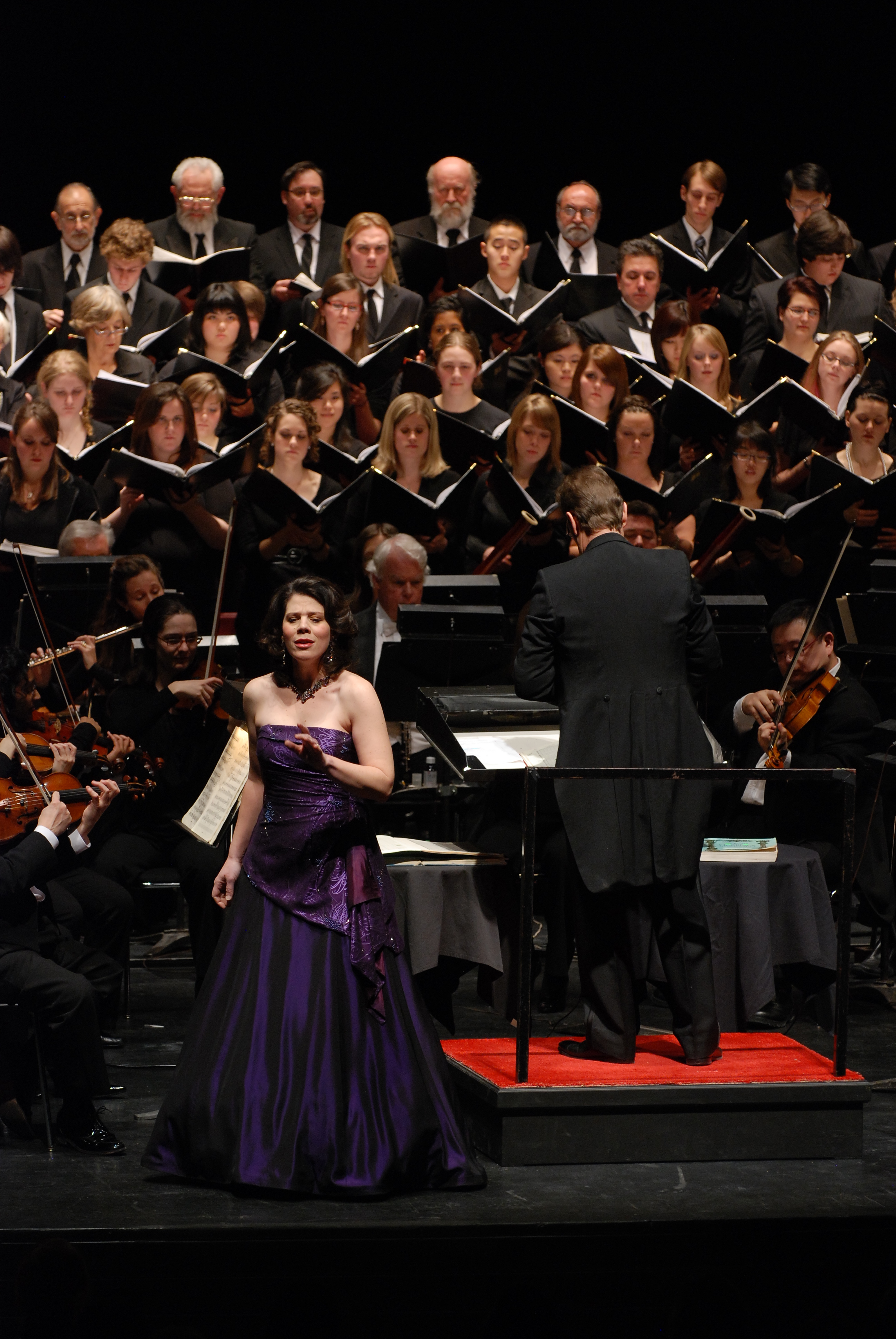
Opera Hamilton’s last Popera at Hamilton Place, before the company’s move to the more intimate and less pricey Dofasco Centre for the Arts for 2011-2012, was a richly satisfying evening. With David Speers conducting, the orchestra began the overture to Luisa Miller lyrically with an occasional punch of Verdian chords before transitioning to full-tilt Verdi of frenzied cascades in the slightly ragged strings, ethereal winds that seemed to tease the bowed sections, and then the assertive and uncompromising brass. Later, in the Intermezzo to I Pagliacci, these same strings seemed a chorus of individuals which in turn humanized the orchestra’s full-bodied sound into a pleasing complexity of texture. In the overture to La Cenerentola, Speers opted not for lunatic urgency one might expect in Rossini but, instead, a very enjoyable tasting of musical detail.

The large grouping of the McMaster University Choir and the Opera Hamilton Chorus seemed, on the whole, surprisingly subdued. In the Cigarette Girls’ Chorus from Carmen, this restraint proved befittingly leisurely for the hot streets of Seville, but in the Kermesse Waltz from Faust the chorus seemed a tad too polite, like a young wine that still hasn’t matured into a blend of subtleties. In what seems the inevitable and inescapable Va Pensiero from Nabbuco, with vocal riches effectively balanced, and with Speers nailing the orchestral punctuation to maximum effect, these Hebrew slaves did seem dramatically without a care in the world.

The solo arias and groupings began in breathtaking fashion with Lyne Fortin’s Ave Maria from Verdi’s Otello given a performance of stunning beauty. Fortin’s voice is solidly anchored in the lower range, so her vulnerability as Desdemona, as a result, was cleanly shaped, substantial in body, and especially clear. Later, in Pleurez, pleurez mes yeux from Massenet’s Le Cid, Fortin was inherently dramatic without artifice, emotionally logical with one depth of feeling leading to another. The night’s mezzo was Allyson McHardy whose Carmen, after a physically cocky entrance, sang the Habanera with a measured richness that was pungent but also defiant in, paradoxically, its air of restraint. This Carmen oozed confidence because she seemed sexually self-sufficient, almost arrogant in sexuality. As Cinderella, McHardy, with a voice of body and substance, showed ease in range, in effortless fluidity, and in ornamentation.

The first pairing was Viens, Mallika from Lakme, in which Fortin’s rounded upper tones and McHardy’s firm delicacy created a blending of lilting individual wills. Later, McHardy joined bass baritone Daniel Okulitch, as a Don Giovanni who seems arrogant about his own charm, in a well-conceived La Ci Darem from Don Giovanni in which physical acting enriched the libretto. In the Finale of Act I of Madama Butterfly, Fortin united what one might call a magnitude of dignity with her delicacy as Cio-Cio San, while tenor Gordon Gietz, with a voice more saxophone than trumpet, brought a compelling qualities of both everyday naturalness and tenacity to Pinkerton. All four soloists appeared in the Act II Finale of La Traviata. Gietz as Alfredo and Fortin as Violetta did not coast as icons of romantic melodrama, but became two people realizing the deep pain of intimacy. Violetta seemed battered already before Alfredo spoke (sang) and he seemed a guy out of his depth in this situation of what he thought was betrayal. By not pushing the drama but instead slowly realizing it, they were indeed very moving.

Like the ladies, the men were adept at characterization. In Non Piu Andrai, Daniel Okulitch’s crisp enunciation gave a flavour of piquant irony to Figaro. He was solid in tone, playful in facial and bodily expression, and a very amiable presence. In Tannhauser, he sang “Dusk covers the land” like a metaphysical pronouncement from the heart, with an authority even in moments of yearning delicacy. In Rachmaninoff’s Aleko his subtly impassioned “How she loved me” showed palpable inner pain and unforced desperation of one who cannot escape into the past. Gordon Gietz’s Chanson de Kleinzach showed a dark-edged tenor with a faintly plaintive quality in his meaty voice doing fun and entertaining, especially when physically punctuating his lyrics. His E Lucevan Le Stelle from Tosca, on the other hand, was sung with poise and some restraint, leaning more to fluidity of musical line than emotional cues in the libretto. It was sung with a pleasingly natural “Everyguy” personality in voice and manner that one not often finds among operatic tenors.

Posted in Opera Hamilton | Leave a comment

SOULPEPPER: DAVID MAMET’S OLEANNA

“It’s just a course,” says Prof John. He speaks from the world of academic concept where he, on the verge of tenure, is secure, assertive, intellectually confident, professorally efficient, and a man of patronizing empathy. Yes, he is annoying. But when Carol, his student comes to discuss a paper on which she has done poorly, he seems automatically genuine, whatever his reasons, in his desire to help her.

Carol is hesitant, vulnerable, uncomprehending of his implications, ironies, and vocabulary, and seems out of her depth in academia. “I did what you told me,” she protests, desperate to pass a course on which her future depends. She concludes, “I’m stupid,” slouched. He cannot find a language that works with her and in no way do they understand each other. She takes everything literally. The tension is unsettling and we’re only a few minutes into David Mamet’s play.

Carol in her frustration –she shortly has a tantrum- is icily defiant and picks the most damning of potential meanings in what John says. Her interpretations of seemingly innocent remarks and behavior begin to sound accusational, but in his cluelessness he for some reason opens up to her candidly about himself and the “system.” He calls tests “a joke” and pontificates conceptually. But life is based on self-preservation, not concepts,
and Carol writes down everything he says.

In the end, John’s tenure and his new home and his life are all shipwrecked because a now black-suited Carol, seated with erect posture and with a supportive group behind her, has the system on her side to persecute John as pedantic, sexist, elitist, and much else. Carol has quoted his remarks verbatim, and when he calls these accusations, she is brutal is insisting they are facts. Now he is vulnerable, now she can assert, “What I say is right”. Now she can accuse, “You know what you’ve worked for? Power.” Now it is she who can inform the professor that she is going “to instruct” him.

The Soulpepper production is intense, unrelenting, and acted memorably by both Diego Matamoros and Sarah Wilson with disturbing accuracy. One will question how the inarticulate Carol of the beginning, a young woman who is pointedly conceptually-challenged (please note this politically correct description), can later orate, with remarkable fluidity and seething articulaton and viscious condescension, the position of the socially, economically and sexually oppressed. I’ve seen productions where Carol seemed to be spouting her “ism” by rote, but here she has the presence and skills of a lawyer, so one wonders at the director’s intent. Was she playing “stupid” at the outset? Does power make one articulate and able?

Of course, this modern classic takes on political correctness for all its justification and absurdity. So Carol screams, “It is not for you to say that an arm on the shoulder was not sexual” and shortly accuses John of rape because he did hold her shoulders. She demands that he remove books she finds offensive from his course and, overhearing John’s phone conversation with his wife, orders him with “Don’t call your wife baby.” The dreaded but anticipated result is that John does indeed beat up Carol and scream “You little cunt!”
It’s hard to convey the force of Mamet’s Oleanna, especially in regard to this superbly acted and directed production of Soulpepper’s, without going into all this detail. Every word is food for examination; every nuance disturbs deeply for what it implies about human nature, our system of both economy and education, the implicit sexism in our culture, the underpinning of power in every human relationship, our behavior, every word we speak and, yes, our obsession with political correctness. I did hear of one claim that this play exaggerates the truth and that such things don’t or can’t happen. Yes, they do. And if you think otherwise, you a part of the problem, or maybe all of it. Essential –don’t miss…..and take a teacher.

Posted in Soulpepper Theatre | Leave a comment

TORONTO SYMPHONY ORCHESTRA

First Movement: Press conference regarding the 2011-2012 Season

Conductor Peter Oundjian is warmly chatty, richly anecdotal , ingratiating, and gently passionate about music and all else it seems. He tells us he has put together “a bold season” for 2011-12, the TSO’s 90th season. The TSO will have three residencies of “three of the greatest artists of our time” -Lang Lang, Itzhak Perlman, and Yo-Yo Ma, which will “all highlight education in some way.” Oundjian feels that education of the young about classical music is “one of the most important things we do…. it gives them a quiet moment when they are not texting.” Other guests will be Ken Dryden narrating The Hockey Sweater, Christopher Plummer doing Shakespeare, and the guest-rich, repertoire-rich 90th season will close with the Symphony of a Thousand” by Mahler in collaboration with Luminato. “We send a different message to our kids than the NHL. We stress spiritual enrichment,” says Oundjian.

Second Movement: Notes on a TSO rehearsal of Mozart’s Symphony # 34.

I’m a compulsive note-taker and some of these hurried scribblings end up in poems, some in reviews, and most in a very large box in the basement. Whatever the case, one learns a great deal about composing, orchestral interaction, recreation of music, relationships of conductors and orchestras, and one’s own response to music while watching a rehearsal. Here we go:

I Allegro Vivace
-three dozen uniformed students from Appleby school raptly watching from the stage side upper level
-lyricism and song-imbued phrasing in the collectively robust strings, a sense of emerging green vegetation
-certainly more an assertive precursor of Beethoven’s individualism than bowing in courtly ritual
-weighty and rugged but not heavy
-more stein than bone china
-proportion with inherent momentum
-more metaphysically confident than ethereal
-hearty textures in the strings

II Andante
-climaxes evolve and anticipate as part of linear development
-a masculine texture
-doesn’t solicit emotion but affirms it
-P.O. thanks violist for bowing suggestion
-not as much an overt humour in the clearly defined beat but more, one suspects, a composer of genuine inner levity

III Allegro Vivace
-P.O. asks for more Rossini
– again P.O. “Does it have an accent at 54? No? Well take out the accent you don’t have.”
-more Mozartian humour, like a large man dancing
-declarative phrasing that makes full-bodied musical points
-P.O.again: “Mozart is so regular that the two five bar phrases feel odd.”
-more country village than palatial court
-watching string players shape a sound, so much discussion of bowing, entries, clarity

Bonus: Mozart’s Adagio and Fugue
-P.O. tells the rehearsal audience, “If you’re not familiar with it, you’ll be hugely surprised, it’s very dramatic.”
-a holistic dynamism in which all the parts have one root and one feels the unity here
-P.O. tells us it’s “the wildest outburst that Mozart ever put on paper” and indeed one feels an inner battle he expresses here, one visualizes a dance company, one senses a serene madness
-an emphatic and weighty pulse that is undeniable

Third Movement: A concert themed Mozart’s World

In Homo Ludens, Johan Huizinga maintains that the eighteenth was the last century in which play was integral to our culture. And what better evidence than the Toronto Symphony concert of January 29 titled Mozart’s World?
 It begins with the Overture to Les Horaces by the much-maligned Antonio Salieri, a rather generic though charming composition of some authority in which the trombones add magisterial oomph to the soaring proceedings. Peter Oundjian combines hosting duties with his role of conductor and tells us that “the rest of the opera is not very good.”
 The Concerto for Double Bass by Johann Baptist Vanhal features principal bassist Jeffrey Beecher who is versatile and lyrical in the Allegro. We sense unforced humour here and imagine an overweight dancer among elves that the violins seem to be. Beecher also suggests a complexity of characterization in this huge instrument of usually hidden and unused potential. In the Adagio the violins shape a context that seems more a part of the collective musical statement, whereas in the Allegro they seemed an envelope for solo playfulness. Beecher’s bass has a creamy fluidity of line and we sense an intimate conversation of emotional self-revelation from, considering the instruments size, the belly of the earth. The finale showcases rapid bowing and runs that nail the tonal character of the bass’s surprising range.
 In the Allegro of the ever-popular and wondrous Eine Kleine Nachtmusik, Oundjian uses the Mozartian shapings and groupings to create an operatic dynamism. The performance has a teasing quality, it seems very naughty, mischievous, but possesses inherent grace. In the Romance there is more than calm, there is serenity, because the conductor knows the potency of understatement and restraint. As a result, his orchestra is declarative with finesse and there is also a mad urgency that never loses its poise. After the lightness of the Menuetto, one that conjures a petal floating on a reflecting pond, we have the Rondo in which the celli and basses support and actively counterbalance the higher strings without sounding merely functional. They seem instead a reality check to ethereal lightness and we feel meta-musical issues being worked out.
 I used to think I knew the oboe, with its distinctly reedy and hence exotic tones, and perhaps took it for granted. But in Mozart’s Concerto for Oboe there is beauty of much variety, especially with principal Sarah Jeffrey subtly probing the instrument’s capabilities. The Concerto begins with the entry of an exotic sustained note and then articulated runs that give dynamic value to each note. Jeffrey’s accomplishment is that she extends the lyrical richness and tonal body in the solo passages into a complete human voice, as it were, and one is enchanted. A haunting experience.

 Franz Joseph Haydn had a genius for writing on the verge of a joke and in there is a prankishness in his early Symphony #8. He is too light hearted perhaps for parody, with its implicit critical edge, so we find here an unselfconscious delight unfolding as Hayden composes. Oundjian and Haydn make a delightful combination as the former, in the Allegro, gives incisive attention to detail and dynamics in the string passages and also enhances the composer’s story teller’s facility of suggesting an unfolding a narrative line. There is much to enjoy as individual instruments do character against the urgency of the orchestra. With Haydn’s agreement to compose on his prince’s demand, he no doubt leaned toward variety and levity as part of his method, ergo many symphonic surprises here. Throughout the performance, thanks to the alertness and refined spirit of Oundjian’s conducting, plus the depth of his responsive musicians, we are in a frame of mind to share many laughs or at least smiles, and in the end to agree with Huizinga’s contention that the age of Haydn and Mozart and all their cohorts was a time of delight. There was play in the air when these composers composed –and played-and the TSO certainly do, in turn, a satisfying take on Mozart’s world.

Posted in Toronto Symphony Orchestra | Leave a comment

A CHRISTMAS CAROL (SOULPEPPER IN TORONTO)

As terrifying as it is, “the spirit world” that torments Joseph Ziegler’s Scrooge, in Soulpepper’s enthusiastically heartwarming A Christmas Carol, might be, ironically, a preferable fit for the man. The corporeal world, after all, is a pleasure-less place for him and he humbugs life, and its people, because he doesn’t know how to live it. He doesn’t join in because he is afraid and doesn’t know how to move among other people. He doesn’t know how to hear what they say. Still, more to the point, this Scrooge seems a man, via Ziegler, who senses perhaps that he might have a humane heart and the thought unsettles him.

Why? Not because he is just a mean and nasty guy, but because a heart is something alien that he can’t understand, he can’t control. It’s not numbers ink-written on a ledger, it’s not a coin in the hand, it’s not an employee or debtor he can bully into shape. A heart is something that might welcome intangible but demanding spirits of conscience and, in turn, lure one into the unknown. This Scrooge, however, invests his daring carefully and doesn’t speculate in stocks of the ethereal world. He wants to play it safe and so he blocks out people and the human warmth and imprecise values they imply with their kind words and deeds. It’s life he blocks out because he just doesn’t know how to get in.

Scrooge here is a man who handles metallic money and is appropriately a body of cold steel, one that stands like a “resolute” and unrelenting deity of inhumanity. He also suggests an inner pain, one that enrages him into meanness, shapes his rigid being. Note how alienated he seems when, with the Ghost of Christmas Past at his side, he attempts some high-kicking dance and in turn looks bewildered. There’s a poignant air of desperation in his awkwardness. Still, he is a classic mean shit or, according to Mrs. Cratchit, an “odious, stingy, hard, unfeeling man” and Ziegler gives him a spiritually cancerous tone. And isn’t the greatest tragedy a man who isn’t connected to the potential of his own humanity. Appropriately, Ziegler is an actor of proportion and no excess, one whose every move hits the mark as it emerges subtly from abundant resources of human understanding. This is a very complex Scrooge.

Bob Cratchit, on the other hand, heartbreakingly underplayed by Oliver Dennis, is decency incarnate, a man of wounded tenderness, especially at the side of his dead son. One feels awed by his spontaneous and unforced goodness. The day to day sorrow in the eyes and manner of Bob and Mrs. Cratchit, the latter played with subtle sadness in her DNA by Deborah Drakeford, is deeply touching. Both have faces that tell lifetimes. Matthew Edison too gives a compelling layered performance as Mr. Fred and the younger actors, like Alyson MacFarlane, seem naturally attuned to their familial context and also to their individuality. Some are very young and we believe them all, whatever their respective ages.

If this Soulpepper production achieves the thrust of literary narrative (well, yes, of course) and tells a good tale, it is also fluidly balletic in its physical realization. Note the elasticity of movement, how the Harlequins especially weave like human threads, like strands of ethereal imagination, or how director Michael Shamata makes his dramatic points physically in, for example, Marley’s weighted steps that echo a weighed down soul. Others, feeling their quiet joy of existence move with sweeping and authoritative serenity. Shamata is a director who, with incisive economy, finds many brief means to emotional effect and often a simple gesture tells a chapter in this tale of Christmas. He and his actors create a world which we, the audience, easily inhabit with them.

This Soulpepper production of A Christmas Carol unfolds dynamically in simultaneous dimensions and that is one key to its charm and emotional appeal. We experience the worldly poverty of starving families and poorhouses, the turmoil of a messed up and tortured psychology in Scrooge, the beneficence of human kindness from many quarters, the magic of a very conceivable supernatural torment, the palpable and unembarrassed strength of innocence in an indifferent world, the profound beauty of love as we see it at the Cratchit Christmas table, the seductive spell of imagination using bodies and voices to speak like water or like stone.

And there’s the dancing, especially the grand physicality and insane joie de vivre of Kevin Bundy and Maggie Huculak swirling and leaping like potent and unstoppable forces of nature. Miss Huculak, with her red and white striped dress and whirlwind kicks as high as the sky, with her smile lit bright as three days of summer light, remains embedded in my mind as a living and breathing icon of joy. A Christmas Carol is certainly a profound tale of spiritual redemption that warms our hearts but, on a cold winter night, this lady joyfully explodes with primordial fire that tells us not how we should live, but why. That’s quite a potent antidote to the greedy and mean-spirited folk one will inevitably encounter, in due course, the next day as the world goes on.

Posted in Soulpepper Theatre | Leave a comment

CD REVIEW SHELBY LYNNE MERRY CHRISTMAS

Shelby Lynne, on her new seasonal CD Merry Christmas, combines a sense of childlike wonder and adult worldly smarts. Her musicality is thoroughly compelling as she imbues often overly familiar lyrics with a worldly understanding of life’s complexity. On every word, it seems, she probes the individual heart for depth of human emotion.

Lynne is not a singer who does hope and wonder by rote, but marries mind and emotion at one intense go. She doesn’t avoid pain, whatever its devastating effect. Like a master actor she creates without deviation an immediacy of human connection, sings with instinctive intimacy in every line, develops intensity through understatement, and reveals an uncanny knack for constant fluctuations of nuance.

Shelby Lynne enriches whatever idiom she uses as a musical vehicle, and there are several here, without effort or self-consciousness. She pulls the listener close as a matter of course until the listener feels he or she is feeling too much as a result. Yes, this is  much a Christmas CD, but a very human one that resonates gently with wisdom and unavoidable sadness. It celebrates Christmas as people know it, not as it is marketed at them.

There are thirteen cuts on Merry Christmas and each one is rewarding. To begin, her Sleigh Ride/ Winter Wonderland pairing suggests a swinging post-war big band girl singer edged in purr, with a vocalized hint of smile. In the self-penned Ain’t Nothing Like Christmas, she is assertive in phrasing and gives her lyrics a slight punch that denotes a centered individuality, a womanly confidence. A laid-back naturalness from which diversity flows is a Lynne trademark and her persona feels easy, rich with life savvy, and unforced. Her southern take on pronunciation makes “I’ll bring the nog, you put on the log” sound like a na-ogue and la-ogue, and I’m charmed.

Few singers come emotionally closer than Shelby Lynne and Christmas Time is Here is rich with inherent vulnerability that knows the value of an island of warmth, Christmas, in a troubling world. Her voice seems to bless what she describes with gratitude. Silver Bells has a sense of discovery to it, like an artist noticing details of people doing a city, but like a novelist Lynne also takes on the perspective of the people she describes. She subtly suggests wistful feelings, perhaps of regret. On the other hand, Christmas Time’s a Coming comes on strong with an irresistible bluegrass drive. Like their vocalist’s style, the band’s instrumental solos along the way are thoughtfully conceived. “I know I’m coming Home” offers a hint of a long-desired salvation.

O Holy Night is not treated as a showstopper but as almost too personal a human experience. It opens with a poignant and serene dobro solo and Lynne proceeds to sing with a humble conviction of a believer who understands both the human and spiritual dimensions of the scene she is describing. This version of O, Holy Night is enormously potent in its seemingly casual understatement.  Some fun again and Santa Claus is Coming to Town is more than declaration of impending parental moral judgment. Lynne sounds like both judge and sinner, half maternal and half woman who has known the good life, perhaps with Santa himself. Ergo the singing sounds like a wink and a nudge that doesn’t get hung up on dividing naughty and nice.

On Xmas, her second composition on the CD, Lynne certainly doesn’t do Christmas by rote and this dignified and very bluesy remembrance of childhood life in a difficult home of familial tensions is a slow punch on one’s heart. We hear “holiday cocktails make me forget the gifts that daddy never opened” and “daddy gets so mad ‘cause Christmas makes him sad” and then “O, Christmas” three times like a cry in darkness and then “merry Christmas to me” over and over with unforced irony and with pain barely restrained.

Next, Shelby Lynne belts and swings Rudolf the Red-Nosed Reindeer as a straight-ahead tale, but this guy sounds like one very hip deer and one readily wonders if reindeer are doing the backup chorus. Her pouting closing line “O, baby I dig your nose” is so full of seductive feminine wiles that I suspect this dude Rudolf will soon have other reasons for walking on air. In Silent Night, Lynne again displays an instinct for making lyrics create a deeply felt and very present situation, one to which the singer is bound with profound emotional commitment. She sounds like a woman experiencing intense beauty beyond words, again in a very private experience which the singing allows us to share.

White Christmas is a pleasantly countrified version that doesn’t resort to sentiment and certainly not to cliché for this ubiquitous standard. Instead it ends this special collection like a remembrance over coffee between friends. It’s a refreshing version because Lynne’s inherent directness accepts no artifice when spontaneous truth of feeling will suffice in a real world. If you check out Shelby Lynne’s photo inside the CD jacket, you see eyes of haunted beauty that, in an uncompromising gaze, allow no mask on whatever they see. Such honesty makes for a uniquely open Christmas CD, one that does not avoid sorrow and, in turn, finds a gently-realized and earned happiness. On the Everso label.

Posted in Compact Discs | Leave a comment

SOULPEPPER THEATER: DEATH OF A SALESMAN

Albert Schultz’s production of Arthur Miller’s Death of a Salesman is so exquisitely unforced, so subtly true to human desperation, so consistently acted with unfailing integrity by an exemplary cast, that its beauty hurts without relief. As Willy Loman first enters his home in darkness, the sound of a flute permeates the air and gives his presence a lingering ghostly quality on the verge of dissolution. It seems a life drifting by. We witness the relationship of Willy and his supportive wife, Linda, and note the introverted quality of two lives losing their bearings. As an audience, we are not watching, we are intruding. Their two adult sons, simultaneously before us, share a bedroom as they did when they were lads. Happy, we learn, has screwed the girlfriends of three executives with whom he is getting even. Biff, his qualitative opposite, is one to seek the purpose of his life, one to live inwardly. As lads, they revered and heeded their dad who advised, “Be liked” and thus they would thrive. As adults, however, watching their lives and their dad’s fall into ruin of no purpose, they now know better.

Nancy Palk’s Linda is loyal, quietly accommodating, a contained greyish presence that is both support and outlet for Willy in his ongoing frustration. It is a poignant interpretation as she tries, beyond her ability, to smooth each rough edge in the family’s tense life and to nurse her husband’s sinking self-esteem. She fits into the lives of others as needed and, because playwright Miller is acutely sensitive to all places where human dignity can be wounded, she is constantly needed. Palk’s Linda is a woman whose identity is founded on the support she gives to others and because she does all she can, she cannot understand why her efforts are not enough. The familial ship sinks no matter what she does. It takes subtle understanding of character to find complexity in Linda’s lack of comprehension, and Palk has it.

Joseph Ziegler’s Willy is indeed “a little boat looking for a harbor,” a man whose constant urge to succeed through likability denotes a frustratingly small life without a centre. The system he worked to create no longer needs him and Ziegler’s take on a now discarded Willy’s humiliation is detailed with nuance and painfully memorable. He does indeed seem tired at the core and unable to maintain even his shallow standards of dignity. He does indeed seem a man of lifelong loneliness in constant need of approval. In Willy’s decidedly ordinary existence, his recourse is to pipe dreams, to quiet irritation, to attempts at being known -we know this man. Ziegler gives Willy an epic dimension because we detect no attempt to do so on his part, no actor’s reach for meaning. It hurts to watch Ziegler’s (and Miller’s) Willy because we see the hopeless parts of ourselves we’d prefer unspoken.

In two words “ Yah, Pop” Ari Cohen as Biff is eager, obedient and self-destructive at one go, a lad whose total submission to his father’s superficial ideals leads to total disillusionment when he finds his dad with a woman other than his idealized mom. And his ironically freeing realization is that “We have been living a lie for fifteen years”. Biff has always been judged by his dad and now, as he is forced to judge his dad, his old self is destroyed. One tragedy here is that Willy can’t or can’t dare to understand Biff’s father-damning realization that “I am nothing, Pop.” But it is a declaration of existential freedom in the face of Willy who has never been free of the dream that takes him nowhere. The enthusiastic and shallow Happy, played with insightful precision by Tim Campbell, reveals an unsettling emptiness of values. Something of a stud, he is unsatisfied in everything he does and Campbell nails Happy’s inability to think beyond his condition to cause and solution. He is a Willy-in-waiting and, because we know his end, deeply disturbing. We want him to wake up to truth, to see some potential in his life, but he can’t. As with Bif, we feel that Happy lives filial pain.

Lorenzo Savoini’s set is certainly cramped, so overlapping movement at times seems awkward and confusing. On the other hand, the set does act as a psychological mirror of the collective and cluttered emotional mind of the Loman family. One example of Albert Schultz’s acute feeling for Miller’s masterwork is that people touch one another, embrace one another, as we in the audience come to realize that no embrace is strong enough when the other is consumed by the American lie posing as a dream. At Willy’s grave Linda asks “Why didn’t anyone come?” but, in the end, the point is that attention has not been paid and the inhuman capitalistic machine that shaped Willy’s dream and his tragically logical demise has made another killing.

Posted in Soulpepper Theatre | 2 Comments

OPERA HAMILTON: THE MARRIAGE OF FIGARO

Opera Hamilton’s subtly realized and thoroughly entertaining production of Mozart’s The Marriage of Figaro satisfies in so many ways. Right at the outset, the overture is conducted by the much-travelled Gordon Gerrard for a lightness of energy and buoyancy of momentum, rather than the punctuation of grand musical lines with big chords of which, in Mozart, there are many. Such assertive understatement, in turn, welcomes many nuances in singing at which this vocally-notable cast excels. Director Brent Krysa, in the initial plot setting banter between Figaro and Susanna, immediately shows a knack, as he will throughout, for implying relationships of covert complexity. We have playful power trips, established habits of communication, Figaro with a slightly mocking stance, and Susanna with latent fire waiting for ignition. They are appealingly casual with their intimate connection.

Above all, this is a domestic situation and each character is defined not by anticipated stereotyping but by situation. Figaro, sung with unforced magnetism by Stephen Hegedus, thus isn’t one to automatically lay on the charm and manipulative smarts without actual need, but instead proves indeed to be an ever-ready serving man who must come to terms with each crisis as it arises. There is an everyday feeling to the man, he is an appealing regular guy, and, in turn, his warm baritone is unshowy and conversational. Nathalie Paulin’s Susanna is a sharply defined beauty who conveys a latent sexual savvy as her tonal variety echoes many shades of personality. She is feisty and, as well as being heartfelt, is also the most felt-up Susanna ever, I would suspect – there isn’t a hand in this bunch that doesn’t settle upon her breast.

Katherine Whyte’s Countess, slightly more velvet-coated vocally than Ms. Paulin, is delicately heartbreaking in “Porgi, amor, qualche ristoro” but, with an interesting turn, she seems less inwardly fragile than much attuned to the delicacy of the human heart. She is also a woman of instinctively flirtatious eyes and smile, a woman of warm and somewhat fleshy radiance. Brent Polegato’s handsome Count, a disconcerting double for Gerry Lee Lewis in his early days, is decidedly masculine yet lyrical of voice, with shades of a dark and dangerous and volatile center on one hand and a charmingly human vulnerability on the other. He seems to live on the edge and is ready to take anyone about him over that same edge. When I checked, it was no surprise at all that Don Giovanni sits in his extensive repertoire.

This is a very sexy cast who take the implicit sexuality of this production in stride, surrounded as they are by walls covered with nude gals in a style that resembles Boucher going on Watteau going on Cezanne. In this spirit, Ariana Chris’s Cherubino, a young writhing fellow of uncontrolled and self-indulgent horniness and very nervous energy, is hilarious as he strokes the bare bottoms on the wall. Song by a mezzo, the part is played to the hilt for sexual ambiguity and Ms. Chris is slightly over the top and delicious. The asexual presence of Daniel Lichti’s Bartolo, Lynn Mc Murtry’s Macellina, and Gerald Isaac’s Bassilio/ Don Curzio, all appealing of voice and distinct in characterization, are thus doubly amusing in contrast.

As said, the setting is a household, albeit one of nobility, and, as far as one hears in this production, the cast have little need to present stadium voices in showpiece arias. Instead, they offer voices of tonal charm and agile nuance that, whenever dramatically required, shape vocal lines with potency and resonance that actually evolve from each characterization. Mozart’s famous music and Da Ponte’s famous libretto are consistently shown to serve each other and every aria thus seems a natural part of the narrative. Thanks to all involved, this is theatre as opera should be; we are without fail taken in by a collective and cohesive effort that creates a new world, not as a classic from the past but as experience in present tense.

This production is directed and conducted for undercurrents of personality and situation. There is less emphasis on types as on everyday individuals who must find resources to survive. Types, as we have often seen, are already defined, but these folks come into being before our eyes in this thoroughly integrated show. It is a mark of this production’s subtly dramatic qualities that the audience pays attention to each word sung and responds accordingly. One feels that even in cinematic close up each character would seem unforced and natural. Without flaunting its dramatic or musical theatricality, this production entertains through and through.

Posted in Opera Hamilton | Leave a comment

THREE PLAYS FOR STRATFORD IN AUTUMN

AS YOU LIKE IT (to October 31)

Things hang loose in Des McAnuff’s magically conceived Arden where absolutely anything goes. The combo of five swings as they would in a jazz boite, folks pop in and out of song, implied realities linger to make themselves almost known, and each iconic element of Debra Hanson’s joyfully eclectic stage design (thanks, Magritte) insists upon a fascinated admiration.

The young here are charming yet directed right-on as they prove clumsy when they want finesse and test out others as they simultaneously test themselves. This is a beautifully touching realization of youth as alien in an adult world. They are unsettled by their love, surprised by it and speak with voices one might hear in the streets outside in day to day Stratford. The harmony of colloquial manner of speech and elevated poetic writing feels very fresh and alive.

Andrea Runge’s Rosalind is something of an “every teen” in essence, an admirable blend of untried audacity and innocence, vulnerability and passion, and she suggests a fetching inner life of open dreams. Cara Ricketts’ Celia implies largesse and elegance in her precociously poised manner and her high heels in a forest trek make a revealing class distinction, as do the five suitcases that Touchstone must carry. Together they are irresistibly endearing in their bubbling girlish sincerity, their energy of girlish conspiracy, their girlish everything. Paul Nolan’s Orlando, in turn, is full of youthful energy and appealing vigor that blend naturally with a young man’s vulnerability in the presence pursuing ladies.

Lucy Peacock’s wide-eyed and thick of brain Audrey, for whom any thought at all is as difficult as quantum theory, is delightfully ready to live anytime, anywhere. Ben Carlson is a robust and acidic Touchstone who intriguingly seems to set his own terms with the very difficult world around him. But it is Brent Carver’s Jaques, as he slinks about spouting a cynicism no doubt made of wounds, who acts as a magical tuning fork for this production. He is everpresent and cool with style, wears a bowler and topcoat like an upper class Vladimir (in fact his head emerges from the floor at one point a la Beckett), and he plays the threads of potential meaning around him as if his voice is the string of a lute. He is unforgettable.

McAnuff’s risk-taking production floats like a cloud yet makes incisive use of many of life’s cruel edges. This is a military state after all and the brutality and torture, stylized or implied as they respectively are, hit home with understated force. There are many sexual undercurrents here and also much suggestion of penile activity. McAnuff’s show doesn’t feel like theatrical depiction as much as every day life exaggerated as it might be at a party after a few drinks. One knows these people and keeps finding out more. I attended a student matinee and it was a joy to hear a young audience so in tune with every word of the play.

DANGEROUS LIAISONS (to October 30)

Under Ethan McSweeny’s direction of Christopher Hampton’s Dangerous Liaisons, this production opens with an imposing chandelier sitting at midstage as its candles are lit by attendants in powdered wigs. It rises to reveal some light on an eighteenth century world of hypocritical façade, one played to the hilt with intrigues and gossip, with sex as a weapon and seedy savoir faire in bed and everywhere else. Making others betray their ideals is a game in this world where the good are too naïve and gullible and inept among cynics who would use them.

As Valmont, Tom McCamus is a smooth and verbally agile seducer who savors each double entendre and irony. He gives his character substantial fibre that informs his words. His dynamic presence draws the distant seats of this immense theatre into the realm of his persona. His ally, and sometimes queen to his pawn, is Seana McKenna as the more inwardly-played Marquise, a woman who leans as much to indifference as to relish in her evildoings. After all, in her book, “When it comes to marriage, one man is as good as the next” and “Shame is like pain, you only feel it once.”

Sara Topham is melodramatic with her virtue, petal delicate in her innocence and a walking whisper of a woman as La Présidente de Tourvel. Martha Hanry brings a worldly and experienced meatiness to her Mme de Rosemonde and Bethany Jillard is adorably inexperienced as Cécile who, once turned on, won’t be turned down.

The play is cleverly theatrical with its show-stopping bon mots and this production, incisively spoken as it is, makes sure that we get hold of each voicing of cynicism before we move on to the next. I do sense a more casual air here than I did at the play’s London opening many years ago: I feel perhaps too comfortable watching here, whereas back then I felt quietly dirty. Perhaps in so large, too large, a theatre, the nuance of malice can get lost.

KISS ME KATE (to November 6)

For the set of Kiss Me Kate, David Farley’s uses strongly defined verticals and high horizontals around the stage that make the large Festival Theatre seem an extension, a smaller and more  intimate space. After all, this is a classic and stylish Cole Porter score. These confines are tentative, however, in director John Doyle’s exuberant and freewheeling show that, for the sake of a will to entertain, won’t be confined by boundaries.  

The explosive costumes on this showbiz bunch are strong hued and, appropriately, every opportunity to overact in parody of classical style or to do an eardrum-blasting squeal (thanks, Lois) is taken joyfully and robustly. It’s the kind of show that starts over the top and then goes further over the top. Still, albeit the physical gags and the energy bursting everywhere, this show doesn’t lose a human centre. Like a delicious song of Cole Porter, it’s there when the production needs it.

Of course, the staging of Shrew is rife with missed cues and magnificently amateurish. The two thugs with their nasal accents are not at all suited for Shakespeare, so laughs are many. And the parallel relationships of Fred and Lilli and Bill and Lois, the duality of backstage and onstage goings on that overlap, the scatterings of sarcastic wit, these are all set up a priori to entertain. All the leads, and in fact all the cast, are strong presences who match the inherent energy of the production with their own brand of gusto. I had both legs tapping at Too Darn Hot.

 Chilina Kennedy’s scene-stealing Lois is lovably air-brained and inept; her best features are obviously below the neck and we are given much opportunity to enjoy them. Her upstaging of Monique Lund’s Kate is hilarious. Lund, on the other hand, conveys a sense of poise, unforced confidence and inherent dignity that nicely balance the otherwise Lois. Both ladies, as they contort, look great in underwear.  Juan Chioran’s Fred is a long, lean, classical ham of grand gestures, intensely melodramatic eyes, and the mannerisms in delivery one might find in an old recording old Henry Irving. He is often an anchor when things get too hot.

Posted in Stratford Shakespeare Festival | Leave a comment