CANADIAN OPERA COMPANY: ARIADNE AUF NAXOS

Backstage gets hectic in COC production.

On the Hamilton-Toronto bus, en route to see Canadian Opera Company’s Ariadne auf Naxos by Richard Strauss, there is time to re-dip into Wilhelm Furtwangler Notebooks 1924-54 and read what this truly legendary conductor has to say about tonight’s composer. Although these notes contain nothing on the opera due in three hours, Furtwangler does prove increasingly more condemning of the composer in entries made over the war years.

In 1939, for example, he writes: “The playful trait in Strauss: not the playing of a child, which is actually in deadly earnest, but the conscious play of the irresponsible person, of the person devoid of content, the redundant person. As he never means it quite truly, quite warmly, quite seriously, he is never heard or felt quite truly, quite warmly, quite seriously. He is, of all of them, the one who ‘can’ do the most and ‘who’ is the least.”

In 1940, he continues, “…art emerges which, following the dictates of the material, increasingly relinquishes the soul (Strauss)….” Then in 1943 he writes, “The more of a technician someone is –Hindemith, also R. Strauss-the more he is interested in style, the less in the work.”

Then, in 1944, we have, “In terms of structure and devotion, R. Strauss is equal to the greatest. In this he is as unobjectionable as Bach and Mozart. But what one must object to is what he has to say, the essence and content of his personality. Here he cannot be placed on a par with the great composers.”

In summation, Strauss stands accused of unengaged and contrived playfulness, of technique and style that prevail over substance of meaning. It’s an image that complies with the sometimes shallow Strauss of musical lore who prefers playing cards backstage to shaping music of metaphysical consequence from the podium. And didn’t his collaborator von Hofmannsthal regard Strauss as a bourgeois?

One case for the composer’s defense, however, is the audience for COC’s Ariadne auf Naxos, in a production that originated with the Welsh National Opera. Note the repeated laughter, from chuckle to roar, in the audience, note the many faces full of delighted anticipation, and one realizes that Richard Strauss is a theatrical magician –and composer- of his own kind. From concept to staging, this is a thoroughly entertaining show, a world onto itself.

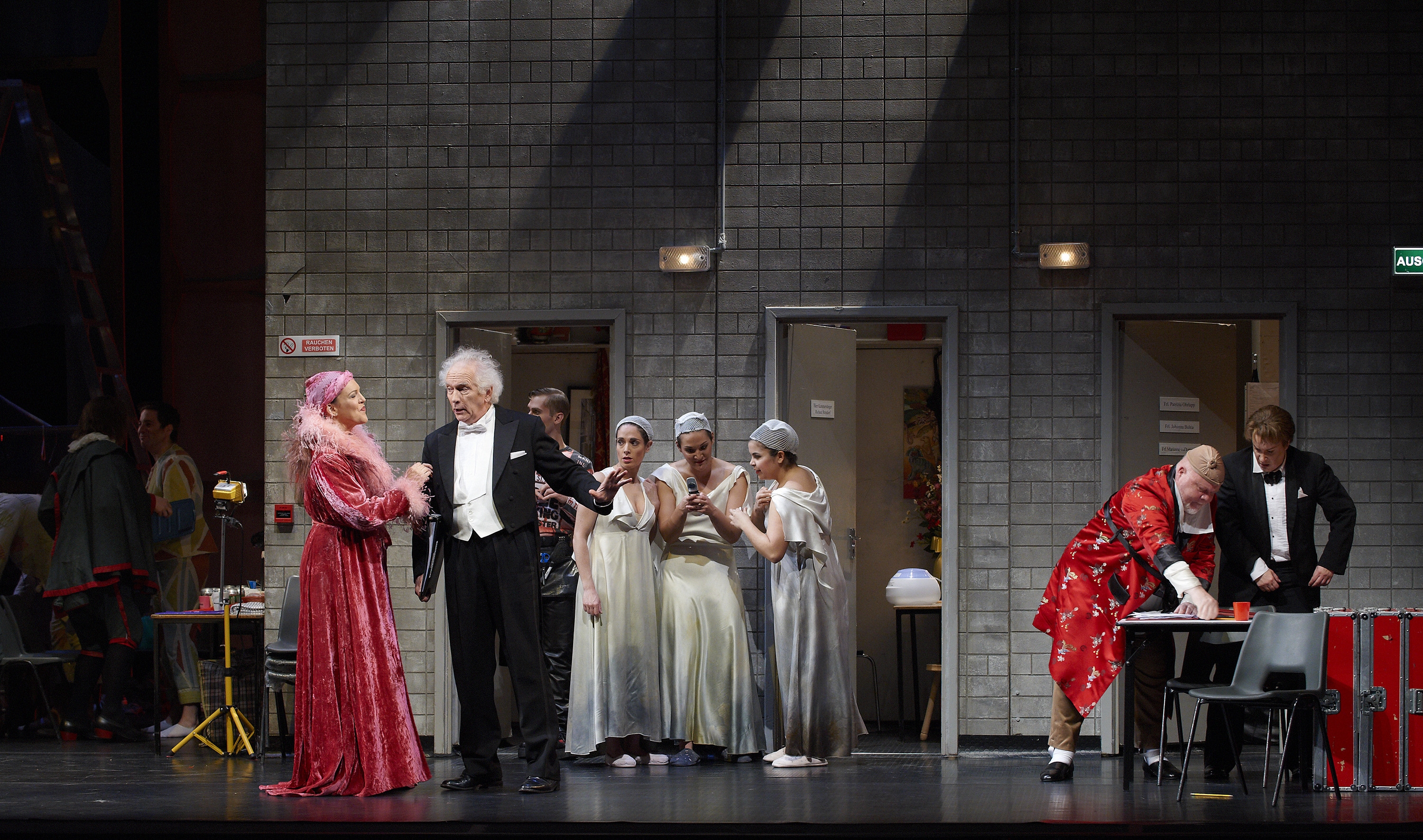
At the outset, the Prologue reveals a decidedly unmagical world behind theatrical fantasy, one bubbling with sarcasm, irritation, ironies, hurt outrage, and shallow pragmatism. No wonder it is so. “The richest man in Vienna” has arbitrarily decided, first, that some comedians will follow the performance of the serious opera that night and then, because all performance must end at nine so the fireworks can begin, that the serious opera and comedic performance will be performed simultaneously.

The composer who at first wonders, “How can I make sure that Bacchus understands he is a god?” then witnesses this same Bacchus in an ungodlike tantrum of childish, foot-stomping variety. He then hears his magnum opus regarded as boring, as merely “all these sharps and flats,” and, being hypersensitive, as all creators must surely be, declares, wounded, “I’ll never compose again.” Meanwhile, the arrogant diva is indignant: “Don’t they know who I am?”

This is funny stuff, of course, because the wounded naivite, the deflatable pomposity, the unjustified pretentiousness, and the pettiness of theatrical folk all show the human species, by implication, as something silly. Yes, we note the set up of easy targets by a composer who seems emotionally unaffected by them, a composer who further inflates these already bloated individuals into further absurdity with musical exaggeration, but do his victims deserve any better? And don’t we sense, throughout, a knowing wink from Strauss, a patient which seems at the essence of his humour?

So much is spoofed in Ariadne auf Naxos, wherein grand opera and comedy of the street have to work out co-existence: the stereotypes in opera, metaphysical aspiration in opera, romance on or off the stage, pretension of all kinds, innocence of all kinds, even dogma in aesthetics. We laugh, however, because this is what we are, even in our sincerity and vulnerability. We are a silly species and Strauss is funny because he can’t be bothered too much with us, all while he wraps us in rapturous music all the same.

But this is a splendid production. Conductor Sir Andrew Davis negotiates, with easygoing yet acutely aware aplomb, the large variety of orchestral effects in the score. These include dramatic chordal punctuation, attitude-setting lead-ins for the singers, ironic and humorous commentary, full collective ecstasy or pomp, and much else. Davis seems at one with the method of Strauss and over Prologue and Opera guides seductive sounds to expand and recede, to dominate the theatre’s atmosphere and then float away like strands of smoke.

One savours these orchestral sounds, one pays attention to the combinations of instruments that create them and sometimes surprise us. But if Strauss indicates a deliberate manipulation of emotional response on his part, Davis in turn deftly achieves an unselfconscious counterpoint of absurd situations on stage and these painfully beautiful musical passages. He skillfully lures us into a musical world, and there moves us to laughter and to feeling.

This is almost sinfully rich music from the pit, but it is not by orchestra alone that such richness is achieved. It is especially in his writing for the female voice that Strauss has sublime effect and the cast of the Canadian Opera production offers a number of vocal gems, male as well as female, that give memorable results.

Adrianne Pieczonka as Prima Donna and Ariadne shows an inspiring self-assurance of voice. With substantial rounded tone, she is declarative yet subtle on a big scale, effortlessly present with beguiling clarity of sound, with feminine power even in her wounded gentleness. Whatever parody Strauss and von Hofmannstahl have in mind, there is radiant authority in Pieczonka’s performance of Ariadne, one that moves us deeply.

As the Composer, mezzo Alice Coote’s repeated nuanced shaping of Straussian elongations and her subtle manipulation of both volume and resonance create a compelling range of emotion in a character who might otherwise seem artsy, self-indulgent and precious. Coote is consistently sensitive in creamy soft shadings of voice that drift off into aching silences and we in turn find beauty, not cause for mockery, in the Composer’s sincerity.

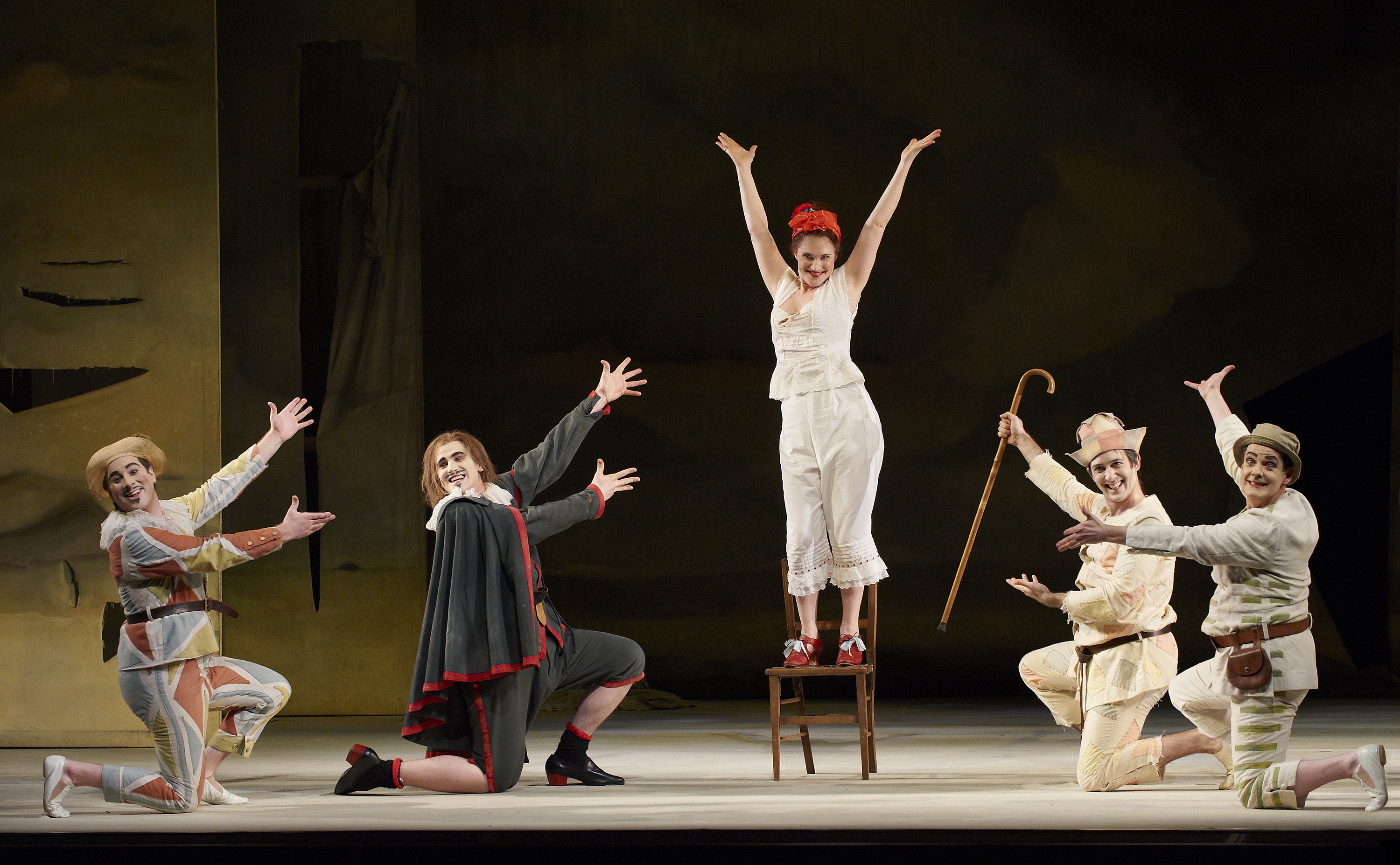
Soprano Jane Archibald sings the delightful Zerbinetta with bounce and exciting pliability of voice, plus an incisive edge that, urgently at times, delineates inner shifts of feeling. All this in a role that in some quarters is considered the most difficult coloratura role in the canon. As an actress, Archibald is adept at coquettish innuendo and a delightfully suggestive physicality. She is sexy with each gesture as she embodies the score.

Richard Margison’s open throated and masculine tenor, ringing loud at full throttle, brings a welcome heroic dimension to these prevailing feminine sensibilities. Unless the original German speaks more true to life, both librettist (who was a poet) and composer have several chuckles at the cliched lines that Bacchus, as a satiric tool, must mouth. Try these gems: “Now suffering changes to joy in your heart and mine.” Or “I’ve become a god through love.” Or ”Great was my need of you. Now I am transformed.” And my favourite: “I needed you more than anything.”

Director Neil Armfield’s knack for physical and vocal humour provides many a delight throughout the evening and even includes stylized copulation behind a curtain. His almost static arrangement of singers during the Opera creates at times the effect of a concert performance. One senses his mockery of opera in the wrong hands and reduced to a series of showpiece arias with little regard for narrative continuity. Meanwhile, Dale Ferguson’s ripped and punctured flats, with a decidedly dirty look to them, appropriately echo visually a high art being sullied.

Composer and librettist and all elements in the COC’s deliciously theatrical production achieve, as desired, a very fine balance of emotional intensity and comic effect. They put quotation marks around their own high art, even as they make satiric points at the expense of that same art whose emotional impact, ironically, they also hone so well.

One feels oneself made emotionally obese by musical beauty, one feels emotionally both self-indulgent and drained, even as one laughs lovingly at one’s submission to operatic effect. By his own rules, on his own turf, Strauss proves he knows both his craft and humanity insightfully well. Who can doubt that he is very serious indeed about the art he creates, especially when he plays both ends against a paradoxical middle where seriousness and laughter can intertwine?

Posted in Uncategorized | Leave a comment

CANADIAN OPERA COMPANY: ORFEO ED EURIDICE

Gluck’s down-to-basics reformist opera, Orfeo ed Euridice, is a very human and sublimely musical rite that explores humanity’s most fundamental and blunt existential condition: we die. Or, more painfully for us, those we love deeply die before we do, and we must then live our lonely grief, sometimes craving our own death to ease unbearable pain. Life with death as an unpredictable and inevitable end is impossible to live and somehow we must finally address our fear and pain.

No wonder this myth of a man, Orfeo, who would go even to hell to once again have the recently dead wife he loves is a cornerstone narrative of our culture. And for eight performances, the Canadian Opera Company provides potent means for us to consider such immediate human matters through their current production of Gluck’s Orfeo ed Euridice, one which is deeply haunting and exquisitely produced on all counts.

At the outset, the paired down orchestra allows individual instrumental voices to suggest isolation and almost immediately we sense solitary existence. The first image we encounter, as the curtain rises slowly, is an isolated male figure, back to us, and an upstage procession right to left silhouette, against brilliant sunset lighting on the horizon, and across the wide expanse of a stage. The setting is an actual burial, we realize, into this wide expanse of gravel-like surface. These seemingly infinite dimensions wherever we look suggest –dare I say subconsciously?- the crushing of the delicate human heart into insignificance. Director Robert Carsen’s brilliant production compactly speaks fears we do not want to know we feel.

The existential continuum that here gives presence to the human condition is the plaintive and heartbreaking countertenor of Lawrence Zazzo. It’s a voice that in essence seems eternally wounded in the presence a darkness that gives no answers and only begrudging light. It’s a voice of inner resonance, inner echo, and accumulating effect. To hear this voice as Orfeo is to witness deep human sorrow. Meanwhile, the deeply resonant and full-bodied chorus of black silhouettes makes, in Peter Van Praet’s intensely unforgiving lighting, elongated shadows across the stage upon which Orfeo walks in despair.

Gluck wanted human emotion and not theatrical artifice to prevail in his masterwork and, under Harry Bicket’s baton, passages that pinpoint and echo the turmoil of human feeling are negotiated with impressively light agility. Again the production’s emphasis on iconographic image-making is superbly unsettling as the dark stone-like shapes across the stage gradually reveal themselves as human forms condemned inescapably, one feels, to the lowest place, the lowest existence. In this Hades, figures creep and crawl but move not very far; they seem at one with the dark and dead horizontal surface on which they almost exist.

When the chorus rises to stand, it’s again into a choreography of motion that is visual poetry, the kind of which Carsen is a master. The robes they discarded lie about like human remains, among which Zazzo’s hunched and desperately jerking figure of Orfeo weaves. When Orfeo and Euridice rise through the grave, it is the fresh and beautiful clarity of Isabel Bayrakdarian’s soprano that brings assertive human passion to the tale. The shining ring to her voice, one that suggests the vitality of life, provides dramatic tension in sound with Zazzo’s lush, velvety and more introspective tone, as did the piercing delicacy in the voice of Ambur Braid as Amore. We hear dramatic tension through the tonal quality of voices in this production.

It is not only love, but magical theatrical beauty, that conquers all in this gem of an offering, one which originated with the Lyric Opera of Chicago. We have here an always wished for consummate blend of orchestra, voices, direction, setting, and lighting that revitalizes and makes boldly new the turf of familiar material. One thus feels indeed privileged to experience the Canadian Opera Company’s intensely beautiful Orfeo.

This thrillingly mounted ritual we have encountered as opera has entered our lives, entered the part of us where we cannot escape the fundamental issues of our lives. Through imaginatively conceived and brilliantly realized theatrical means, we have been given a dimension of beauty that, at very least, speaks back somehow to the death that awaits each of us. Without doubt, this is a production one will never forget.

Posted in Uncategorized | Leave a comment

CD REVIEW: ALEX PANGMAN 33

Alex Pangman’s new CD, titled 33, begins at speeding ticket tempo with I Found a New Baby and it sits comfortably in memories of the instrumental 1937 Teddy Wilson Orchestra recording. After all, Pangman’s band, the Alleycats, are an ace jazz unit whose irresistible swing, catchy idiosyncratic solos, and rhythmic daring are all effortless, musically fresh, and cause for celebration no matter where you hang your hat musically.
These guys constantly play rhythms against the prevailing rhythm, solo with an unsettling knack for aptness, and on repeated listens sound absolutely new each time.

Yet, albeit the musical riches from her instrumental friends, this is without question Pangman’s recording, a splendid collection of eleven vocals, ten songs of which were popular in 1933, and, in her idiom of choice, Canada’s Sweetheart of Swing is as good as this music gets. The stylists who inspired her would be pleased since, if she is definitely one of them, she is also a stylist who is distinctly her own person. She doesn’t simply sing a style of long ago; she lives the style and, just like her band, is repeatedly a first time experience of songs very familiar or unknown. As you might guess, without fail, she sings with the smarts of an instrumentalist.

Pangman’s musical personality is one of a delicious ambiguity, one that incorporates both womanly sophistication and a sexually delighted girlishness, both spiked with hints of unspoken intimacy that, teasingly, she won’t quite reveal. A caressed memory here, a sassy suggestion of womanly savvy there, then a brief peek at sensuality, then a dose of naughty innocence, then a burst of good-natured ecstasy -these all suggest past and present pleasures she has known. Nothing blatant here, however, just personal magic that is comfortable in subtlety.

Also, the singer’s heart acts as a guiding influence in her voice, with its longing and resolution and wistful sighs, but who is she, this singer whose every word implies a story? We almost know, almost, and that is part of Pangman’s persona’s magic. We have joy, we have life’s bruises, but the singer maintains an air of modest mystery that engages us without fail. But the key to the singer’s heart is, above all, the prevailing air of gratitude for love in her voice. For Pangman, love is the place to be, perhaps the only place in the world, and she can’t help telling us so.

It’s hard to nail tonal values in overdrive tempo, but Pangman does so in her snappy account of I Found a New Baby. Her diction in overdrive seems crazy with joy. In Ain’t Cha Glad, the slightly nasal echo in her voice, used discreetly, is full of friendly charm that welcomes the listener. In A Hundred Years From Now, her solidly declarative stance is romantically packaged in reassuring vocal caresses as she displays, as always, an astonishing vocal palette. To sing of love with such grateful enthusiasm and gentle savvy, one must know the turf well and Pangman certainly suggests she does in Thanks. Here her elongated, and experience-revealing phrases give touching results.

In Honeysuckle Rose, Pangman takes an imaginative instrumentalist’s liberties with phrasing and certainly sounds like there’s no place on earth she’d rather be than in this Waller classic. It’s Calypso country with the cozy, peppy sexiness of Happy as the Day is Long and then Shine, another classic. Here we have a fast toe-tapping beat that Pangman inhabits with ease, since an enthusiastic joie de vivre is in her bones –and I dare you not to get up and dance. I Surrender Dear shows Pangman at her narrative best, infusing each phrase with deeply felt memory, as does duet partner Ron Sexsmith whose crooning feels very human, very natural, and deeply rooted. We have a very evocative duo in this one.

As Lovely Lovers Do opens with a suggestive reedy tenor sax and in turn shows Pangman in voice that, as always, speaks directly with undeniable sincerity to the listener, this time through a romantic partner implied in the lyrics. This approach puts the singer up close, which makes sense since she penned the song. Hummin’ to Myself shows Pangman again making the music a second nature as she hits the beat assertively or stretches out over it, chat-singing or scat-singing as the music tells her to do.

A breathy urgency informs You Brought a New Kind of Love which creates a musical process of realization of love’s joys. Denzal Sinclaire, with his happily satisfied voice that almost smiles, makes an ideal duet partner, and we as listeners feel good about the world where love like this has a chance. Indeed, the two duets on this disc make one wish for more Pangman and partner recordings, since the lady in question does interesting relationships when vocally mated.

The reasons Alex Pangman belongs among her musical mentors -on record, of course, since she’s only thirty-three- are manifold. She has thoroughly internalized an encyclopedia of idiomatic resources that allow her to take whatever chances she wants musically and to do so in service of the character singing and her romantic reality. Her performances, detailed as they are in musical and psychological touches that constantly pop out and delight, always suggest a depth of musicality in reserve.

Among so much else, Pangman offers a solid and subtly shaped tone and refreshingly playful phrasing. Her knack for delicately concealed innuendo might one day get her arrested or be great stuff for a bio, but here it suggests, over and over, a shared experience to be treasured in quiet moments together. She is a discriminating singer with an inherent sense of style that leads her to say just enough. Her enthusiasm is most infectious and puts her three steps ahead of the listener who, in turn, is always just keeping up, always glad to be along for the ride.

Pangman, through declaration and implication, is also a natural storyteller. In fact, one listener told me that each song Pangman sings on this disc is like an invitation to a journey of some kind. She shapes each word into its most affecting emotional value and always implies that human narrative guides her phrasing. Her ability to inhabit lyrics as their emotional vehicle makes her use of old lyrics decidedly present tense.

Pangman can move with uncanny ease from conversational whisper to elegant vibrato to girlish enthusiasm with a barely suppressed squeal of happiness, and we always sense some new level of personality in her. She achieves character through spontaneous use of idiomatic devices that seem not at all contrived but as natural as breathing, for this is a recording that is genuinely alive to the max. It’s a recording that invites us to come along and celebrate, with our hearts, the moon and stars and that very special love we are so lucky to have for as long as time will allow.

Posted in Uncategorized | Leave a comment

CANADIAN OPERA COMPANY: LA CENERENTOLA

At the outset, under conductor Leonardo Vordoni’s baton, the overture to Canadian Opera Company’s current La Cenerentola seems more a reticent sigh than a twinkle of fun one expects in Rossini. What hint of playfulness there is seems outside the music reaching in and at times the conductor appears content to acknowledge the score and give it a respectful reading rather than shape it to delight the listener.

This somewhat leisurely account also lacks the decisive linear propulsion that usually brings comic urgency to Rossini’s buffo operas. One enjoys Vordoni’s reading but one doesn’t smile too much, at least not until the Act I quintet, the Act II sextet, and those many times throughout that the composer punctuates the score with the audacious big chords we all love.

On the other hand, mezzo Elizabeth DeShong, from her first appearance, creates an Angelina, La Cenerentola, whose every note seems an eventful resonance of solid richness, be it in her stunning lower register or in her full-bodied glissandi. DeShong is a singer of engaging assertive musicality who delivers staccato lines with thoughtful tonal variation and thus consistently suggests commitment to her character.

In fact, so rooted is she in inner conflict as well as outer, so connected is she to the push and pull of each situation, that, physically, hers is a beguiling presence one can’t help but watch. She is feisty yet warm, full of frustration yet resourceful, inwardly hurt yet compassionate. Still, it is DeShong’s singing that makes one hold one’s breath as each aria becomes a sculpture in sound. Her runs sound each like a string of resonant pearls, each one a centre for the rest. Hers is the kind of Rossini singing that gives one gladness.

Likewise the Prince, Don Ramiro, of tenor Lawrence Brownlee whose agile and ardent tenor shifts from vocal caress to heroic ring without any effort and leaves something of a velvety aftertaste in one’s ears. His solid lyricism unfolds with an underpinning of unforced authority that can also suggest, as needed, a sense lingering ardor or dignified bravado, the latter quite appropriate for a young prince on the lookout for the right lady.

Moreover, the bel canto scales he negotiates with impressively casual ease come hand in hand with a pleasingly forward vocal presence that nicely balances that of DeShong’s assertive mezzo. Add to this blend the Alidoro of bass-baritone Kyle Ketelsen, a voice of rich depth and compelling tonal variation, a voice that rings with inner vibrations and intelligently conceived characterization, and on vocal grounds alone this production shines memorably. With these three, did anyone suggest lieder? Each aria seems a mini-drama, an occasion of narrative and characterization.

Although Rossini at the time of composition was in process of moving toward opera seria, the buffo elements of his earlier successes prevailed in La Cenerentola and are here served delightfully by Donato DiStefano’s Don Magnifico, Brett Polegato’s valet Dandini, and of course the spiteful and decidedly “loser” sisters Clorinda and Tisbe, each blatantly inane in the hands of Ileana Montalbetti and Rihab Chaieb respectively.

DiStefano’s humour certainly has a human centre and his words emerge from character as well as comic stereotype as he takes time to shape each line with dramatic purpose. As a father of some authority, he asserts his position through careful attention to the intention of his words, and he succeeds equally on the farcical side by using vocal and physical exaggeration to give his comic villainy substance. His Magnifico is realized with a rewarding theatrical intelligence.

As a counterbalance in human foolishness to Don Magnifico, Polegato’s Dandini acquits himself quite well as a smart-ass servant. His tone of self-mockery, with its subtle nudges that underline many of his moves, makes him funny indeed. In a production that sometimes tries too hard to be hilarious, his duet with Magnifico, with its rapid fire enunciation in stereo, delivers unforced comic goods that, somewhat underplayed, stand out.

As for the sisters, the first impression they make is of a nightmarish cartoon, which makes sense since set and costume designer Joan J. Guillen is also a cartoonist. Broadly conceived, the sisters are bombastically awkward types who, filled with vanity and meanness, push about the stage in every direction. Whether they distract from the music and the more rounded characterization that Rossini was now exploring in his leads is a matter of taste and an issue open to debate.

Yet, although mad with colour and exaggerated shapes like those of the sisters, Joan Font’s production, strangely, seems conceptual and rooted in idea. Yes, it is a bold and busy and boisterous show, but adding absurdity to the already absurd, again with the sisters, merely distracts from the human centre of absurdity that Rossini so needs. He is a witty composer after all, one of frenzied lightness. So quick is his humour that one finds oneself catching on just after the fact time after time and the ultimate effect is one of end to end levity that hardly touches the ground.

Font, however, is blatantly up front with the ridiculousness of the sisters and we are being almost told to laugh. When the sisters look and act so silly, who cares if they sway their hips or bow awkwardly with their rear ends projected into the audience? We are not surprised when absurdity upon absurdity tends to cancel out any comic effect. We wait for production and music to find a common ground, a common attitude.

On the other hand, taken as visual spectacle and solely as a production of broad humour based in tongue-in-cheek stereotypes, Font has created something of a hallucinatory trip for his audience, one that offers stunning set pieces like the distribution of individual characters against a grid pattern brightly lit in the second half. Font, after all, is offering theatre as theatre, an event for which all resources combine to blow the mind of anyone watching. And so, he does offer scenes that give great pleasure in their richness.

The sextet of Part II, with its hilariously rolled Rs and marionette choreography is a riot of fun. The deliberately self-conscious storm scene –with thunder via a sheet of tin, a carriage rushing in dramatic silhouette, a wind machine, the carriage accident in miniature- is theatrically magical, as is the transition from hearth to ball in Part I. Even the movement of the chorus is ambiguously funny since we don’t know if its plodding awkwardness is deliberate or just pedestrian direction.

As for the ever-present six rats who provide an athletic, sometimes balletic, counterpoint to the action, they are both theatrically enchanting and extraneous. Once again, some will find Joan Font’s take on Rossini overwhelming and thus delightful, while others will find it too overwhelming and listen for Rossini’s witty musical coloring that is perhaps lost once too often in the bold colours of set and costume.

Posted in Uncategorized | Leave a comment

OPERA ATELIER: LA CLEMENZA DI TITO

In Opera Atelier’s production of Mozart’s La Clemenza di Tito, now at the Elgin Theatre in Toronto, Measha Brueggergosman’s Vitellia is an immediate thrilling creation. She is dynamic, eruptive, self-indulgent, confrontational, full of demons urging her on, and quite at home in bitchy anger. Yet, in calming Sesto’s suspicions, she sings with gentle authority and with an intriguing timbre whose lusher leanings have a cutting edge. It is an aggressive characterization, complex and unsettling, something one would talk about at length after final curtain under normal circumstances.
But so abundant in theatrical riches is this organically realized production, so full of genuine operatic gems, that the celebrated Miss Brueggergosman is but a starting point in praising its various outstanding merits. Michael Maniaci’s Sesto, for one, offers a heart-stopping voice that is both airy and imbued with liquid richness. Such secure delicacy of tone and feeling certainly seems to embody the human heart at its best in this story that otherwise concerns jealousy, rage, betrayal, political intrigue and other human madness.
Kresimir Spicer sings Emperor Tito in a substantial voice that is endlessly capable of nuance and tonal beauties. His is a presence, in figure and voice, with confident beneficence at its center and is thus most compelling. After all, this Tito is a hero who can declare “I know all, forgive all, forget all.” The voice of Mireille Lebel as Annio has a sparkling ethereal ring to it that repeatedly pleases the ear and her duet with the very touching Servilia of Mireille Asselin is ripe with moving tenderness. Will the beauty of this production never cease?!
In the opera’s systematic plot of endless complications wherein almost every duet seems to present a problem in urgent need of resolution, we certainly have melodrama, albeit based in genuine emotion, at quite a brisk clip. At the same time, Mozart in his last year, and rushing to meet a commission’s deadline, has created a continuum of wondrous musical poignancy. As a result, we savour emotional colourings and vocal shadings over and over in this stunning marriage of emotional intensity and exemplary vocal resources presented by Opera Atelier.
The interplay of vocal lines, as they combine and interact, as they weave inward to their psychological source that motivates them, is stunning. Even the many vocal gymnastics that thrill so often seem not so much for effect as a reflection of inner emotional turmoil of some kind. The Tafelmusik orchestra, under David Fallis, is, as we have come to expect, decisively capable of shifts from urgency to lightness of heart to proclamation and grandeur, all with subtle textures at their bidding.
Set designer Gerard Gauci’s flat painted backdrops are dimension-defying, spectacular in the creation of illusion, and hypnotically magical. Jeannette Lajeunesse Zingg provides choreography that is appropriately stately in this eighteenth century, not classical, setting. It is delicately elegant and, with its sense of proportion, a calming source of balance to the emotional intensity of the soloists.
Note that Opera Atelier’s La Clemenza di Tito is the opera’s North American premiere on period instruments and what better to celebrate the company’s 25th Anniversary season than a production that is dramatically convincing, musically rich, and subtly beautiful throughout? It features distinctly memorable voices, musicality of unending variety, and thoroughly seductive theatricality that as a whole receive a spontaneous standing ovation at final curtain. To miss it would be madness indeed, bordering upon self loathing.

Posted in Uncategorized | Tagged , , , | Leave a comment

TAFELMUSIK: BEETHOVEN SYMPHONY # 9 AT KOERNER HALL

A composer friend and occasional collaborator, Barend Schipper in The Netherlands, once explained to me how the modern ear, with its reverential and oh-so-serious attitude toward Mozart, often missed the humour in his essence. Tragedy and humour are not separate entities, he maintained, but crucial elements of a whole. His remarks reminded me of Shakespeaean scholar G. Wilson Knight who, in The Wheel of Fire, I believe, maintained that King Lear illustrates a kind of cosmic humour that plays out through human lives.

At the outset of Tafelmusik’s recent performance of Beethoven’s 9th Symphony under conductor Bruno Weil I certainly expected cosmos and metaphysics to permeate this esteemed orchestra’s take on the most influential symphony ever. I expected some sense of daring innovation that defied tradition, as the composer’s personal turmoil shaped itself into a breathtaking masterpiece that one still discusses in hushed tones. I did not, however, expect so much earthy humour, so much surprising detail, such variety of audacious individual sounds and, in turn, a striking revelation about both Beethoven’s creative mind and his humanity. It was a performance I’ll never forget.

The program notes suggested that we “listen with ears more comfortable with the symphonies of Mozart and early Beethoven and the operas of Salieri and Rossini” and awareness of this late 18th/early 19th century musical context made good sense of Weil’s unforced and perhaps mischievous interpretation. Beethoven, born in 1770, was creatively a creature of his musical past but also driven to new musical form and language, and here one could experience idioms of past and present working out a new relationship. One could hear each note, each passage, the individuality of each instrument’s sound, all in distinct contribution to the musical whole. One could sense the daring of Beethoven’s writing because one was made repeatedly aware of each part of it.

A composer writes notes, not necessarily meaning, and Weil gave us a thoroughly involving musical experience as we felt Beethoven pushing at boundaries of music and, thus, social decorum. One could wonder, in the second movement for instance, how an impish piccolo could fit in with its lithe audacity as the strings amassed their collective sound to the reassuring yet ominous punctuation of the tympani. Though deaf, Beethoven certainly knew the sounds that instruments, individually and collectively, could make and if there was compositional tension here, there was also humour and boldness through flippancy. What’s this? A collective clucking like gossping chickens in farmyard hyperactivity? In the holiest of holies, the 9th Symphony? No doubt, Beethoven could chuckle to himself even as he explored his despair.

It made sense that the Adagio didn’t seem a sublime ethereal stratum beyond our planet and human reach, but more the song of a body worn down by life on earth yet singing its connection to the universe. Again, Weil challenged us to hear the variety and richness of Beethoven’s method, to resolve the myriad sounds not meant to soothe but to be heard and felt in whole experience. If, in the Finale, one might smile at flippant pizzicati, the most touching moment came with the celli taking up the main theme as one vulnerable and gently assertive voice, as if hope could emerge from human chaos that, say, Brueghel would paint. When all strings joined in, we could sense brotherhood not as an abstraction but something born of flesh. And if we didn’t get the humanness of humanity, and got too scrubbed clean and abstract with idealism, Beethoven provided a flatulent bassoon to bring us back to reality.

Weil’s achievement was to bring the 9th Symphony down to earth and make it, with its variety of occasionally rude sounds, a very complex and human place to be. Appropriately, the soloists each brought an ease to their individual exuberance and each sang with assertive poise and clarity, with inherent and unforced dignity, with warm and positive vibration. The marvelous Tafelmusik Chamber Choir, in the Beethoven and in the selections from Mendelssohn, Brahms, and Part that opened the program, consistently offered an almost rugged finesse and a meaty blend of longing and spiritual achievement that is always the human condition. The always compelling interaction of distinct solo voices and small groupings within the choir created pulsations of vocal texture throughout each composition. There were riches everywhere indeed!

Posted in Uncategorized | Leave a comment

THE TIME OF YOUR LIFE AT SOULPEPPER

In 1939, when William Saroyan won both the New York Drama Critics Circle Award and the Pulitzer Prize for The Time of Your Life, a civilization pummeled by the Great Depression now had the unimaginable carnage of World War Two around the corner. If Saroyan’s play seems rather leisurely for the urgency of the day and somewhat arm’s length from the world’s unrelenting brutality, one can certainly understand why. The time needed hope, the time needed reminding of life’s inherent worth, reminding that some good exists in humanity. Part of this work’s appeal is that it promises compassionate reprieve, though not escape, from an unforgiving world.

The setting, according to the lovably blunt bartender Nick, is “the lousiest dive in San Francisco.” Yet although wood surfaces are worn down by the decades of human lives that have passed through the swinging doors, a surprisingly unembittered lightness of goodwill prevails here. The eager paperboy bubbles, “Good morning everybody….paper mister?” Several of the men are stylish and wear fedoras indoors and out. While reed-slanted bands on the jukebox mellow out the atmosphere with waltzes, five cents a play, dresses hang on the hookers, gentle as moonlight, from derriere to knee. The banter, though sometimes pushy, never means any harm.

One life drifts into another in this place and it’s repeatedly obvious that many of the habitués need to be heard or held or given some respect. The Prospero of the joint is Joseph Ziegler’s philanthropic Joe, a man who seeks “a life that can’t hurt any other life.” He asserts, “I believe dreams sooner than statistics.” and dream after dream is given the go-ahead though his doing. Most notably, he nurtures the romance of Tom and Kitty Duval along, giving Tom personal direction and bankrolling Kitty’s escape from whoredom.

Kindness is all in Saroyan’s world and, like a beneficent echo to Joe, Nick gives casual work and free lunches to the destitute. At the same time, understandably, he despises Blick, quite despicable in the hands of Michael Simpson, who “hurts little people” and at one point deeply humiliates Kitty. Happily, two bullets eventually end Blick’s existence, for even Saroyan allows that kindness can go only so far. Otherwise, human spirit continues to celebrate itself in many small but meaningful ways in this dive.

The play and production offer an endless supply of memorable characters and many a usually starring actor, in this superb cast of twenty-five, goes right for the heart in a poignant vignette performance and then disappears. Jane Spidell as Mary, for one, is haunting in her brief exchange with Joe, one that seems almost like Noel Coward and Gertrude Lawrence on the seedier side of life. Another is Krystan Pellerin who as Elsie speaks volumes in a few lines as she imagines her Dudley being “sent to be killed in uniform.” As Lorene, Tatjana Cornij departs after only a few poignant lines and our hearts go with her.

Others have extended, decisively etched and thoroughly engaging roles, some of these being Stuart Hughes as the flamboyantly wild and yarn-spinning Kit Carson, Kevin Bundy as the limited but endearing Tom, Karen Rae as a Kitty of lingering sorrows, and Jeff Lillico as the never-say-die Harry, all very human with subtle complexity, no matter how dynamic their individual stage presences. These people stay with us after final curtain and in truth this list of ace performances, thanks to the direction of a concisely imaginative Albert Schultz, needs to be a roll call of all the roles.

Saroyan’s text is lightly wry, spiced with poetically human insights and paradoxes. Says Joe, “We were in love, at least I was, you never can tell about anyone else.” Later, “Everything’s right, right and wrong.” And since he made his fortune by hurting other people, Joe well knows that “money is the cruelest thing in the world.” The local cop, Krupp, warmly shaped by Oliver Dennis, wonders, “Why are we all so lousy? This is a good world….it’s wonderful to move around….. (but) nobody takes things easy.” As you might note, the frequent philosophizing has an everyday, wistful quality. Thus, the audience becomes almost a character in this joint as we relax and nod in agreement each time.

This remounted and widely-praised production won Dora awards several years ago for Ziegler, understandably since his performance implies a lifetime beneath, and for Stuart Hughes. If there’s a Dora for dialogue with each actor’s mouth quite packed with chewing gum, it would take that one hands down. One bonus, in this production bursting with quality goods, is the presence of jazz singer Denzal Sinclaire, a man of stylish chops who evokes an era of not that long ago with each piano riff and each vocal shading. That, as black musician Wesley, he takes an unprovoked beating from racist Blick certainly reminds us how whites gave -and still give- repayment for the musical heart of our culture born in black ghettos.

Posted in Uncategorized | Leave a comment

ALL MUSIC GUIDE ERRS ON BIO OF HAMILTON’S JACKIE WASHINGTON

About two years ago I notified the online All Music Guide that their biography of Hamilton’s Jackie Washington contained a number of errors because its author had mixed biographical information of two Jackie Washingtons. I explained further that I, with Jackie, was the co-author of his two autobiographies, Talks with Jackie Washington and More Than A Blues Singer.

Alas, this mess of an entry remains. It contains, accurately, the dates of Jackie’s birth and death, but one of the albums in the abbreviated list of three is not his. A good place to go, however, to have this mess sorted out is www.wirz.de/music/washing.htm, a “labor-of-love” for the other Jackie Washington, where you’ll find complete discographies and photos of the album covers of both men.

The irony in all this is, of course, that the bio’s author, Bruce Eder, is a respected historian of both music and film. Or maybe that’s another Bruce Eder.

By the way, the offending passages that don’t apply to Hamilton’s Jackie are below. I know he would have been very amused by the confusion….

“Born Jackie Washington Landron to a family of West Indian and Puerto Rican descent ………..he worked at various times under both names, performing music as Jackie Washington, and as Jackie Ladron when he worked as an actor, his second career

He was signed to Vanguard Records in the early ’60s, and began performing extensively in the United States, especially in New York’s Greenwich Village at venues such as Gerdes’ Folk City and other friendly havens for the music. One of the songs in his repertory was a version of “Nottamun Town,” a mountain song recorded and written by Jean Ritchie that he adapted musically to a minor key into his own style, with a droning sound on the guitar. Among the audience members who heard him do this song was Bob Dylan, who asked to hear it several times, according to Washington in the Eric Von Schmidt book Baby Let Me Follow You Down. A while later, Dylan’s “Masters of War,” re-creating Washington’s music from his version of “Nottamun Town,” was released on The Freewheelin’ Bob Dylan, the album that established the latter’s primacy in the contemporary folk music landscape. Washington talked of suing but evidently never did. He later took a savage swipe at Dylan’s sound and his opportunistic streak, however, on “Long Black Cadillac” — which sounded like a parody of “Like a Rolling Stone,” in an electric arrangement by Felix Pappalardi, featuring the Youngbloods — which was released in May 1967 on his LP Morning Song, his fourth for Vanguard. In the interim, he’d also released the live album Jackie Washington at Club 47 and the soul-flavored single “Why Don’t They Let Me Be,” all attracting relatively little attention.

The unfortunate part about Washington’s recording career — for Washington — was that Vanguard never really pushed his recordings; the label was evidently content to let the music filter into the folk and blues communities — and in those days, they hardly ever even released singles, and weren’t a very big presence in the radio marketplace. On the other hand, their relative complacency meant that Washington got to record many of the songs that he was doing on-stage at the time, thus leaving behind a fairly substantial percentage of that end of his repertory

Posted in Uncategorized | Leave a comment

SHERLOCK HOLMES: THE FINAL ADVENTURE

Here’s the scene: a dark and shadowy street with strands of London fog drifting in and out, a lamp post, a bobby strolling through, a variety of street-world English accents, and a voice that shouts the news of Sherlock Holmes’ death. Next a few words from Doctor Watson, the play’s narrator, and we flashback with scene change to the study of the famous detective where he listens with ears and heart to an operatic soprano on a cylinder –and I bet you don’t remember those.

Holmes offers a slew of quick observations regarding his associate –that he has gained seven and a half pounds, has moved his shaving table, has a clumsy servant girl – and concludes with, “You see but you do not observe.” We, in our turn, observe that he is smitten with the singer. When he gets to meet her, not long after, he speaks haltingly and awkwardly and with breathy urgency, for hers is “a face a man might die for.”

The ensuing dramatic narrative of the play, we soon discover, is actually a blending of two plots. One involves the King of Bohemia who explains, “The scandal of my life involves that voice.” It turns out that the King was “romantically entangled” with the opera singer Irene Adler and now, on the verge of marriage, must retrieve love letters and a compromising photograph before they fall into hostile hands. The second plot involves the life-threatening presence of Holmes’ eternal rival, Professor Moriarty, and we know there’s a waterfall in their cards.
.
Steven Sutcliffe as Holmes has a readily ignited instinct for melodramatic cadences. His insinuating voice is rich with a comic self-indulgence that goes oratorical and judgmental in a snap. His Sherlock is finicky in manner, condescending in tone, and approaches every possibility with a boyish gusto. He enunciates in broad sweeps and speaks in pockets of resonance or with prickish understatement. He is charming.

But the casting of this splendid entertainment provides several humorously melodramatic individuals, and each distinct voice gives this production a symphonic variety in sound. Peter Krantz, as the King of Bohemia, for one, speaks with a gruff authority and a blustery roar that punctuates the atmosphere and the play’s headlong pace.

As Moriarty, Thom Marriott is a tall, darkly brooding presence who glides regally in his steps and speaks with solid, commanding and measured delivery. He is elegantly dignified in attire, without a crease. He is a thinking villain, one with a beard he strokes in moments of deep and evil thoughts. His disposal of implicating witnesses keeps him untouchable. Another gem of a performance in the group of conniving criminals in Cliff Saunders as Sid Prince, a cheeky safe cracker with attitude and a nicely shaped Cockney.
accent.

Doctor Watson, on more than one occasion negated as a bumbler elsewhere, is here made a quietly complex creation by Clive Walton. He’s a slightly stooped, linear figure who speaks like a professional and a man of the streets. He is rough-edged and sufficiently slow in keeping pace in detection of details, which allows Holmes, in turn, to dazzle. This Doctor Watson is slightly seedy and rumpled in manner, certainly a compellingly defined character with a real life hidden in his pocket. One keeps wondering about him.

As Irene Adler, Ieva Lucs has a perky, contemporary, and not too worldly quality that plays sunshine to the production’s often brooding setting. She’s a charming creation who speaks her emotions with a pleasant ringing clarity and delivers one of the play’s ace lines: “I have shot tenors, James, and after that a woman can shoot anything!”

This briskly melodramtic production, with its many amusing points concisely made, is directed for sprightly precision by Marcia Kash. She maintains a tone of very refined agitation, something that one may not notice save for one’s constant chuckles in response to it. She ably realizes the comic potential of each scene and delights in lightly maneuvered exaggerations of manner and propriety.

Shawn Kerwin’s involving set, in which the era is here detailed and there simply suggested, provides a physical context for both Edwardian stodginess and crisp narrative momentum. We suffocate in close quarters and then we run frantically along with the story.

The Final Adventure is concisely written, with the text carefully informative as it sends the plot moving ahead in quick leaps. It is an adaptation by Steven Dietz of the once immensely popular play by actor William Gillette and Arthur Conan Doyle. Some scenes certainly take liberties with the canon, even demystify Holmes, but if you suspend your loyalty to the original stories, you’ll thus have much here to enjoy.

Imagine Holmes and Adler youngishly making plans together, although she informs him that “a woman can never be solved.” Imagine the woman-inept Holmes in a lover’s spat where Irene is irritated by his talking about pipes when she wants “evidence of his heart.” And Holmes, though not woman-savvy – he even asks, “What is a man to say?”- does briefly show signs of a heartfelt wooer. Imagine that!

Whether anyone with even a cursory knowledge of Doyle can believe, accept, or even imagine such a Holmes is, of course, the issue temporarily on the shelf. In the meantime, however, this production is pure delight throughout. And it’s on view, appropriately, in London’s Grand Theatre, a “Victorian style theatre, built in the Edwardian era.”

Posted in Uncategorized | Leave a comment

SOULPEPPER: A MIDSUMMER NIGHT’S DREAM

The near-to-first production I saw of A Midsummer Night’s Dream was the legendary Peter Brook mounting of forty years ago that placed a smugly grand Alan Howard as Oberon on a trapeze. At the end, the cast burst into the auditorium and startled the audience with personal greetings everywhere and I got to shake hands with Puck. My prof at grad school protested that “this isn’t Shakespeare” but ever since, after many productions, I realize that the play’s potential for theatrical magic allows for a variety of directorial approaches that can, each one, conjure and realize the play’s otherworldly centre. And thus does the current Soulpepper production under Rick Roberts’ freshly imaginative direction that makes us as much participants within a compelling atmosphere, from which characters emerge, as witnesses to a consistently engaging play.

You’ll note that all but two of the speaking parts double as fairies –and sometimes trees- although, because of their hooded attire and Lorenzo Savoini’s seductively dark lighting, we never quite know who or what we are dealing with. Now and then, these large looming figures emerge with concertina, fiddles, bodhrans, and bells in hand and contribute to Mike Ross’s evocative and varying soundscape. The use of flashlights as travelling spots makes for many an eerie moment with misshapen, figures landing upon the lighting’s rich hues. Likewise, the text sometimes doubles as individually delivered phrases of sound within a sonic dream that includes a repeated motif here, an electronic crescendo there, finger tapping to suggest rain, and always a breathy undercurrent that creeps about the stage like a soft wind of undefined intention. As with a McLuhan medium of low definition, we have to fill in the goings on, sometimes with our own fears, and are compelled to be involved.

Among the actors, there are several who please a great deal. Mike Ross –yep, the sound designer- as Lysander and Brendan Wall as Demetrius are young men not quite out of boyhood who react to situations from an emotionally driven core, as much physically as in words, always with an inherent playfulness. They are dopey just enough to make them lovable. In comparison, Alena Malika and Karen Rae, as Hermia and Helena respectively, offer detailed and carefully shaped readings of the text, sometimes edged with emotional shadings that suggest individual personality, yet sometimes one senses a conceptual approach in which rhyme and form safely rule too much. But note Tatjana’s First Fairy who, with soft lilt in her voice, musically blends both earth and air in a brief, but enchanting, brew.

As Theseus and Hippolyta, Ins Choi and Trish Lindstrom concisely suggest presences of quiet unforced authority in both public places and in the bedroom. As a physically agile Oberon, Choi is not so much kingly as a short-fused and seething inner intensity awaiting a reason to burst, and sometimes the outbursts seem arbitrary. But just as Oberon easily gives in to rage, Lindstrom’s Titania very readily awakens to what seems an unrealized sexual freedom and we can tell, via her fawning and probing caresses of Bottom’s body, that this is one ass who turns her on. This Titania, who earlier fell asleep as if suspended in air, exudes an insistent sensuality. Both pairings of Choi and Lindstrom offer revelations, as does Gregory Prest’s Puck, a menacing realization of theatre’s favourite gofer who, here, implies a secret life and a not-too-concealed mean streak. And his last words are very threatening indeed.

As one would hope, the tradesmen-players round off the disconcerting elements in both play and production with a guileless, clueless innocence that allays the worldly and metaphysical sharp edges that one can easily find herein. In something contrary to expectation, Oliver Dennis is a more inward Bottom whose socially rough edges show some grace, while Michael Hanrahan’s Quince is less bookish than I have seen, pragmatic and gruff and slightly prissy. Their play is indeed the thing, genuinely hilarious with a prancing, breast-baring Thisbe of Michael Simpson, who gets off on feeling up Wall and the crotch underneath, and a self-indulgently oratorical Pyramus who bellows, wails and sobs way over the top. His suicide with not less than five knives and a well-positioned phallic sword is eye-watering funny. Go see, go enjoy, for there is magic in this Soulpepper production.

Posted in Uncategorized | Leave a comment