CREATURES: MARIE-LYNN HAMMOND’S NEW CD SHOWS A SINGER-SONGWRITER’S ARTISTRY, COURAGE, AND COMPASSION FOR ALL LIFE

Marie- Lynn Hammond’s superb new CD, Creatures, is a work of finely realized imagination, seamless artistry and delightful variety. Sometimes this gently potent collection does heavy duty work in the fibers of the heart and does so with grace, composure and inspiring humanity. Other times, while listening, one takes in the seductive spontaneity of these songs and is eager for more of life’s contradictory realities. As well, with producer David Woodhead’s rich but discreet imagination in control, and with his remarkable sense of rightness at play throughout, Creatures, with its twelve songs, is both profoundly moving and a lot of fun.

Creatures begins with the spritely-stepping A Dream Last Night and its reality-bending lyrics that would make Bunuel smile: “I dreamed of you and you were dreaming of me dreaming of you.” Life’s Like That follows with a run of evocative images that reflect the ubiquitous effects of chance in our lives. One goes along easily with Hammond’s stance of philosophical acceptance of life’s trials until reading, in her notes in the enclosed booklet, that the song ensued from the singer’s horrendous, life-changing accident. Still, she summarizes, almost matter of fact, that “some lessons were learned.” Emily Flies, “inspired by terrific kids and horses I met at therapeutic riding facilities” involves a young girl who “doesn’t really talk” and “uses canes to help her walk.” With the girl now seated on the back of a discarded horse Cody, now used in therapy, we find that, free from the prison of her condition, “Emily flies”.

Thomas Foster, with its unforced compassion and subtle turns in the lyrics, explores, in perfectly judged narration, one’s attempt to resolve impossible grief. There are many gut-wrenching moments on this CD and the song’s conclusion is one. We have a progression here and begin with the singer declaring “and I too called on Art and Beauty but ….. the muses all forsook me and it very nearly broke me for I had no other faith to see me through.” Then the artist returns to her art, in order to deal with life’s tragedies, and sings “by the light of the evening star for the first time in seven years I picked up my guitar.” In Le Cheval Sauvage, en francais, Hammond uses the back and forth format one finds in riddle songs of folk music and considers the loss of life – whales, horses, storks – on our planet. Its pleasing manner carries a heavy subject, but I can’t imagine any listener not singing along.

Children of Peace shows Hammond’s knack for melding historical narration, here of the Quakers, with its inner spiritual momentum. This is a celebratory, dignified, and very human account that stands hymn-like and firm on Canadian soil. Electric Green takes on the ruination of our naturally evolved earth by unchallenged development. In a collection rich with many unobtrusive hooks, one again naturally joins in on the catchy “two hundred twenty five acres for sale zoned industrial, zoned industrial.” The notes tell us that Hammond lives “on the edge of the Oak Ridges Moraine which runs across southern Ontario” and her detailed account of the richness of natural life now made vulnerable strikes home.

Silver Boy is a loving tribute to Hammond’s companion cat. Hammond has a knack for encapsulating complex issues – here our homocentric attitude to cats as toys and fads – and her mastery of honed lyric writing serves her purpose concisely and well. She also celebrates the intimacy of human connection with one’s cat: “I can tell he senses how I feel ‘cause he whimpers when I cry … I have dated men with far less appeal.” Newfoundland Pony, meanwhile, is a rousing, elbow-swinging, heels on plank floors tribute to the Newfoundland Pony and one can easily imagine it sung everywhere on the Rock. The tune is catchy, idiomatically unforced and, like the other songs, it addresses forces that threaten our life on this planet. Stormy’s Song is straight ahead upper stuff about a dog once “trapped in a pound in Ohio, frozen in terror on death row.” It expresses a love uncluttered by sentimentality and, like the dog Stormy in the song, this cut is full of “boundless joy.”

A friend, in something of a confessional mood, once declared that when he listened to Hammond sing, he felt he was having an affair with her. Indeed Hammond possesses an intimate and very feminine voice that reaches far below the clichés of pop music to a place where nakedness of existence is the reality. Do You Remember is a song of longing memory concisely rendered as in “who said ‘stay’ and who said ‘I don’t know.’” I suspect that Do You Remember will be taken up by other singers for their repertoires.

This will certainly be the case with Reluctant Angel, a potential classic by any standard. In this deeply poignant song, Hammond assumes the voice of her dead sister. However, “Oh how I miss the world, I miss the senses and emotion, the pulse of blood, and sun on skin” is not the voice of a dead woman with no life in her but of one who so much wants to still be alive. It always hurts doubly to find words for one’s losses and Hammond does so with admirable dignity, as she explores the truth of human feeling with genuine artistry. As a result, one feels open to being real.

In sum, Creatures proves to be an exemplary union of craftsmanship and deep feeling magically united in giving voice to human truth. The songs are sometimes playful and sometimes the quintessence of poignancy. Hammond is a versatile songwriter and a compelling story teller. Her delivery is open-hearted, evocative, and warm as she sings of urgencies that vulnerable human beings and other creatures endure. Her distinctively beautiful voice is quietly radiant and personal, nuanced and heartbreakingly sincere. And no matter the pain implicit in some of the songs, this CD is a masterfully-rendered creation that is thoroughly compelling. Creatures is a gem and few singer-songwriters do their art better than this.

Posted in Compact Discs, Uncategorized | Tagged , , | Leave a comment

A MEMORABLE TAKE ON SONDHEIM’S “COMPANY” FROM THEATRE 20 AT CANADIAN STAGE-BERKELEY THEATRE

“Bobby….Bobby” At first this melodic motif is a gentle, multi-voiced echo that later recurs throughout Sondheim’s Company, even as a cello-alto sax duet, and in all cases it is hauntingly ambiguous. We sense affection, to be sure, yet also a delicate persecution of a single stud among married couples who can’t seem to tolerate his ease with interchangeable sexual partners whose names he can’t get right. At times, for all their supportive involvement in his life, these friends seem as unrelenting in their torment of their Bobby as crows in Van Gogh’s field. Or they seem like a mother scolding a young child to behave.

Company precedes Bergman’s Scenes from a Marriage by several years and, if it doesn’t take the route of ripping emotional skin off its players, Company is a theatrical masterwork that often subtly explores why couples are simultaneously sorry and grateful that they are wed. Folks in this world may declare “I’m ready” but they never are and never have been as they unite in bonds of submission and compromise, sacrifice and self-realization, accumulated annoyances and even marital war where love, ironically, has been declared. As these marrieds drive each other nuts, they also wear each other down into deeper love. They find happiness as it is through one another and in spite of one another. They also demand the same for their single friends and Amy advises Bobby, “Want something.”

Sondheim’s Company is a perfectly tuned creation for theatre, one that expertly achieves finely developed variations on its theme of relationships. It is clever and carefully proportioned in applying or suggesting its compassion in this cityscape of wounded, lived-in faces. It subtly negotiates each frenzied subconscious with patience and dips easily into poignancy without being maudlin. If Sartre might declare “Hell is the Other” Sondheim might retort, “Well, yes and no.” In Sondheim’s Company people don’t have answers about others and they don’t really know the right questions to ask to find them. They don’t really know each other that well, or themselves. They are always alone and always together. Their world of marriage, relationships, and sexuality is potently undefined as they try to find themselves through others. And always, as each pair or trio works out their lives, the rest of the cast sits at tables –watching.

Company, if intended in its pre-musical form as a group of short plays for Kim Stanley, is here in this production, with no exceptions, implicitly dramatic, freshly entertaining, and deeply touching throughout. With director Gary Griffin’s knack for economical suggestion and precise effect and with a group of actors who, in vocal nuance or minute gestures, find intense individual riches of character in passing textual brevities, we have from Theatre 20 a genuinely memorable production. For one, the friendships feel real, be they bitchy or goofy or quietly confrontational or faux buoyant or suggestive of untested connections with others. Each character is a performer in a vaudeville of life, psychological thespians even up close to others or even down deep within. Blink for a second and you miss a character-revealing touch. And through Marc Kimelman’s rousing choreography, the production vibrates with New York energy.

One of cinema’s greatest directors, Yasujiro Ozu, once pointed out the difficulty in achieving the everydayness of people’s lives without recourse to stereotype and other anticipated exaggeration, and this is perhaps the key to the high quality of acting here. Give one of these actors a few lines and you get an implied lifetime that is present in each intensely focused moment of daily reality. Thus W. Joe Matheson as Larry briefly summarizes a whole marital relationship in which he lovingly abides Joanne’s pain and its resultant nastiness. David Keeley as Peter, with his tentative reach into bisexuality, and wife Susan played upper and bright by Eliza-Jane Scott , who feel “more married now” after their divorce, become tempting mysteries for speculation beyond their brief lines. Steven Sutcliffe’s David with a juicy smile full of innuendo can turn controlling cold to claim back his stoned wife Jenny, played with vulnerable spontaneity by Nia Vardalos, as she looks about with eyes like commanding yet playful orbs of light that in turn take their cue to fall into marital darkness from David’s frown.

Every marriage needs a wife taking karate classes and through Nora McLellan’s Sarah a feisty joie de vivre survives in part through her oozing pleasantly defiant rejection of those who would control her while, now and then, oozing her verbal control of them. As hubby Harry, Brent Carver gives this long married guy a loving persona but also the suggestion of an eternal wanderer in his own private thoughts. If Jeff Lillico’s Paul is bright, clean, and unreachably okay, his fiancée in Carly Street’s Amy is wired to bursting inside as an unsure bride to be who is facially contorted with psychological realities that have no other way to make themselves clear. The show’s best known number The Ladies Who Lunch belongs to Louise Pitre’s Joanne, an ironically cynical and passionately unresolved woman whose social schtick is bitterness as she points to her embittered self through others. Her eyes seem a sob of futility even as her voice broadly condemns everything in sight.

Meanwhile, Dan Chameroy’s Robert is attractive, vulnerable if sometimes wilfully, stylishly adaptable to others, undefined by relationships and defined by not having a marriage. He talks the talk of relationships –“You’re a very special girl and not just overnight”- and does pre-bedding push up preps like Fellini’s Casanova. He seems happily free when he doesn’t seem somewhat rudderless, and is regarded as a “good person” by those who obviously love him. Three who do are Bobby’s luscious young babe friends, all compactly realized: fleshy Marta who categorizes New Yorkers by a-hole diameters, a fleshy stewardess April via Marisa McIntyre who is given to wide-eyed declarations like “I’m so boring”, and Lindsay Frazier’s gymnastically sensual Kathy who contorts with quiet elegance and leaves much unspoken.

These are all concise characterizations that imply human essences and also suggest concealed and unaddressed human qualities. Sondheim works splendidly here due in equal part to actors who, even briefly, make solid his intentions with their unobtrusive expertise and no ostentation. Each scene is thus a “big scene” of living and not merely a theatrical exercise designed to pretend meaning. Like life itself, each scene also engages, as with Carly Street’s “what the fuck” take on her impending marriage to her “own Jew,” at the end of which she declares “I don’t love you enough” and the resultant silence is gripping. And there’s the communal toking up that goes from quite high to very low in marital disconnect. And there’s Jenny and David feeling sorry for “poor Bobby” while flossing and brushing their teeth. And Bobby’s big “Being Alive” number when we sense that, like all humans, he hasn’t changed much and probably never will. And what about the speeding ticket enunciation of Carly Street and Cleopatra Williams? Or those many revealing glances or gentle touches of another’s arm here and there?

It takes substantial smarts on the part of a theatrical team to make art breathe in and exhale like life, to have a creation effectively go for both the heart and the gut of an audience and discover its soul, and to have this creation be realized in fullness so as to send an audience back into their own lives, not with hope perhaps but with less loneliness. And that’s what this fine production does. An audience sees it, but the production also sees them and doesn’t leave them to be alone. Highly recommended.

Posted in Canadian Stage, Uncategorized | Tagged , , , , | Leave a comment

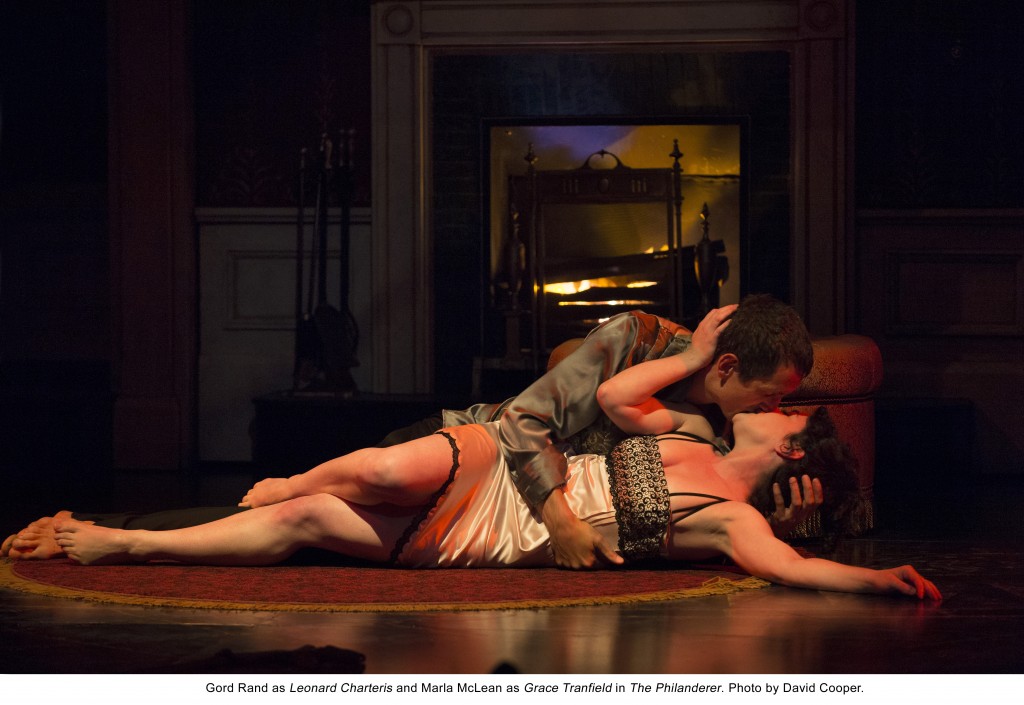
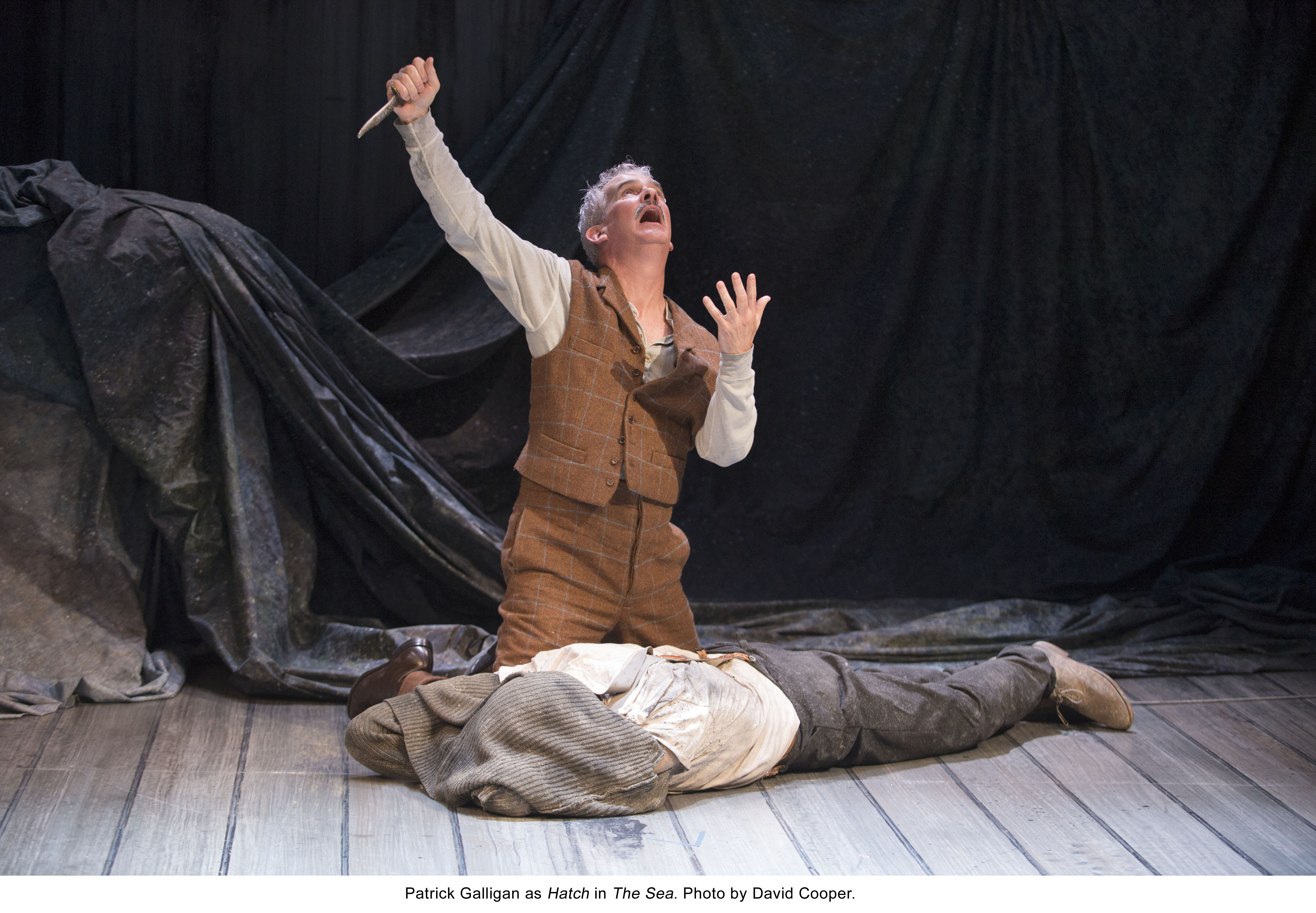
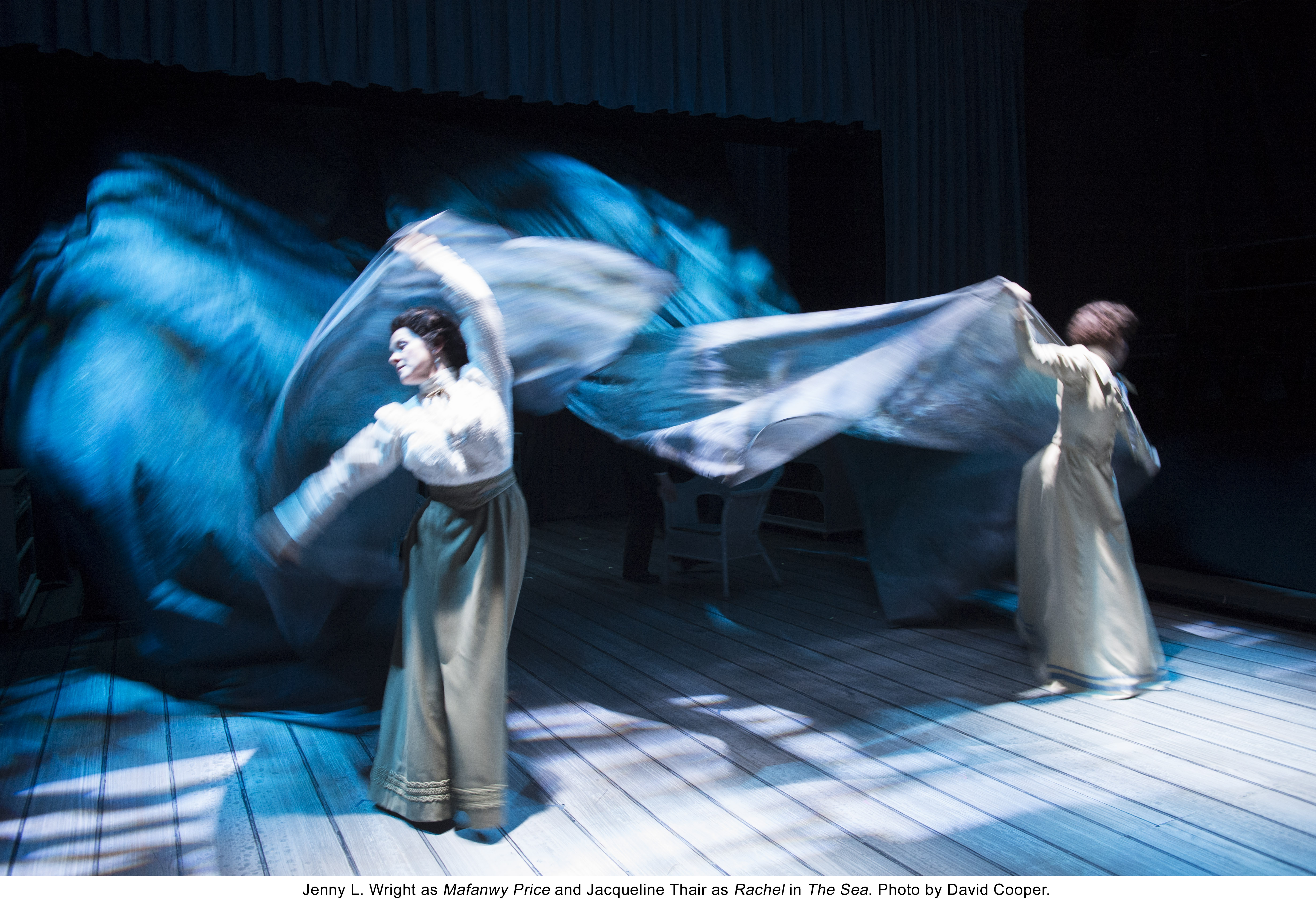
AN INTERVIEW WITH PLAYWRIGHT EDWARD BOND ABOUT HIS LONG AND “CONTROVERSIAL” CAREER IN BRITISH THEATRE AND HIS PLAY “THE SEA” NOW AT THE 2014 SHAW FESTIVAL

This season the Shaw Festival is producing its first take on a work by Edward Bond, a playwright who, through his uncompromising play Saved, first produced at the groundbreaking Royal Court in 1965, helped to change censorship laws in Britain. Almost fifty years later, with over fifty plays to his credit, Bond remains one of the most controversial and challenging, sometimes condemned and internationally produced, playwrights of our time. This interview took place in June of 2014

James Strecker: You started writing plays two decades after Auschwitz and Hiroshima when, “in a way the problems were behind us and we could look at the future” whereas today “the problems are in front of us and the theatre is unable to deal with them.” To begin, what are these problems we face and why isn’t theatre up to the task?

Edward Bond: If you go back say four hundred years, you can see a steady though irregular development of democracy. This was because new forms of industry depended on workers massed in cities and factories, not spread out over the land. These workers were exploited but – in spite of harassment – they were able to struggle and organize for political representation. In this way they improved the conditions of their lives. In two world wars – which were really crises in democracy – they fought and died to protect what they had gained, though this also meant dying for those who exploited them. After the Second World War they had a new confidence and created welfare states. I’m simplifying for this interview but that is the broad outline. Then thirty years ago in the 1980s this four hundred year development was stopped. This was possible because modern manufacturing was so successful it could create an enormous amount of goods, so that it could pretend it was a Utopia. So instead of struggling for democracy – that is, for human decency – people were asked to become mass consumers. Again I have to simplify, but the rich became obscenely rich and the poor became poorer. That doesn’t happen in Utopia. Eighty people own half the world’s wealth. The other half is owned by the rest of humanity. You could get eighty people into a corner of the Shaw Theatre. If you gathered the rest of humanity outside the theatre they would cover Canada. That cannot go on. Culture is always a cry for justice – it is often distorted and muffled, but if the cry was not there we would cease to be human. The eighty don’t exploit only the rest – they exploit the earth sea and sky. We are destroying the world. That doesn’t happen in Utopia. As the world gets smaller, the problems get bigger. The economy tries to solve its structural problems by destroying more of the world and putting it up for sale on the market. It is a slave market: the modern economy enslaves the world. If this goes on the world – our environment – will reject us. We consult our bank accounts as if they were oracles. Instead we have to ask ourselves what the future is. You don’t need an oracle, you need common sense. But only drama can disentangle common sense from our madness.

JS: In one of your poems from only a few months ago, you write, “I ask myself can you be happy in a world choked with madness and violence to its horizons”. You’re well known as a writer who takes an unflinching look at the inherent violence of our species, so I wonder what your answer to this question might be.

EB: The answer is yes. The happiness isn’t the glib and short-lived satisfactions you can get from the market. It is the happiness of understanding the situation and knowing that it can be changed. Otherwise happiness is superficial. You have to look reality in the face. Actually only human beings can be happy. Other animals might be from time to time “satisfied.” But in itself the fact that only we can be happy is the greatest cause of happiness. And so we have to cherish our happiness and not damn ourselves by making others unhappy, those who certainly aren’t among the “cursed eighty”.

JS: I long ago read about your play Saved in the 60s, about the scene in which the baby is stoned to death in its pram, and about the controversy that ensued including your appearance before a magistrate. So I wonder about the theatrical world into which you introduced this intense work. Did it need shaking up, did the audience need to be aroused from slumber of some kind, and is our situation today much the same?

EB: A French writer recently said that in that play – and in my subsequent plays – for the first time ever ordinary working people were put on stage with all their rights to be there and to be themselves. That is, they were made responsible for themselves and for their society. I say that their motive for murdering the baby was their nostalgia to be human. That is of course a paradox – but all drama is about the human paradox, the struggle to know ourselves, to decipher the labyrinth of human complexity. When social justice seems out of reach, people become destructive. Drama is about justice and not the law – the law allows eighty people to exploit the rest of humanity. That thought ought to keep you awake at night. It is a greater offence than murdering a child. The law is always manipulative but justice cannot manipulate. It is an imperative deep inside our “self” and drama is the only means we have of freeing it from the ramifications of social conformity.

JS: You are often enough described as uncompromising and shocking, so how do these labels feel to you? What have you wanted of your audience over the years?

EB: You refer to the negative – naturally, because the negative clouds our lives. I have had plays staged in over sixty countries. Plays I wrote years ago are still staged around the world. Last year I had a play staged at the Comedie-Francaise and at the same time in Colombia in the middle of a jungle guerrilla war. This year my play about war was staged in Japan and I have just come back from holding workshops in China – and because I was in China I wasn’t able to respond to a plea to see another of my plays in Istanbul. As drama deals with the most important problems – it’s why it figures so strikingly in the history of civilization – perhaps compromise would be wrong. Hamlet, Antigone, Hecuba did not compromise – and their writers could not compromise. If they did they could not create these people, extract them from the body of humanity. And if they hadn’t done that, we wouldn’t be here because civilization would have collapsed. When I directed a new play in London three years ago, the London Times had a headline: Edward Bond’s new Evil Plays. At the same time the artistic director of London Royal Court Theatre wrote: “Edward Bond’s moral purity stops him making contact with the audience.” That is odd because my plays are never out of production. The people who now run our theatres have a problem. If I refer you back to my earlier answer, they have been in place for thirty years, but I have four hundred years behind me. That gives me a confidence.

JS: Your play The Sea was first produced at the Royal Court in 1973, so, after writing at least fifty other plays since then, what does The Sea mean to you today, first in terms of what you are saying about human beings and secondly in how the play fares as a theatrical experience?

EB: Recently I took part with someone from The Royal Shakespeare Company in a BBC programme to celebrate 400 years of Shakespeare. He asked me how we should stage Shakespeare now. I said you can’t stage him now because you are not interested in what interested him – you are interested in profiting in the market. So directors gift-wrap Shakespeare instead of interpreting him. They do not want to understand him – or Sophocles or Moliere – because if they did the audience would want to change their lives. The directors of the Royal Shakespeare Company or the Royal National theatre don’t want that because it would be bad for their profits market. The last time The Royal National Theatre staged The Sea, the whizz-kid director managed only a grimy puddle. When everything is made for the market, all subtlety and paradox must be avoided because it is bad for a quick sale and so the market must degrade culture. It is a law of economics that the present market must corrupt culture.

JS: You recently said, “My plays are not commercial products, I don’t write for the market, I write for human salvation”. You also use the word “soul” in reference to humans, so I wonder what there is in people that gives you cause for hope and what there is that causes you despair.

EB: I use salvation and soul as short hand – and “salvation” was probably an ironic response to something in the question. Dostoevsky said only narrow-minded people hope. If I’m asked where the hope is in my plays I say it’s in the audience. When my plays are properly staged people tell me they find them strangely liberating. The English dramatist Mark Ravenhill sent me a letter earlier this year. He wrote: “Thank you, you continue to speak the truth in such a way that I feel in equal parts elated and frightened.” Shakespeare never despairs, that is his gift to the audience. I am often appalled, but I cannot despair.

JS: One commentator, in reference to a character in The Sea, has said that “Bond externalizes his inner homicidal maniac by imagining Hatch” and this makes me wonder: Why do you think you make some people uncomfortable about the things in themselves to which you are drawing attention?

EB: If anyone is uncomfortable about something in or about themselves, I think they would be wise to change it. We are human not because we can reason but because we have imagination. Imagination can make us mad – but without imagination we could never be human. It is imagination that enables us to enter madness and unravel it. King Lear goes mad – but when he becomes sane again he says the world is mad. It’s where we have to find our sanity. You can’t buy sanity in a market – it is created by drama. We need imagination to be sane in a mad world

JS: What purpose do reviewers and critics serve and what good or harm can they do?

EB: They are kind enough to ask people like me questions. I try to be helpful. A character in a play of mine repeatedly asks himself “Was anything done?” A critic, with an arch smile, once asked me “Was anything done?” ie, how had I used my life. I was going to ask the critic what he had done with his life since for the last thirty years most nights he had sat through an awful lot of rubbish without making any great fuss about his life being wasted for him. I didn’t ask him because it would have been impolite. Actually “Was anything done?” was said by Leonardo da Vinci. He repeatedly asked himself the question at the end of his life.

JS: What are the main difficulties you have encountered in writing plays? How does one make points that the audience does not want to address without shutting them down or alienating them into deafness?

EB: I think I’ve answered that – when they are properly staged they make the audience creative. I never judge an audience at one of my own plays. However, that they have paid for their seat does not mean they have purchased the right to ask me to patronize them. Writing a play is a difficult pleasure. I hope they will share the pleasure.

JS: One has to take care with causal links in biography, but I do wonder how your childhood affected you as a writer. You were born lower working class, lived through the bombings of London in 1940 and 1944, you were evacuated during the war, left school at fifteen, all the while educating yourself, especially in theatre. How do we see that background in your plays?

EB: I regard all that as an exemplary education.

JS: Regarding some of the comments I’ve read about you in the press, I find them vaguely derogatory and almost dismissive, yet at the same time one can read that “Edward Bond is one of the most respected playwrights living today” and “Bond is broadly considered one among the major living dramatists”. Any explanation to this contradiction?

EB: The word is divided into the politics of left and right. And you also have to share the world with the fanatical and the bored and indifferent. Sometime I shrug with one shoulder, sometimes with two.

JS: What were the most important events in your life as a playwright?

EB: The most important event is the play I am currently writing. And after that, the next play.

JS: Why did you turn to directing your plays? What have you learned from that experience over the years?

EB: I was fortunate in having my first plays directed by a great English director. In fact he was the greatest English director of my life time. He illuminated my life. I started to direct my work when the market took over and directors became shop-window dressers. The most important part of drama isn’t writing but acting. The writer sets up situations for the actor to use. My professional satisfaction is in writing good parts for actors. That really accounts for the contradiction in some responses to my plays: they may want to hate everything about me but they have to relish the parts I write for actors. I suppose it’s annoying when you are moved or amused by someone you want to regard as an enemy. I am really a comic writer. Any good tragic writer has to be. It goes back to your question about happiness. Being able to tell jokes well is the mark of being human – can you imagine Hitler telling a joke? I live from the creativity of actors. Guru directors who rely on tricks and stunts and “effects” can destroy actors. Drama occurs when – without interventions – the actor looks the audience straight in the eye and the audience aren’t blinded by banal lighting effects.

JS: You have said, “If my plays are acted properly, they are affirmative of humanness” and I wonder, in turn, what three plays of yours you would like to see next produced, say at the Shaw Festival which is this summer featuring The Sea?

EB: Any three.

JS: What are your reasons for writing for younger people and working with them?

EB: Children are intensely creative. Teachers sometimes tell the actors in the children’s theatre company that I write for (I’ve written them ten plays): “The children won’t understand that, it’s too difficult. They can’t even sit still.” After the performance they are surprised by the children’s concentration and perceptiveness. I wrote a play for children to act in themselves – they had to improvise some of the parts. Afterwards the head teacher told me: “I’ve been teaching children for twenty-five years and I never knew they could do that.” Later, when instead of life-problems children are confronted with business-problems and survival-problems, their creativity may be forced out of them so they can find a place in the market. It is a tragedy. Our market-society is afraid of creativity because it always involves the moral imperative – the market wants cunning, ingenuity, contrivance. It can’t distinguish between creation and destruction. An economist boasted that the market was creatively destructive. He is highly respected. He probably thought Auschwitz was a maternity hospital. I don’t exaggerate when I say our society is mad.

JS: What differences have you found over time between British actors and those on the continent? What about differences between the publics in Britain and that in Europe?

EB: I’ve written my last fifteen or so major plays for a National Theatre in France. The French have a sense of the wider cultural value of drama. If the ground is opening up at their feet, they expect drama to notice and not tell the audience to look the other way. So drama becomes more dynamic. It becomes essential again. English speaking audiences are patronized by Hollywood and TV -they are the market at its most insidious and disintegrating. Their scripts use the language and imagery of advertising, and their plots are disguised sales gimmicks. Three years ago when Luca Ronconi staged one of my plays in Milan, he was anxious I would find the production “too Italian!” It was very Italian! – but the actors knew what the play was about and it worked wonderfully in the Italian translation. In England, the Royal Shakespeare Company can’t even play Shakespeare in English – any more than the bankers in the city can be honest, since they are both integrated in the same culture. The effects of bankers’ swindling are obvious – but culture can conceal its offences because it can corrupt the means of perception and judgment. Drama is the great art of the English language, what music is to Germany and painting to France. And when the English degrade their drama, they degrade the core of their culture and their moral reality. They bury four centuries of democracy for the sake of their bank balances.

JS: You have called Cameron, your Conservative prime minister, “a profoundly ignorant and destructive person” and, since we too in Canada have a much-criticized Conservative prime minister who causes much concern, have you any suggestions how theatre might serve as a remedy to undesirable politicians?

EB: From what you tell me about your prime minister, I should think if I took him to one of my plays he would spend the time propping up the bar till he fell off it. I would happily give Cameron a free ticket for any of my plays, preferably one of the longer ones, because at least for that time he would be distracted from making the poor poorer and the city of London more vicious

JS: Thanks for the interview. I appreciate your insights very much. And, in anticipation of your 80th birthday on July 18, I wish you a very satisfying occasion.

Posted in Interviews from Theatre, Uncategorized | Tagged , , | Leave a comment

INTERVIEW WITH LOUISE PITRE OF SONDHEIM’S “COMPANY” AT TORONTO’S BERKELEY STREET THEATRE FROM JUNE 21

Actor-singer Louise Pitre has understandably been called Canada’s first lady of musical theatre. She has garnered a variety of accolades, in her ongoing and distinguished career, which include a Theatre World award for Mama Mia! on Broadway, a Tony nomination and a Drama Desk nomination for the same production, four Dora Mavor Moore awards in her native Canada, and three honorary degrees. She will next appear in the Theatre 20 production of Stephen Sondheim’s Company at Canadian Stage’s Berkeley Theatre from June 21, 2014. This interview took place in early June of that same year.

James Strecker: What are the challenges and pleasures of doing Sondheim’s company, first as an actor and then as a singer?

Louise Pitre: The script is denser than you think. With Gary Griffin directing, it is an enormous challenge as an actor, difficult to incorporate all that he sees but a thrilling challenge. The score is also very demanding, not only melodically and harmonically but rhythmically.

JS: Let’s say that a newcomer to Sondheim was coming to see Company. What would you tell them in order to enhance their enjoyment and appreciation of this production?

LP: I would not say anything beforehand. I think this show is one of the most accessible of Sondheim’s. Musically, it runs the gamut so there is something for everyone. The topic of marriage-commitment-love is one that speaks to everybody.

JS: What’s are the pleasures for you in being part of such an impressive cast?

LP: Knowing we can just go! We take notes from Gary, adjust what we’re doing, and move on to the next set of notes! It is a joy to be with a whole group of terrific performers. There’s no waiting around for somebody to “get it”.

JS: Sondheim has fanatical devotees and detractors too, so, from your experience of his work, why does Sondheim matter to musical theatre?

LP: Because it changed what we thought of musicals. Because it is so damn smart, clever, tasteful, and heartbreaking.

JS: What do you think of Sondheim as a lyricist?

LP: The best. Simply the best. No one can do poignancy or humour like he does. And all with internal rhymes to boot! He’s an intelligently clever lyricist.

JS: What was the effect on you and your life of all those awards and nominations you received for Mama Mia! on Broadway?

LP: It made people in Canada take more notice of me and my work. Since we don’t have a star system here, it did definitely heighten my profile. It also made folks in New York take note of me. It has had a lasting effect.

JS: You sing a substantial repertoire of songs from French singers in French and I wonder how you feel about the translations these songs receive into English. Also, what difficulties do solely English speaking singers face in grasping the attitude toward life, the idioms of style, the personality, the content, the intangible life experience, and the flavours of the originals? Or are the songs translated out of existence?

LP: So often, English translations of French songs are not successful. I’m sure you can say that about any languages. I have sometimes done my own translations. The thing about translating a song is that it cannot be a word for word translation. It has to scan with the melody. You have to find different images and expressions to express the same feeling of the original song. It is a very difficult thing. Herbert Kretzmer is a terrific translator of songs. Les Miserables is a good example of that. He also translated Charles Aznavour songs and well!

JS: What difficulties arise when you write songs that you yourself will sing? Which is easier, singing your own creations or those of others?

LP: I don’t think there is any difference for me. Truly. When I sing a song, I feel like it is mine, whether I wrote it or not.

JS: How does one learn to accept vulnerability and personal exposure as a singer and as an actor? Do you ever find yourself more exposed than you can handle?

LP: Sometimes in rehearsal, when you really get to the meat or heart of the scene or song, you can cross the line of self-control. It is good to go there during rehearsal. If you need to feel it that deeply, you should feel it while you’re working on it. When you perform, however, you don’t want to be the one blubbering. You want the audience to cry or laugh or cringe or whatever. Besides, it is impossible to sing well if you’re really crying….

JS: Do you ever feel crowded by Piaf’s originals of, say, La Foule, Hymne a l’Amour, La Vie en Rose, Mon Manege a Moi, and Milord when you put your own stamp on these classics? Why is your CD, that includes these songs, titled La Vie en Rouge?

LP: No, I don’t. I do not sit and listen to other versions. I did years ago, when working on the stage musical “Piaf”, to get the style and idioms. But not to imitate. I am not the same singer as Piaf. We have different voices, but the heart is what matters to me. And the gut.

The CD is called “La Vie en Rouge” as a play on the song title “La Vie en Rose”. I feel the way I sing is more dramatic and emotional, therefore pink is not the colour I would use to describe me and my style of singing. Red is definitely more appropriate.

JS: More and more, a few of the songs by Jacques Brel have entered the repertoires of many English-speaking singers. Why do you think his songs resonate with these interpreters?

LP: Because they’re friggin’ fantastic! That’s why.

JS: When I first saw Jacques Brel is Alive and Well and Living in Paris, I immediately headed for Sam the Record Man, bought his LP that contained Seul and La Mort, and never listened much to the musical again. Since French is your first language, what do you like about Brel’s songs?

LP: Each song is a one-act play. All I want in a song is to be able to stand on a stage and have something I really want to communicate, say, feel. He gives that in spades in every single song.

JS: You’ll be doing a show based on Aznavour songs next October, also at the Berkeley Street Theatre, so how do you prepare yourself to enter into his world? What qualities does Aznavour have as a songwriter that you admire most? What impact does the fact that he’s a man have?

LP: Again, he writes stories. They are narrative songs. That’s what I love to perform. He is such a poet! No, it does not matter at all that he is a man. Gender never matters to me. A great songwriter is a great songwriter. Period.

JS: Any chance I’ll be hearing some of my faves like Les Comediens, Et Pourtant, Il Faut Savoir, and Desormais. I’d love to hear Bon Anniveraire and Isabelle as well, but that might put a different spin on the show.

LP: At this point, I do not even know what I will be singing! I was in Chicago doing “Gypsy” when they did the workshop here in Toronto. I could not do it. I cannot wait to see what songs I will be singing.

JS: Thanks for this and, with deep regret that I missed La Vie en Rouge live, I am now happily off to get the CD.

Posted in Interviews from Music, Uncategorized | Tagged , , , | Leave a comment

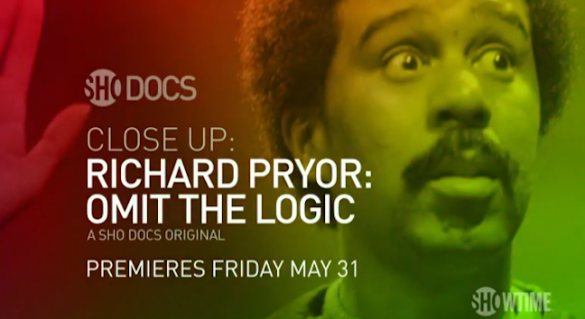
RICHARD PRYOR: OMIT THE LOGIC: An Interview with the film’s executive producer -and the comedian’s widow- Jennifer Lee Pryor

The film Richard Pryor: Omit the Logic serves as a compassionate but unflinching exploration of comedian-actor Richard Pryor’s inner and outer lives -and how one affected the other. It’s a rich experience of a film, in part because of many insightful and profile-creating interviews with the likes of Robin Williams, Whoopi Goldberg, Bob Newhart, Walter Mosley, Mel Brooks, Lily Tomlin and others. Equally impressive is how this documentary unfolds as a challenging drama of one man’s life. This interview with executive producer Jennifer Lee Pryor –also an interviewee in the film and Pryor’s widow- took place in May of 2014.

James Strecker: In the film, Whoopi Goldberg calls Richard’s performance free-flying and Robin Williams compares Richard’s routine to Coltrane playing. Was Richard into jazz? Was a need for improvisation part of Richard’s life?

Jennifer Lee Pryor: Richard adored jazz and had many musician friends, among them Miles Davis. Richard worked much as a jazz musician would, with lots of improvisation then he’d nail it down so he could be free to improvise on top of that.

JS: People in the film discuss or imply Richard’s demons. What exactly were these demons and what did he do about them and which ones couldn’t he shake for his whole life?

JLP: Aaah, huge question, not easily answered. Demons, we all have them, but Richard’s were like monkeys on his back. It all begins in childhood. Having fame and money doesn’t help squash them, but rather nurtures them.

JS: Apparently the look that Dean Martin had in his eyes while Richard was doing his Vegas gig jump-kicked Richard out of compromise as an artist and then “Richard Pryor became Richard Pryor”. What exactly happened in that series of events?

JLP: Richard walked off stage in Vegas and headed to Berkley where he hung out with the Black Panthers, slept on a mattress and discovered his truth -which he was able to translate into his brand of rich comedy.

JS: Someone in the film summarizes Richard’s attitude as “If it wasn’t real, fuck it.” I’ve always felt that a finely-tuned bullshit detector was deep-rooted in him and part of who he was. His intense eyes seemed to be constantly checking out the world and people around him for deeper levels. What do you think?

JLP: Oh hell, yeah, if he sensed bullshit or lies, it made him angry, made him want to confront it, because he couldn’t stand it. This too was a burden.

JS: I’ve always sensed that Richard always pushed his audience far beyond their complacency, whether they knew it and liked it or not. He also pushed the boundaries of censorship and surely he pushed himself. What was it about the man that needed to do deny barriers or challenge the status quo?

JLP: This question follows the bullshit detector question and it all goes hand and hand. Richard was a seeker and he was relentless. The audience had to come along for the ride or it didn’t. And they didn’t always, but Richard didn’t care, since it was the truth or fuck it.

JS: How did he prepare himself to go on stage and do his performances and what did it take to improvise the way he did?

JLP: Actually, when Richard worked, he was incredibly disciplined. I worked with him on Live in Concert, his first concert film, and we went to the Comedy Story every night where he would improvise and I took notes. The following morning we went over the notes and he decided what he would keep and enhance and what he would drop. This is called ‘woodshedding’. This went on for months and, at the end of this period of time, he had an amazing concert which he took on the road and which culminated in a film.

JS: What did he want or need as a human being and what did he want or need as an artist?

JLP: Existential questions here. Ok, I’ll give it a try: Love. Acknowledgment. Love. Fame. Love. Love. Love. Love.

JS: You’re identified as Wife #4 and Wife #7 in the film and, from the segments of the interviews with you, it is obvious that Richard is still deeply part of you, so are you willing to tell us about your relationship with him?

JLP: Happy to share. Actually, I always identify myself as ‘the best one’. He was and remains the love of my life, a complicated and magical man. I fell in love with him the first day I met him. I was introduced through Lucy Saroyan, who was working for him and dating him at the time. I worked for him for 6 months before we began dating. It was an intense relationship, turbulent and exciting, resulting in marriage, divorce. I moved back to New York and we always kept in touch. I returned in 1994 when Richard was ill with MS and needed me more than ever. We remarried in 2001. Obviously, the second time around was not as turbulent but was filled with the drama of his illness and familial issues. I had to restructure and organize his business, which involved suing a whole bunch of motherfuckers who were stealing what wasn’t nailed down. I am passionate about securing Richard’s legacy.

JS: I’ve discussed racism with a number of black musicians including Dizzy Gillespie, Oscar Peterson, and Jay McShann, and conclude that there is no way that a white can remotely understand and actually feel what it means to be a black in America. >From knowing Richard as you do, what would you say?

JLP: No one can understand what it is to be black in this country. But we must try to empathize and understand and always fight the good fight against ignorance, always raising our voices against racism whenever we see it. That is an obligation I feel deeply and always have. My great aunt was married to Oliver Brown, one of John Brown’s sons, who was killed along with the rest of the sons, Brown and his cavalry, while trying to free the slaves at Harper’s Ferry, West Virginia. Slavery was American’s birth defect and remains a visceral scar.

JS: Richard’s first and groundbreaking LP was titled, “That Nigger’s Crazy” yet, during your trip to Kenya, he declared, “I ain’t ever gonna use that word again.” Could you explain what this declaration meant?

JLP: Actually, his first album was simply titled Richard Pryor. You are referencing a tour de force, however. We were standing in the lobby of the Hilton Hotel and he looked around and was stunned that all he saw were black people. He said, “Look, there are n*&%^#”s here, Jenny”. He saw dignity and people comfortable in their own skin. Richard believed the word to be so pejorative from then on, and he never used it again.

JS: What -or who- were the most influential key factors in Richard’s life that made him what he was and why was it so for each one?

JLP: Grandmother Marie, who was the ‘madam’ of the brothel in which he grew up. Richard was forced to choose between his grandmother and his mother on the witness stand as a young child. That was traumatic and scarring.

JS: You lost Richard to his freebasing and then you remarried. Your discussions of him in the film are quite moving. So what was it about Richard –and I’m going by the interviews in the film- that seemed to inspire such love, dedication, compassion, and concern in people for him? Was it his pain? Or his magnetism? Or what was he like as a human being?

JLP: Richard’s vulnerability was moving and deeply endearing. He was a lonely man, I was a lonely person too on this planet, and we found each other. I connected to his pain as many people did.

JS: According to Robin Williams in the film, doing his comedy routine was a vulnerable and raw experience for Richard. Why did Richard do comedy as he did?

JLP: As Dick Gregory said, “Richard performed brain surgery on America.” I think comedy saved Richard’s life. It was a place he could exorcise his demons and shout the truth about his life, his pain and how he viewed the world.

JS: I don’t mean this to be a ridiculous question, but do you have any favorites from Richard’s performances that feel especially meaningful to you?

JLP: That, of course, would be Live in Concert, as I worked on it with him and we were very much in love, and also Live On Sunset, because we were married. Live in Concert remains my favorite and, if you watch it, you will understand why.

JS: What are the public misconceptions about Richard Pryor that trouble you most?

JLP: That Richard was merely someone who did drugs and beat up women. This was the darkness. There was also a tremendous amount of light in Richard. He was a wonderful person and cannot be diluted with these simplifications.

JS: Would you care to talk about Richard and Hollywood and network television?

JLP: Richard was given the opportunity to do a ‘variety’ show for NBC, late seventies, and he kicked ass, and then the executives realized what they had done and pulled the plug; lol, it was genius television.

JS: Tell us about Pryor’s Planet, what it is and your role in it, and about Richard’s love of animals. What did animals bring into his life? What were his feelings about animals?

JLP: We both shared a deep love and understanding for animals. Richard and I founded Pryor’s Planet, two years before his death, of which I am director. I am a very hands on rescue. Richard was like a child with animals. He gave voice to them. The first time I saw this was in a pasture in Hana, HI. Richard pretended to interview a cow: “Mr. Cow, please tell us what it’s like in this beautiful pasture overlooking the Pacific. I myself would get rather bored with all this beauty.” Fish, dogs, monkeys, horses, on and on, he connected with them. And you can hear that connection to animals referenced in some of his comedy.

JS: What new projects are you working on?

JLP: I am producing a bio pic on Richard’s life and writing a second book. I am always looking for new projects and ways to enhance Richard’s legacy. And to introduce Richard to a new generation.

JS: I would think that capturing a unique human being like Richard in a bio pic would present many difficulties. How are you handling these? What’s the book about and how’s it going?

JLP: Richard’s life is a big life, big material, so it is challenging to articulate this authentically and make it accessible so as to make Richard truly come alive and understood. Challenging indeed. The book is about my return to Richard and the years that followed and the monumental challenges that we had to meet, and the ones that I had to confront alone. What a journey.

JS: Thanks for the interview and the film.

Posted in film & television, Uncategorized | Tagged , , , | Leave a comment

HAMILTON PHILHARMONIC & TWO FINE BOOKS ON FILM

Hamilton Philharmonic Orchestra
Perhaps it was our especially cold winter lingering still in one’s bones, but conductor Gemma New’s recent take on Beethoven’s Pastorale Symphony with the HPO certainly drew one into the richness of an approaching spring. Here was an unforced but thoroughly compelling and insightful performance in which both an air of fresh musical discovery and an engaging sense of springtime human abandon prevailed. One’s mind drifted quite easily, at times as if seduced by a dew-light flow of dance. One sensed blossoms and leaves made into sound and, beyond that, the welcoming warmth of sunlight on grass, all from this performance. And then the storm.

Certainly, after skilfully negotiating an ominous undercurrent of impending danger, one that gave the listener a feeling of vulnerable unease, New revealed, as in the Saint-Saens earlier, an effectively emphatic hand in the “Tempest” Allegro and one did indeed feel need for shelter. But with the overall naturalness implicit in this fluid and organically sound performance, one also felt enriched by New’s respect for the compositional intent of the score. All parts were made clearly individualized and vibrant, propelled by lyricism, inherent fun, and firm musical logic that were cleanly stated and subtly robust.

I especially loved how, in this orchestral canon staple, one could hear familiar passages given surprisingly new life. One felt here a sense of discovery, all while savoring both musical nuances shaped by New and Beethoven’s intriguing and uncanny sense of placement of parts in his overall design. While happily consumed by this Pastorale on aesthetic grounds, one became repeatedly conscious musically and, at the same time, emotionally enriched and challenged. I suspect that if Gemma New were made the new conductor of the HPO, the dynamics of Hamilton’s musical scene might develop in some community-friendly yet musically invigorating ways that these dire times for the arts require.

Plus two film lover’s books:
Dark City: The Lost World of Film Noir by Eddie Muller (St. Martin’s Griffin) lives and breathes the Noir world and one almost feels bound to don a Stetson and to pull its brim down over one’s eyes while relishing Muller’s flavorful prose. The author is both hip and sufficiently academic, precisely attuned to the defining qualities and gossip of actors in the Noir canon, and splendidly evocative in writing that brings this world to life in one’s imagination. Every two page spread offers at least one riveting photo in which the drama of life and death pulsates for the eye. Many films are summarized with narrative smarts and beware that you’ll be checking out both Noir films you’ve seen many times before and those you’ve never seen.

In Barbara Stanwyck, a BFI book published by Palgrave McMillan, author Andrew Klevan analyzes nine of this great actress’s film performances with meticulous appreciation of each role’s possibilities and Stanwyck’s often unanticipated realization of each part. We begin with Ladies of Leisure from 1930 and on the way to There’s Always Tomorrow of 1956, Stanwyck classics including Stella Dallas, The Lady Eve, and Double Indemnity are all considered with exemplary insight. Klevan is especially balanced but quite aware of critical failings elsewhere, say with Ball of Fire, that miss Stanwyck’s overall intention and her brilliant but subtle thespian turns that bring piquant life to both her character and, in turn, a given film. It’s also a pleasure to see director’s like Hawks, Sturges and Wilder discussed as co-creator’s of Stanwyck’s art.

Posted in Hamilton Philharmonic, the arts | Tagged , | Leave a comment

Kafka, Kurtag, Dunlop and existence in every word, every note: An interview with soprano Stacie Dunlop

Stacie Dunlop’s ongoing crusade for the composition and public performance of contemporary vocal music hits Toronto on Saturday, May 10 with Gyorgy Kurtág’s Kafka Fragments at Toronto’s Gallery 345. Ms. Dunlop’s longstanding intention is to challenge her listener’s multisensory being and to take her audience’s musical limitations for a long walk into new realms of existentially-rooted sound. It’s a tough task, since we live in a self-restricting world of popular music that does bonehead, volume, cliché, attitude –and often little else- to the max. The real stuff happens in that unpredictable place where a singer’s being is realized in voice that, through performance of exploratory music, achieves the singer’s existential meaning. This interview took place in April, 2014.

James Strecker: Stacie, let’s dive in deep. How naked do you find yourself when you sing your chosen modern repertoire? I ask that because the Kafka Fragments suggests, to me, both the dread of being completely exposed and, on the other hand, a rushing to and hungering for the complete nakedness it dreads. This paradox isn’t easy stuff to live in. So what happens to you as you sing it?

Stacie Dunlop: I don’t know if naked is the way to describe the way I feel when performing this work -or any contemporary work for that matter- but in a sense you do “bare all” in front of the audience. Perhaps “vulnerable” is a better way to put it, because the work requires extreme virtuosity of both the physical and dynamic range of the voice combined with complete mental concentration and emotional commitment. If you don’t have this all lined up and in focus during the performance, the possibilities of becoming unglued and falling off the rails is very possible, and this can make one feel extremely exposed. Luckily, I have an amazing collaborating partner, Andrea Neumann, and we have had the advantage of putting in many hours together in preparation for these performances of the Kafka Fragments, which I believe helps us to both to feel more “clothed”, and yet no less vulnerable, perhaps in fact maybe even more so.

JS: Let’s try this: I’m going to quote some of Kafka’s words that you’ll be performing on May 10 in Kafka Fragments and I’d like you to tell me what it’s like to enter this special author’s world and mind through each quotation.  Given that translation is an inherently inadequate art,  here are the quotes anyway, and please say a sentence or two about each one.

-“Once I broke my leg: it was the most wonderful experience of my life.”

SD: Pleasure in pain: there is something about Kafka’s fascination with all things painful, both on an emotional and a physical level, that speaks to me in this fragment. It seemed he relished in extreme experiences, particularly at the end of his life when he was dying a terrible death of tuberculosis of the throat. It was at this time when he appeared to be the most connected to his emotional state, as if only through this suffering could he have had this deep understanding into what pain truly was.

-“From a certain point on, there is no going back. That is the point to reach.”

SD: This is the fragment that speaks to me the most out of the 40, thus the title of our show: “No Going Back.” For me, in life, I feel that once you decide to go down a certain path, you must keep up this intention of forward movement, no matter what happens along the way. The path may take different turns and side roads along the journey, but it is the realization and embracing of the idea that once you start, you can’t turn back, that life is forever changed from the decisions you have made, and that’s what I find so powerful. Kafka was committed to staying the path, particularly in his writing and definitely in his love life, even if the prospect terrified him, which it often did especially when it came to the idea of perfection in love.

-“There is no ‘to have’, only a ‘to be’, a ‘to be’ longing for the last breath, for suffocation.”

SD: We are all in a constant state of suffering, as to live is to suffer and we need “to live” in the moment (“to be” in the moment). We can’t “have” the moment, we just have to be, but in this being we are suffering -and thus we are longing for the suffering to be over.

-“Coitus as punishment for the happiness of being together.”

SD: Kafka had this thing about sex. He both craved it and despised it, and despised himself for wanting it. He believed in love as a pure thing, and sex as something dirty, so to have a sexual relationship with someone he was in love with, or shared happiness with, was in fact marring the sanctity of this relationship.

-“I am dirty, Milena, endlessly dirty, that is why I make such a fuss about cleanliness. None sings as purely as those in deepest hell; it is their singing that we take for the singing of angels.”

SD: Kafka was tormented by the need to be pure. He went to all lengths to keep his body pure by eating a simple vegetarian diet, supplemented with copious amounts of milk, especially when he was ill. He was obsessed with the idea of purity in love, spending sometimes years in a chaste relationship to preserve this state of being and yet, at the same time, he had cravings of the body, which made him “dirty”. His carnal desires were satisfied by visits to brothels and this struggle between his desire and his idealistic view of what love should be was a never ending torment for him. He was living a double standard, but to the outside world he was seen as an angel.

JS: I’ve been following the score of Kafka Fragments on the internet, one that has an audio performance track synchronized with it and, as a result, I can try to read it as I hear it. Tell us how you figured out what exactly Kurtag wanted of you throughout this very complex and demanding score and how did he make each wish explicitly known?

SD: It’s funny because during the process of working on this piece during a residency at The Banff Centre, Andrea and I had the opportunity to work with Marco Blauww, a wonderful trumpet player, famous for his performances of Stockhausen’s music, who has spent quite a lot of time with Kurtág and knows his music well. We were working on a particularly challenging passage in the final fragment that called for mordents and other musical indications which I hadn’t had much experience using in the past, and I was feeling really at ends with the score. Marco’s suggestion was to look at the text, find the meaning behind it, and through that we would figure out what Kurtág was really trying to indicate with his notation. He told us that what was notated in the score was not what Kurtág wanted, but he had no other means to express his desires to the performers. So that is how we have worked through the piece, by looking at the meaning of the text, and making sure this meaning is being described in our interpretation of the musical gesture notated in the score.

JS: What was your first reaction to the work as a combination of writings and sound, and how did you change as a person and as an artist in order to develop the work to the state for performance it is in now?

SD: my first reaction was and sometimes my reaction still is: “OMG, what the hell have I gotten myself into, why torture myself with all of this work, is it really worth it?!” And then we perform it, and the audience is touched by this extraordinary piece, and it makes all the hours of toil 100% worth it. Have I changed as a person? Perhaps. I think I know myself better, and also how to communicate on a different level than I did before this undertaking. This is something I owe a huge part of to my collaborating partner because she has taught me so much during this adventure.

JS: How exactly does Kafka’s writing affect Kurtág’s music?

SD: Kurtág understood Kafka. Reactions we have had from the audience, especially from those familiar with Kafka’s writing, are that his music has deepened their understanding of Kafka’s text, even going as far to say that it has embodied the text and brought it to life.

JS: Are the vocal challenges –and pleasures- of Kafka Fragments different from those of others modern vocal works you’ve performed, say, Pierrot Lunaire? How did you prepare to perform this work?

SD: Everything in the Kafka Fragments is a vocal challenge, but the most interesting thing about the work is how it focuses and almost restricts the voice, due largely to the extreme dynamic range, but especially in the pianissimo. The pleasure is the vocal acrobatics required throughout the piece. I’ve always loved the circus and gymnastics and performing this piece is my own personal experience of a really great tumbling routine! It is different from any other vocal work because of two things: the collaborating instrument is a violin and the duration in performance is almost 70 minutes, so it is an endurance feat for mind and body of both performers. We prepare this work by many hours of practice, both on our own and together. We take sections apart, put them back together, use repetition and then run through things to make sure we have the whole picture. Then after each performance, we debrief, talk it through and make a game plan for the following rehearsal…it is never ending.

JS: What did you learn of Mr. Kafka from reading and singing these selections of his?

SD: I actually learned more by researching Kafka outside of the work, as these fragments are only a brief opening into his mind and not easily interpreted. But by learning about him as a person though the writing’s of others, I believe I do have a better understanding as to who he was. Franz Kafka was sensitive, passionate, neurotic, obsessive, intense, committed and definitely a little bit crazy. Let’s just say he was very easy to identify with.

JS: From the clips I’ve seen, Kafka Fragments needs to be experienced live and in person, rather one to one. Certainly, it’s an alien vocabulary to many classical music lovers, one of serious, unsettling exploration. I remember something Charles Wuorinen said to me, that the little old ladies who only come to Mozart concerts and can’t understand Wuorinen music, don’t understand Mozart either. So what do we have to know in order to understand first Mr. Kurtag and second Mr. Kafka.

SD: One thing: nothing. My friend brought a young student who had never been to a “contemporary” music concert before to our performance in Calgary. They were a bit antsy in the first part of the concert, but when the Kafka Fragments started, he sat there almost unmoving for the entire 70 minutes and afterwards leaned over to my friend and said “that was cool”. For some reason this is a work that takes you in and captivates the listener, no matter what your musical understanding or education. But I would agree, it is the live element that is part of the effect.

JS: The Fragments number 40 and take over an hour of linear time to perform. Apparently, Kurtág was quite systematic in creating this complexity of music over two years or so, and every page was carefully dated initially and then on revision. In turn, it seems that not one note or word takes a breather here and every passage is compact, unrelenting and driven. How do you, as the performer hold this very intense and uncompromisingly segmented work all together in your mind as a manageable entity of some kind? Or do you feel easy among all these fragments in an apparently anchorless world?

SD: Easy? Definitely not. It is, as I said before, a journey, one which Andrea and I undertake and support each other through from beginning to end. The pacing is informed by the nature of each fragment and we move forward in a way that has grown over time since we first undertook this project. There is now an ease that we feel when immersed in the performance, but easy is still not a word that I equate with this work.

JS: These fragments from Kafka originate in the writer’s diaries and letters that he wished to be destroyed after his death. His wishes were famously disregarded by Max Brod and I wonder how you feel about such invasion of privacy.

SD: I feel that it is not an invasion of privacy. Kafka was a public figure who had a great gift and he chose to share this gift with others through his novels and plays. While the fragments were taken from journals and letters from his “private” thoughts, they were also his art as I think you cannot separate the two. Not sharing this gift of his with the world would be a great shame.

JS: You’re an active influence in the creation of new music, having commissioned works from Canadian composers R. Murray Schafer, Harry Freedman, Juhan Puhm, Clark Ross, Scott Godin, Tawnie Olson and British composers Sam Hayden and Paul Whitty. What drives you to follow this road of choice, what’s at stake, and what do you achieve?

SD: I love to be the first voice of a new work and to sometimes even be the inspiration as to how a composer will set a work so that is specifically composed for what I can do with my voice. What’s at stake is that it becomes very personal and if the new work is not what I expect it to be, there can be issues between the composer and the performer and that can be very hard. But when it’s right, and communication is open and ideas flow, there can be some pretty amazing magic created. Musical creation is an incredible entity, not really comparable to any other art form, and it is such an honor to be the voice that brings a new work to life.

JS: You often wear the garb of a multidisciplinary artist who incorporates both theatre and visual arts into your productions. Am I accurate in assuming that this is because the modern vocal music you choose to sing is so conducive to a visual, physical element?

SD: Well, there are a few reasons to incorporate both theatre and visual arts into my productions. In the case of the Kafka Fragments, it is not a staged work, and yet somehow still a work of theatre. There is no story, but a journey is undertaken throughout the duration of the piece. As for visuals, like my last show, Rêve doux-amer, there are translations projected to assist the audience as the Kafka text is in German. It is also to help us get a visceral connection to Kafka, as these specific visuals, designed by Also Collective, use actual manuscripts of some of the fragments from Kafka’s journals and writings for the background images to the translations. It is not necessarily because it is “modern” music, that I am inspired to create a visual or theatrical element in my productions, as my last show had works on it of Debussy, rather I am hoping that the elements I choose will help make the works more accessible to the audience no matter what era they come from, and yet at the same time not be a distraction to overshadow them.

JS: What do you ask of your audience as they watch you perform this challenging and exciting  Kurtag-Kafka work?

SD: Again: Nothing. We invite them to come experience this music with us…that is all.

JS: What’s next for you?

SD: Ah, that is a multidimensional answer. Let’s just say that there are many pots cooking on the stove, and keep an eye on my website www.staciedunlop.com for upcoming performances and projects. In the short term however, I have my official premiere with Thin Edge New Music Collective on June 13th in Toronto’s Array space, performing 2 new works by Canadian composers, and then head to Montreal for a week of new works and premieres directly after that performance.
Posted in Interviews from Music, Uncategorized | Tagged , | Leave a comment

MEMORIES OF PETE SEEGER (Published February 13, 2014 in the Hamilton Spectator)

MEMORIES OF PETE SEEGER

The last three postcards from Pete Seeger were signed ‘Old Pete’, though the handwriting was quite graceful and still verging on miniscule as in his first letter in 1961. After one of his concerts, back then, I’d handed him a folk music periodical I was publishing and he’d responded. “They look good, but try to include as many points of view as you can, or else you’ll just have a house organ”. These words came from a man who, at that very moment, was facing prison for defying the House Un-American Activities Committee and demanding the right to speak his own views.

But then, Pete’s having the guts to be a man of his principles had long made him a hero to so many. I still own a 78 rpm recording by his group the Weavers from 1950. One side is Banks of Marble with the ever relevant chorus “Then we’d own those banks of marble/with a guard at every door/and we’d share those vaults of silver/that we have sweated for”. In the wake of Joe McCarthy, Pete was blacklisted for a long time in the “land of the free,” where he lived, for such views. No wonder, years later, he’d remark, “I never dreamed I’d receive a Kennedy Centre Award”.

The flip side of Banks of Marble was The Hammer Song, whose inspirational lyrics were sung at the March on Washington by Peter, Paul and Mary. If Pete was surely the most influential folk singer of his time, he was also a very passionate activist against segregation, pollution, the Vietnam War, exploitation of workers, racism, sexism, even cultural complacency. “Judge a nation by the number of people who can make music themselves,” he said.

A dozen years ago, in a lengthy interview with Pete, I confirmed that, inside this icon we’d loved for years, was a private and feeling man. “I’m normally a fairly cool person who doesn’t get emotionally involved,” he said, “but sometimes with a song that I’ve done numerous times, I’m surprised to find myself choking up.” There was a reason for his studied folksiness too, I found: “I prefer not to sound like an academic with words that are too involved. I’d rather talk the same words that rank and file people talk.”

The master mover of audiences turned out to be an inward guy who explained, “I have been socially backward most of my life and could easily retreat into books. I suppose that’s a contradiction.” He was married to Toshi for almost seventy years when she recently died and he acknowledged that, without her, the Pete Seeger we knew couldn’t have happened. He also told me, “People feel truths even if you can’t prove them, like it’s good to look into someone’s eyes and be in love.”

We sometimes forget how innovative, imaginative, self-demanding and technically impressive a musician Pete Seeger was. He was dedicated to folk tradition and remembered: “If somebody could have taught me to sing like Leadbelly, I’d have studied with them, but they all wanted me to sing bel canto”. About the performer’s responsibility, he felt “the audience needs to be shown something and it’s rather trivial just to demonstrate how original you are”.

Banjo virtuoso Bela Fleck once told me that the next thing he bought after his instrument was the Seeger classic manual “How to Play the Five String Banjo”. It made the instrument immensely popular and a delighted Pete recalled “I needed some words to show someone what to do, so I invented to terms ‘pulling off’ and ‘hammering on’ and even rock musicians now use these terms.”

Singing along with Pete meant that we’d keep folk music going after his concert and that we’d take on issues addressed in many of them. The man who built his own house by hand wouldn’t accept that “the USA is a nation of couch potatoes in many ways and our main exercise is transferring our asses from one seat to another.” He still voiced optimism, albeit guarded, about his hope for humanity’s survival, because he wanted to get people involved. When I once sent him my bleak book of poems on human cruelty to animals, he sent me his own latest book inscribed “with admiration” but also a brief note saying that we shouldn’t forget to have some Dr. Seuss in our lives.

Recently, on discovering that an elevator operator was Spanish, I started singing Si Me Quieres Escribir, from the Spanish Civil War, and he joined in right up to the fifth floor. But that’s the thing about Pete Seeger songs: they’re from everywhere and about everything and they fit right back into our lives. When our governments vindictively persecute the average worker or when financial institutions screw the rest of society, we have a relevant song to sing because Pete Seeger taught it to us, in three-part harmony, no less.

And, after all these years, I still make a lousy attempt to frail my five-string as well as Pete on Sally Ann because, as he proved with his life and his music, “you don’t give up, you keep on going”.

James Strecker of Hamilton is a writer, poet, consultant in human development and in creativity, and author or editor of many books

Posted in articles by james strecker, Uncategorized | Tagged , , , | Leave a comment

AN INTERVIEW WITH CARLY STREET OF VENUS IN FUR AT CANADIAN STAGE

Venus in Fur had its first run with Canadian Stage at the Bluma Appel Theatre in the autumn of 2013. Upon closing, this critically-acclaimed and very popular production soon moved to the Berkeley Street Theatre for an extended run. Co-starring with Rick Miller as Thomas was Carly Street as Vanda, both directed by Jennifer Tarver in unforgettable performances. This interview with Carly Street took place in January of 2014.

James Strecker: After seeing this production of Venus in Furs twice, I find that a number of terms come to mind – sexuality, power, manipulation, self-deception, menace, sexism, masochism, assertiveness, self-destruction, creativity, truth, vulnerability, ambivalence about ambiguity- and that others might easily be added to a long list. In other words, it’s a complex human experience for the audience. So what does it take on your part as an actor to negotiate your way through the play?

Carly Street:  I had to read the play many, many times before I felt I had a clear picture of the map of this piece. The first task was to identify all the themes and ideas that the playwright was investigating, and then what I felt and thought about them.  There could be no moment, no beat, where I didn’t connect with those ideas, because it was my character driving them all.  I really had to walk all of myself up to the work and find a million points of connection.  And that could be very exposing, because our audience basically got to see all of those sides of me, only wrapped in a different package.  It took a marriage of my mind telling me the things the story needed and my instincts and experience daring to meet them there.

JS: What are the potential pitfalls you face as an actor in your role?

CS: We found that as our familiarity with the piece grew, and we were more at ease with the material and each other, we could fall into a scenario where we were too playful.  We would let ourselves as actors enjoy each other too much, pulling the tension and friction out of the relationship between Thomas and Vanda.  All of a sudden, the characters were too familiar with each other, too kind and more respectful than the material dictates.  In essence, our personal chemistry had to be kept on a shorter leash.

JS: What process did you go through to be chosen for the part you play?

CS: In the case of “Venus”, I was brought in to read (audition) for the role for the director, which is common.  I had taken a very long bus in from New York City, as I thought the role and the director were worth making the trip in for.  I had the first appointment of the first day of auditions, and Jennifer had us come in to read in pairs.  Incidentally, Rick and I were the first pair.  We worked through the three scenes with Jennifer giving us adjustments for about fifty minutes.  And that was that!  I got a call a few days later in New York asking if I could come in again for a callback a couple of weeks later.  That callback was, again, with Jennifer and a “reader”, in which we worked in greater depth on a couple of the scenes.  A challenge in auditions is to make swift and specific changes or adjustments that the director is looking for, without losing the foundation you’ve built for the character while preparing on your own.  The preparation process is a long and rigorous one; reading the play a few times, looking at the scene, breaking down what’s happening, figuring out the action, the characters’ wants and needs, connecting the text to the character, finding the voice and physicality, learning the text well enough… very lengthy!  And it’s a very emotional journey, as well.  You fall in love with the character,,,

JS: How have you changed as a person in daily life as a result of playing your character and encountering the other character?

CS: I have more compassion for guys like Thomas since doing this show.  I see how much they are afraid of the feminine (the real feminine, not their idea of it), and how so many of their choices are based around fear; if they keep the feminine ideal really narrow, it won’t get too big and swallow them up – or (worse) reject them!  Their masculine imperative is not intended to be as wholly damaging as it is; it’s a bi-product of fear.  And that warrants patience and compassion and examination.

JS: The play seems an ideal vehicle for an actor with its delayed revelations, its timing, its snappy and insightful writing, its dramatically effective pacing, its surprises and twists, its emphasis on interaction, and much else. So what do you like most about acting in this production?

CS: I’m always delighted to work on something that is a combination of politically/socially relevant AND entertaining.  You can trust that the material is strong, and then get in there and offer it up to a willing crowd, and know that you’re not just performing fluff!   I really cherished my relationship with both Rick Miller and Jennifer Tarver in this process, and what we built together was solid and complex.  What I liked most about acting in this production, however, was the expression of a feminist perspective: the plight of women in literature, arts and entertainment, and my experience of that on a personal level.

JS: How has acting in Venus in Furs challenged you as an actor to extend yourself?

CS: That frequently comes in working with other people in agreeing to what story you’re actually telling.  Most of us think we’re right most of the time, but the creative process is not a dictatorship and everyone’s insight and instincts are valid and worth exploring.  When working with fellow actors and a director, I am constantly having to move beyond my intellectual or instinctual “comfort zone” in order to make room for better ideas and insights.  And in that sense, I suppose I would be “extend”ing myself in the ways of openness and generosity of spirit…

JS: What was the director’s specific contribution to your performance?

CS: The director rarely has one specific contribution to a performance.  The director is the overseer of the performance as a whole, and in parts.  I bring choices and ideas into the room every day, and each day the director identifies which elements are useful for the scene, and which are best left out.  She illuminates themes and ideas, so that I make further choices that support and highlight those themes.  She works with us to establish the rhythms of the text, the switches in moods and intentions, and points out where we are being unclear about what we’re trying to do to the other actor.  In this case, Jennifer is such a highly intelligent human that we relied on her on all these fronts.  She gave me a lot of freedom in the rehearsal room (as sign of her immense confidence and experience), so that I could scratch and sniff my way towards Vanda.  She would then step in and get me back on track when I ran down the wrong paths.  She also asked me a lot of questions about the character, and in that way, wasn’t imposing things on me so much as guiding me.

JS: Could you describe any revelations about the characters or the play which you experienced during the run, revelations that you took back into your ensuing performances?

CS: After a couple of weeks into the run, I discovered that no two people would have the same experience of the play; that the playwright had been intentionally ambiguous about the “reality” and, in particular, the ending.  I had charted a course through it that I found personally satisfying to explore, but that wasn’t going to be interpreted by most of our audience.  The point was that everyone would get SOMETHING out of it, and that I needn’t worry myself about their interpretation in my actual playing of it.  Sometimes the hardest thing as an actor is to let go.

JS: What changes do you see in the other character since the beginning of your run?

CS: I’m not sure what you mean by this one: Have I seen Rick’s portrayal of Thomas change?  Or have I had new insights about the character of Thomas himself?  Rick’s performance certainly deepened and sharpened over the run, as is natural.  He kept a pretty steady course and didn’t ever veer far from what we had developed with Jennifer in the rehearsal room.  That is part of the actor’s job; to maintain the elements which tell the story, while still keeping things alive and fresh onstage.  Rick is a master of this.  But the character of Thomas didn’t change.  Only my attitude toward him which, as I mentioned earlier, has now a more sympathetic aspect.

JS: How, if at all, have your relationships with the opposite sex and with your own sex changed because of your work in Venus in Fur?

CS: I haven’t noticed any change in my relationship with men or women, really.  I suppose I experienced a brief, heightened sense of my sexuality as interpreted by others.  The ways that men and women would remark on the sensual/sexual nature of the piece made me self-aware of that potent stuff… and of being an object to some, an object of envy to others. But I do not perceive my relationships as being altered by my experience of this play.

JS: One experiences a distinct atmosphere of freedom in this production and in each of you, so if you agree, please explain why it is so?

CS: “Freedom” is a terrific word to describe how I felt with this piece, and with Rick!  We had such a massive level of trust and were so simpatico that we were able to do things differently every night without actually “doing anything differently”.  The playfulness we had between the two of us, and Jennifer’s willingness to let me free-wheel a bit, was very liberating.  I believe the audience could sense that we were never sitting back on our performances and could sense that we were trying to walk up to the line each night and jump on past it, but they would always be on the journey with us because we wouldn’t leave them behind.  Again, this freedom is something that the director establishes with the actors, and that we judiciously wield in performance.  Too much freedom and you’ve lost the plot, but a little and it’s like flying!

JS: What do you think is a natural misconception one in the audience might have about each of these characters?

CS: I think an audience member might think to themselves of Vanda, “She’s using her sexuality as a tactic in her relations with Thomas.  Isn’t that the opposite of feminism?”  My answer?  If that is the only lens through which Thomas can see women, then that is the avenue she must enter first in order to get his attention.

Posted in Interviews from Theatre, Uncategorized | Leave a comment

ARNOLD WEINSTEIN’S THREE AMAZING COURSES ON LITERATURE…plus Canadian Stage, Soulpepper, and London

A BRIEF NOTE
Because I’ve decided to give a good chunk of my existence over to completing several books on which I am working, I haven’t had much time or mental or emotional space to do much reviewing for the past –how many?- months. On the other hand, sometimes one’s heart decrees that, with pen and notebook in hand, a different kind of attention must be paid, so what follows is another re-entry into the world of review and commentary. I intend that there will be more since, books and CDs and DVDs aside, who can willingly not attend performances by Hamilton Opera, Opera Atelier, Soulpepper Theatre Company, Canadian Stage, Canadian Opera Company, The Toronto Symphony, The Hamilton Philharmonic, The Hamilton Players’ Guild, and others, all of whose brochures I’ve been eyeing with hope for months. Thus, I truly feel you should, if possible, check out the following………

ARNOLD WEINSTEIN’S THREE AMAZING COURSES ON LITERATURE
Many years ago I reviewed a course on poetry from the Teaching Company. It was at a time when I was working on a new collection of my own and when I had just been a guest lecturer for a university class on aesthetics. In both the course and the class, I found varying degrees of self-indulgence with abstraction and little awareness of what actually happens when one tries to create a poem in writing. In fact, while listening to the course, I found myself laughing throughout. The professor seemed to be doing a Monty Python send-up of the obsessively self-referential academic who sets up a system of his own logic, one that doesn’t concur with other realities, and does so with a language that is obscure and solipsistic to justify his thinking. For years, I didn’t return to the Teaching Company because of this experience.

Several years ago, however, I became addicted to Teaching Company courses, of all things, in part because my dentist, a regular listener, enthusiastically sang their praises as he mined for ruin in my teeth and gums. In time I plan to recommend a number of these offerings from the Teaching Company, since I’ve been through many of them. The first mention, though only brief this time, refers to three courses by Arnold Weinstein, a professor at Brown University for thirty-five years. Those that I’ve listened to and which I intend to give another go, because of their many rewarding riches, are the following: Understanding Literature and Life: Drama, Poetry and Narrative; Classic Novels: Meeting the Challenge of Great Literature; Classics of American Literature.

Each of these courses is a consuming experience, and one senses that Weinstein’s attempts at understanding the many authors discussed in these recordings are each time a manifestation of his commitment to human truth. Many academics begin and remain in their heads, as if their bodies and much of the world we know by our senses do not exist. Weinstein, on the other hand, seems to approach words not only as a tool but as an extension of existence, one that has a sensory dimension, one that risks to say what it is, one that seeks to know more of what it is.

Weinstein is not an unnecessarily showy lecturer, but he is, happily, a passionate, companionable, and subtly gripping one who sees each author as a being of inherent value. We know the stakes are high as he speaks. We know that we can learn from him only by our own commitment to know who we are through the works of the authors he discusses with fresh and challenging insight. In Weinstein’s world, literature lives and breathes and, like each human being who makes it, remains in a constant state of becoming. Books are their authors and Weinstein’s challenge is that we too remain in a state of becoming beside the authors presented here who have each extended their being in words they put to paper. We learn a lot from Weinstein’s courses, we respect the profundity and articulation in them, we feel refreshed by their honesty, and –I say this rarely about an academic- we believe in him to the point of trusting him. He invites us to join him as he digs deep into our value and our meaning. I strongly recommend that you do.

CANADIAN STAGE
Canadian Stage has instantly remounted its production of Venus in Furs, beginning December 13 to 29, this time at the Berkeley Street Theatre and not where it ended its run only weeks ago at the Bluma Appel. Rick Miller plays Thomas and Carly Street plays Vanda. The pace is unrelenting, the switches in mood and reality are unpredictable and quick, the intuitive rapport between the actors is unforced and enticing, the theatricality of the piece is insistent, and the humanity conveyed Miller and Street is delicious and unsettling. Vanda is a mercurial, resourceful and mentally agile creature and I found myself sitting forward in my seat, with my mouth hanging open much of the time, in response to Street’s creation. After the matinee performance I told both actors that I had to see Venus in Furs again because I had to catch up with what I had seen the first time. Enthusiastically and warmly recommended.

SOULPEPPER
Another production I intend to see again is the The Norman Conquests, by Alan Ayckbourn, that begins on February 10 at Soulpepper in Toronto. This production is also an instant remounting, having ended its initial run about a month ago to much enthusiasm from its audiences. And no wonder, since director Ted Dykstra here extracts gem performances from six distinctly gifted actors: Derek Boyes as Reg, Laura Condlln as Annie, Oliver Dennis as Tom, Sarah Mennell as Ruth, Fiona Reid as Sarah, and Albert Schultz as Norman, this being the very Norman of the play’s title. Inevitably you’ll recognize some of your family or your friends or perhaps your enemies here in this very human trio of plays. I had missed The Norman Conquests twice before in London, for some reason, and am glad to have the opportunity to see it twice on my home turf –well almost, since I live in Hamilton. Highly recommended.

LONDON
While in London in early October, I unfortunately missed a trip to Oxford to see an exhibition of Francis Bacon and Henry Moore, as I had planned. Happily, the Ontario Gallery of Art is importing this very show from the Ashmolean Museum starting April 5 for three months. I did snag a ticket to the Donmar Warehouse –often hard to do- to see a production of Roots by Arnold Wesker and came away deeply moved by this splendidly rich ensemble production. I had never seen a play by Wesker on stage -if memory serves me right- and, yes, Wesker can be given to laying on the dialogue, but here we had immaculately detailed and subtly understated acting throughout. Linda Bassett and Ian Gelder played the rich-as-the-earth rural parents of Beatie with an instinctive sense of truth to their characters and, as Beatie herself, Jessica Raine proved, with exquisite savvy about the overt and unspoken aspects of her coming-of-age character, why she is being touted as a “huge star in the making”.

Posted in Canadian Stage, Soulpepper Theatre, the arts, Uncategorized | Tagged , , , | Leave a comment