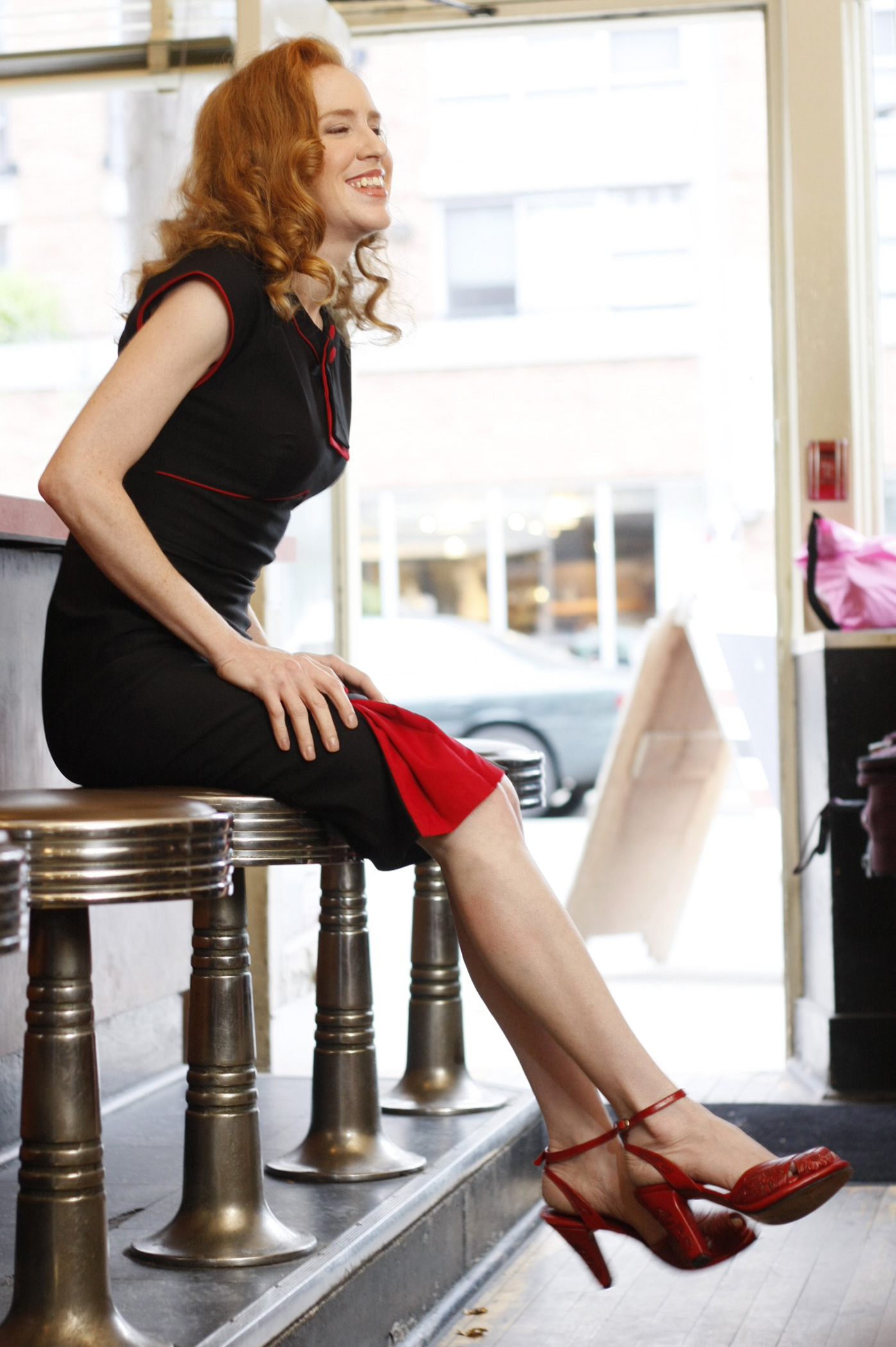
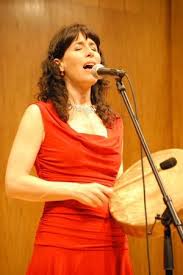

AN INTERVIEW WITH SINGER ALEX PANGMAN, CANADA’S LONG-REIGNING SWEETHEART OF SWING AKA “LA CRÈME DU JAZZ CANADIEN” -WITH A NEW JUSTIN TIME CD RECORDED IN NEW ORLEANS

For many years jazz singer Alex Pangman has been widely respected and praised as an exponent of jazz vocals from the twenties to the forties, a singer with insightful smarts in the idioms of this repertoire and an inherent sense of swing. On the occasion of her new CD, soon to be released, this interview was held in October of 2014.

James Strecker: The Toronto launch of your new CD is November 3rd at Hugh’s Room in Toronto, so please give us the goods on it. What should we know about the music, the musicians and your take on the songs?

Alex Pangman: It’s an album that we recorded in March (2014) in New Orleans, the city where jazz was born! I put myself to the test and took this recording to a new studio, in a new city, with new players (all NOLA musicians) and new producer! I’m happy to say it was a lot of fun, and I think that comes across on the new disc. It’s a relaxed and happy romp through a swinging collection of tin pan alley songs, plus three Canadian compositions, an Original by me, plus I’ll Never Smile Again, and The World Is Waiting For the Sunrise.

JS: I find that some newer jazz singers do their chosen idiom almost as if they’ve learned it by rote. Others seem to embody an idiom as if it is who and what they are. I have always found you to be the latter, that you seem to live and breathe this music naturally. What do you say to that?

AP: I can totally understand why people who sing other genres would be drawn to jazz at some point in their careers: the melodies, the lyrics, the honesty of it eventually appeals to many. I was lucky to discover jazz in my teens, so I steeped myself early before my brain and voice were done forming! Ha ha ha! Honestly, I can’t blame them, but it does irk me when they don’t do it justice. Some people should just not record it, but it doesn’t and won’t stop them from trying! Good will have out.

JS: What exactly is your repertoire in terms of the dates it covers and the songs you do?

AP: I do love to sing music from the 1920s to the early 1940s generally. Those are the years I tend to cover. I mean I love and listen to a lot of music from other eras and countries, but the earnest songs of that period really speak to me.

JS: Who are your, maybe half a dozen, favourite singers and why do you respond to them?

AP: Ella, Valaida Snow, Ethel Waters, Armstrong, Teagarden, Crosby…. only six? I respond to them by actually getting physically excited listening to their albums. But I forgot Boswell, young Kay Starr, Hashaw, Etting, Waller and more! I’m pretty sure my heart beats faster on some of their recordings. I mean excited. These are honest performers who had three minutes to make a record, no overdubs, no special effects, no studio fix ups. They are what they are: magnificent. I miss that feeling in music nowadays.

JS: What orchestras or musicians from the past especially turn you on?

AP: Chick Webb, Artie Shaw, Armstrong, Django all bear repeat listening. All are convincing and strong personalities that each epitomize a moment in music history.

JS: Art Hodes once explained to me how musicians fuel one another and derive great joy from collaborating with others. Tell us what it is like for you as a singer interacting with the musicians in your band? What do you give them and what do they give you?

AP: Energy. A good night on the bandstand is like a ping pong game of energy between members, a conversation using ears and eyes to make art. And it can be a familiar conversation with your own band, or, as in the case of New Orleans, a conversation with musicians I had just met, a first date conversation as it were. But yes, energy.

JS: How is it easy or difficult for you to write a song in your chosen idiom? Any examples?

AP: It can be pretty hard. I get discouraged sometimes, but recently a musician I really admire complimented me on my songwriting and it felt great. You see, Gershwin already said it all, and Irving Berlin, too! I speak in modern parlance which is often hard to reconcile with classic jazz vocabulary -I’m talking lyrics- but it can be done. One of my fave songs, The Fog Song, was written stream of consciousness driving on the highway, lyric and melody caught on a recording device in my lap. Pretty neat to take it off the piano bench and someplace in the field where I didn’t overthink things. It came out well, I think.

JS: One thing I find hard to take is when singers who do a jazz repertoire pull all manner of affectation out of a hat and seem to be playing at being jazz singers. I don’t want to put you on the spot, but what would you say to that?

AP: I have little patience for vocal affectations.

JS: Tell us how you first got hooked on your music and how, over time you developed a relationship with it?

AP: As a teen I turned away from commercial radio, finding it vacuous and uninteresting. Classic country then caught my attention, itself an honest form of music not unlike jazz in its themes and musical dynamics. By my mid teens I had heard jazz by way of a fellow equestrian. Really, it was like love at first listen and a voracious appetite soon developed for this art form. It didn’t have to court me long before I was headlong in love and obsessed with it.

JS: You have recorded with the legendary Bucky Pizzarelli. I’ve always liked his music, so I wonder what that experience was like.

AP: Pretty far out to be in the studio with a legend such as Bucky. He was so open to recording the good tunes on my song list and encouraged me to record an original. He didn’t like to do too many takes, but then, we didn’t really have to. What a pro! It was fully awesome to be speaking a musical language with a gent who’d hung with Zoot and Frank and the lot of ’em. But that’s what jazz is: a common language even strangers can speak.

JS: I once heard you do poignant rendition of Singing Waterfall by Hank Williams and you are married to country band leader-singer Colonel Tom Parker, so how does C&W music fit into your life? Which C&W singers matter to you the most?

AP: Well Hank of course! His heartfelt singing never fails to interest me. Seeing a yellow and black MGM label in a pile of 78s still gets my attention. I am presently the back up singer in Tom’s band, Colonel Tom and the American Pour, who have a record mostly recorded for a spring 2015 release. I love singing high harmonies to him: and it’s fun to be in a supporting role for once. I do get a few feature vocals in the band, drawn from singers such as Loretta Lynn, Dolly, and Connie Smith.

JS: Tell us about your double lung transplant? How did it affect your life and your career?

AP: It gave me back my career! It has improved my voice to where I never cough anymore. Any singer knows the damage a chronic cough can wreak on your voice. So, in many respects the voice never felt better. I could finally make the phrasing, make the sounds I wanted, without interruption from lungs that were on the blink. It’s a lovely thing to be able to breathe.

JS: What do you do now as an advocate for the donation of human organs?

AP: in 2011 I did a lot of press and awareness raising, including radio and TV and news interviews. Being a donor just makes sense. We recycle our old tin cans, why not our bodies. One donor can save up to eight lives and enhance so many more! That awareness campaign took a backseat when my health began to decline again in 2012 and 2013 to the point where I was listed for a second double lung transplant. I was shy about needing a re-transplant, and I was still working, so I didn’t want sympathy. A successful re-transplant in August 2013 really saved my life — again. It dovetails very nicely with the title of the album we are now launching -“new” -during which press push I plan to remind the world again about being a donor, and talking to your family about your wishes.

JS: Please fill us in about your past CD’s of which you have half a dozen? What do you like about them and what would you change?

AP: That’s a lot of CDs! Each disc from my first to my most recent marks a chapter in my life. My first two albums I was so naive and just learning about love. Then I find my own confidence and learn some of life’s cruel lessons and then I think the albums really start to get interesting. The last few albums have been fairly celebratory. I don’t know that I’d change anything per se because that would be like re-writing history. I did the best I could with each disc. I think I continue to grow, and growth is important to me and why I push myself to try new things, like travel to the USA to make a disc this time!

JS: You’re a horse person and I would love to know about your relationship with horses.

AP: Horses are my “happy place” in life. They make me smile when skies are grey, as it were. It’s where I get my confidence, my relaxation, my exercise. It is through horses that I was introduced to jazz -the riding coach loved jazz- and that really shaped my world. Eventually music led me to my husband, too, so I owe it ALL to horses.

JS: You do a monthly gig at the Reservoir Lounge in Toronto. What other future gigs and recordings have you for us to look forward to?

AP: Right now my future gig is the three album launches planned: November 3 at Toronto’s Hugh’s Room, November 7 at Montreal’s Upstairs, and November 9 in London, Ontario at Aeolian. As for next recording projects, I’m not too sure: Immediately, but I’ll be putting harmony vocals down on my husband’s country album. My information is at http://www.alexpangman.com

Posted in Interviews from Music, Uncategorized | Tagged , , , , , | Leave a comment

WHAT DOES IT MEAN TO ‘ACT LIKE A MAN?’

My article “What does it mean to ‘act like a man?'” first appeared in the Hamilton Spectator in the spring of 2014 in a shorter version. The subject is very relevant to both creators and audiences in all the arts, so here now is the complete text of the original.

“I’m glad you got yourself a man’s hat,” he said, deepening his voice into a growl on the crucial word “man’s”. It was odd to hear any such reference to masculinity from one widely considered the resident sycophant of the college where I worked at the time. Odder still was the cause of his outburst. I was wearing a new fedora in lieu of my usual beret, the latter being the traditional chapeau of choice among countless Frenchmen, Spaniards, and the military of many lands. What I heard, without question, was an unworldly individual very hung up about his manhood.

So what is a man? Is he the central-European husband of a neighbour who dropped in one day when I was a kid? Her eyes were puffed up, her arms blue with bruises, and her explanation was this: “A man who doesn’t beat his wife is not a man.” Is he the career-driven and wealthy executive I know who doesn’t bother to support or even communicate with his mentally underdeveloped son, perhaps because his son isn’t the man his father needs him to be?

Is he the persona created by Don Cherry, a man once seriously nominated as the “Greatest Canadian” in a poll later won by the very un-macho, articulate, and far more gutsy Tommy Douglas? We all know of Cherry’s demeaning, prejudicial, talk-tough non sequiturs that shield him from thought and contradiction. Is one of his many approving fans an acquaintance I call “the king of the sucker punchers” because he inevitably makes disparaging cracks about others and just as inevitably flees from the room before one can take him on? For that matter, is man the gang rapist who is encouraged by his culture to terrify, abuse and murder women? Is he one of the Ontario gang who raped a friend and, when finished, tossed her on someone’s lawn afterwards?

Can it be that a current version of man is actually a reversion to a more primitive state, one that is free of social obligation, rational thought, humility, subtlety, dignity, responsibility, or class? Is he one who gloats in being unreachable and immune to social standards of value and behavior, one who follows his own course and –free at last!- doesn’t have to do what he is told, even by a larger population to whom he is responsible? Do I hear the name Rob Ford, a man with a fan base of both men and, indeed, women?

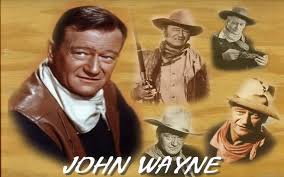
Cultural observers note more and more how we live in a trying time for men. If the quintessential cowboy, John Wayne, was once the annual favorite male movie star, this icon of the strong silent type is no longer the ideal. It is now acknowledged that indigenous peoples were long cheated, humiliated, and murdered by the man with a gun and some of us finally call this not history but genocide. Bison were wantonly slaughtered to near extinction, for no reason, by men of the west once held up as heroes. Nowadays it’s a glaring irony that hunters, armed with high tech weapons, call their killing sport when, of course, their foe have no guns of their own to fight back. But some guys just like it that way.

Still, if the icon of the cowboy is kaput, the Stetson remains ubiquitous in Nashville, Calgary, and even on Stephen Harper’s head. However, although the leader of the Conservatives likes to play with guns, held by someone else, of course, and build prisons for those he deems bad guys, he certainly doesn’t embody the cowboy myth. He doesn’t face his rival, man to man in the dusty street at high noon, but, instead, prorogues the dual. He may talk tough on the international scene, but at home he hides himself in secrecy. Stetson or not, he doesn’t talk straight, and the folks in his town look over their shoulders when they speak his name.

At a reading, I once offered my short poem with the title A Mother Prays for her Son, a quip really, which goes like this: “Dare be strong enough not to become an ass”. A woman in the audience later gave me hell for being so down on myself as a man and, although she hadn’t considered that the poem could well apply to women too, she was right in a way. Like many, I am constantly troubled by the patriarchal stupidity, the uncontrolled cruelty, the smug smallness of spirit that emerges from some fellow men. It’s ironic that some men can frequent coming of age films but never grow up.

At the same time, however, I profoundly respect the everyday courage of men who make a dignified life for themselves and, in many cases, support families, albeit by working decades in spirit-numbing jobs. They are unspectacular and sometimes flawed human beings who know they don’t really matter to our system, know they’ll one day be discarded like garbage, but they still try to be decent and fair to others and, if lucky, to themselves.

A friend once remarked, “My wife always says I should open up, but when I do she doesn’t want me to have the feelings I have.” When I once remarked to another friend that “We all have problems” he, in turn, retorted, “Not me, buddy.” Obviously he had decided to “act like a man”, ironically in this time when men are supposedly becoming extinct. He did not want to reveal vulnerability to anyone, man or woman. Perhaps this attempt at self-preservation made sense, especially when I remembered that four people I once knew who were nastiest to women were women themselves, indeed articulate feminists.

But we are aware, of course, that women are confined to roles they play not only by men, certainly, but also by their cultures and by themselves. And what of the recent London Sunday Times article titled “Housewives happy to kill for Hitler” that noted “A new history of the Holocaust reveals that the supposedly weaker, kinder sex were just as capable of casual acts of horror?” The article made no note whether each killer from the feminine side was wearing a man’s hat or a woman’s.

Of course, none of this will matter when the earth speaks back to us with drought, floods, storms, hunger, disease and other ecological disasters that we brought upon ourselves and which we can no longer deny are imminent. And all because we were not man, or woman, enough to look into the mirror and admit how great the damage is that we continue to do, in part because of how insignificant we are.

“James Strecker of Hamilton is a writer, poet, consultant in human development and in Creativity, and author or editor of many books.”

Posted in articles by james strecker, Uncategorized | Leave a comment

ONE OF A KIND EN DEUX LANGUES: AN INTERVIEW WITH SINGER, SONGWRITER, BROADCASTER, PLAYWRIGHT MARIE-LYNN HAMMOND

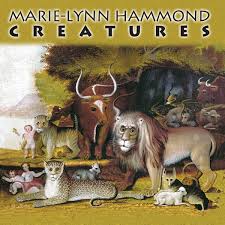
Not long ago, singer Marie-Lynn Hammond released not one but two CDs -Creatures, reviewed previously in this blog with highest praise, and Hoofbeats- both after a devastating accident. Upcoming soon are several gigs in Southern Ontario and Quebec. This interview took place on the singer’s 66th birthday on August 31, 2014. It comes in two parts below.

Part One

James Strecker: While listening to The Reluctant Angel on Creatures, I was moved by the artistry and grace with which you sing of your dead sister. I know from experience how difficult it is to write about such loss, so how did you manage going through the creation of the song and what is it like performing it?

Marie-Lynn Hammond: Actually, it’s not specifically about Denise, though it is inspired by losing her when she was only 47. Here’s what I wrote about “The Reluctant Angel” for the liner notes of Creatures: “This song began as some lyric ideas about two years after my sister died, but at the time I didn’t have the heart to complete it, and filed it away so well I forgot about it. When I found the file ten years later, I was surprised when I got to the last part—I hadn’t remembered where the story was going. I think I must have been influenced by Wim Wenders’ beautiful film, Wings of Desire.”

So the distance of a decade helped; my grief wasn’t so immediate when I completed the song. And the narrator in the song feels like someone I sort of channelled—a distinct character with a distinct voice, though not my sister. They share a premature death in common, but Denise knew she had terminal cancer and so was able to prepare for her death, inasmuch as one can. Whereas the narrator in Reluctant Angel is struggling because her death was sudden and totally unexpected.

I’ve only ever performed The Reluctant Angel twice live so far because I don’t perform much anymore. But, to be honest, another song about losing Denise called “Omaha,” from my 2003 CD Pegasus, is a much harder song to sing. I wrote it soon after Denise died, when I was beyond devastated, and everything it recounts actually happened to me, so it’s far more personal. But people are telling me they are blown away by “Angel.” I think that’s in part because of the arrangement on the CD and Marilyn Lerner’s inspired piano playing, but also because it deals with universal themes from an unusual perspective.

Well, I hope you weren’t expecting a short answer!

JS: Please tell us as much as you wish. Now the purity of spirit and unaffected vocal beauty in your singing of this poetic gem is deeply moving. On the other hand, it nowadays seems de rigueur in music one hears to go with affectation, simple-minded attitude, superficiality, cliché and unsophisticated technique in both song and performance. So, with your obviously high creative standards, do you feel out of place in this context?

MLH: I have no choice about the way I sing. My voice is, technically, an extremely limited instrument. I don’t have much power or a big range, and I lack a normal vibrato. I sing more or less plainly, but with emotion, because it’s all I can do!

As a result, I write to suit and compensate for my voice, to distract from its limitations. I write stories with plots, I try to incorporate moving or powerful imagery, or, in some songs, humour. I know many of my songs can be demanding of the listener, and I know they’re not for everyone. But I don’t think much about what other people are doing. There’s no point wondering why Miley Cyrus is probably a millionaire by now, whereas I’m hovering around the poverty line. That way madness lies! I’m just happy to know that my music touches certain people.

JS: How do you manage to create lyrics that are both, at one time, poetic and literate? Is it difficult? How long does a song take?

MLH: Thanks for the compliment—from a poet, that’s fine praise. I don’t know how I do it. I’ve always loved words and savoured them for their evocative powers, their nuances. I wrote my first poem at age five—dictated it to my mother. 

Sometimes I’ve wished I could write more abstractly, more vaguely and mysteriously, so that listeners would ponder what the heck I meant by any given phrase. But that’s just not me, I guess. I like to tell stories with beginnings, middles, and ends, though not every song on Creatures is like that. So that structure dictates a certain amount of clarity. And then I want to make my listeners see, hear, taste, feel; I want to take them through a range of emotions. And that dictates poetic, and often concrete, imagery.

As for how long a song takes to write, it varies, but I’m generally a slow writer. I laugh when I hear songwriters say, “It took me three whole days to write this tune!” I’ve rarely taken less than three weeks, or even three months, to write a song. I craft and tinker and edit. Factual story songs, like “Children of Peace” about a breakaway Quaker sect that built the Sharon Temple in the early 1800s , can take a year or more, because of doing the research, and then looking for the way into the story—who’s telling it and why? And it can be a real pain trying to cram a complex story into five minutes or so, AND make each line rhyme perfectly!

Exact rhymes in songs are a minor obsession of mine. I don’t always succeed, but I try. And yet, other than in classic music theatre, no one seems to care any more about perfect rhymes. Sad, that. I think it’s part of the musicality of songs, those little sound echoes. Of course sometimes I eschew them completely, as in “Electric Green.” about The Oak Ridges Moraine. I knew I wanted the song to mention rare or endangered species in that area, and that rhyming little bluestem or Blanding’s turtle was going to be near impossible.

JS: Your love of animals and of the earth resonate deeply in your songs, so could you explain somehow this profound and a very personal connection?

MLH: I can’t really explain it. It’s always been there, since I was a tiny child. I came to consciousness around the family dog and, since I was an only child for almost four years, he was like a sibling to me. Then I met my first horse when I was three or four, and I was a goner. Cats came much later, but horses and cats became my totem animals, my yin and yang, prey and predator, forcing me to deal with those inherent contradictions.

Then, when I was eleven, we started spending summers at Lac Simon in Quebec. I spent long days roaming the woods and meadows and shoreline, and nature became both an adventure and an escape from my dysfunctional family life.

When my sister Denise was dying, and in the months after her death, my only break from thinking about her or from going mad with grief came when I was riding a horse or doing cat rescue work, especially working with feral cats and kittens. In those situations, you have to be very present and in the moment, because that’s where animals live. On a horse, you have to be relaxed yet aware: what is the horse paying attention to? Is it going to spook because there’s a coyote up ahead? With a feral cat/kitten, you need to sense where it’s at: how fearful is it? Will it just huddle in a ball, or will it bite or lash out? You kind of mind-meld with it, and from there work on gaining its trust. When you get that first purr, it’s magic. Being in the moment with animals is like a combination of psychotherapy and Zen.

JS: Several of your songs on Creatures show another profound connection –to Canadian history and to people who have lived it. Please tell us more. Are you thus inclined because you are French-Canadian? Because you are a feminist?

MLH: I am a feminist, yes, but that’s kind of separate from, or maybe parallel to, my cultural nationalism—although I’m sure I wasn’t the only feminist back in the day who thought that Canada’s relationship to the USA was like that of women to the patriarchy—and we know who’s always been screwed in that relationship.

I guess my interest in Canadian history and culture began when Bob Bossin and I started Stringband in the early 70s. Canadian cultural nationalism was in bloom then; many writers, poets, musicians and filmmakers were trying to articulate what it meant to be Canadian—as opposed to being a British colony or an American cultural colony. So we consciously decided to write about Canadian themes.

And yes, since I’m half Anglo and half French Canadian (well, three-eighths, with one eighth Abenaki in the mix), I felt like a human microcosm of Canada and wanted to express both sides of me.

Our first album was called Canadian Sunset, and I have a song on it called “Vancouver” and another one that mentions the Ottawa River and “Sunday mornings in a small Quebec town.” This was fairly revolutionary at the time, to mention Canadian things in songs. Other than Ian & Sylvia and Gordon Lightfoot, no one was really doing it. And the first song I ever wrote in French is on that album. Bob Bossin’s penned some great tunes with real Cancon too: “Dief Is the Chief,” “Maple Leaf Dog,” and lots more.

So Creatures includes four Canadian-history-themed songs, if you include “Electric Green” -a history of the Oak Ridges Moraine, but also an environmental cri de Coeur- to bring attention to these amazing stories that many Canadians are unaware of.

JS: You have written songs with a wry and satirical edge on issues especially relevant to the lives of women in our patriarchal culture. What were these issues you addressed and, knowing what women must endure, how do you manage to go the route of wryness and not anger? If you were to do a new CD of topical songs, what issues or people of any kind would you address?

MLH: Let’s see: with my tongue in my cheek, I’ve addressed menopause, birth control, menstruation and reusable menstrual pads in “Period Piece,” men and housework, younger men and older women and vice versa, women and the Catholic Church in “Leave Room for the Holy Ghost,” the preference for boy children over girls, and more. I think humour is a great way to treat these issues, because it gets you further than anger does—at least with the males in the audience. And people who are laughing have a harder time being defensive.

I’ve also written a couple of non-satirical songs that celebrate female friendship, and some serious songs that touch on women’s issues in the context of other themes. For example, “Flying/Spring of ’44” is told by the wife of a WWII pilot who returns home a broken man and an alcoholic, so we get a glimpse of how that war affected women even if they did not see combat, as some do now.

And I’ve written a song, “Sixth Day of December” which is not on any of my albums, for the women killed in the Montreal Massacre. Even in these cases, I tend to avoid direct anger, or at least I avoid blaming, unless it’s appropriate to the narrator. Punk bands do a good job of being raw and angry in music, but I’d just sound silly if I tried to do that. I prefer to tell stories with a believable narrator, as in “Flying,” or to write something more elegiac, as in the case of the December 6th song.

If I were to write some new topical songs, I’d like to take on factory farming, but it’s hard to be funny or satirical about the suffering of billions of animals. Instead I’m working on a song about Esther the Wonder Pig, because that’s a good-news story about a rescued pig who’s changing a lot of lives. And I’m currently repurposing a song I wrote about former premier Mike Harris to discuss Herr Harper and how he’s wrecking Canada. Stay tuned!

JS: The production on Creatures shows discerning insight into how to make each cut musically seductive and aurally appealing, so please tell us about the many smarts that went into producing the actual musical sounds of your CD.

MLH: Well, my producer, David Woodhead, is a near musical genius—that helps.  He always has great ideas for arrangements, and unlike me, he knows theory and reads and writes music. But it wasn’t as if he was always imposing his concepts on my songs; if I had an idea, he’d be game to try it out.

We’ve done three albums together now, so he’s gotten very good at translating my often clumsy notions (“Hey David, I’m thinking something sort of chukka-chukka, like a Telecaster with the strings muted—or maybe on synth—know what I mean?!”) into actual musical sounds. Also, he plays any number of instruments really well, so he’d pick up, say, the mandolin and play along to the song; then he’d try out a high-strung guitar or a lap steel or whatever, and we’d keep going till we found what worked.

For me, it’s about showcasing the lyrics and the stories as opposed to flashy playing or effects for their own sake, and David gets that. We always look for that magical sound or note that will enhance or elevate or express emotion. It helps too that David plays beautifully, and with feeling—you can hear him on every cut on the CDs.

I also have to credit my long-time accompanist Tom Leighton, in particular for his huge musical contributions to “Children of Peace.” He played piano and did the band arrangement on that track. And for “Newfoundland Pony” he wrote an original jig that weaves in and out of the tune, and he plays accordion, piano, and bodhran on it.

JS: We should say something about that horrible accident you had and your recovery. Tell us about both.

MLH: In August 2006, my usually quiet horse, Beau, suddenly and inexplicably began to buck—most likely because of a wasp sting. I was thrown and knocked unconscious and sustained various broken bones and concussion, bleeding in the brain, and damage to one of the cranial nerves connected to my right eye. Long story short, I now have a permanent visual disability: I see double whenever I move my head or eyes, which affects my balance.

Sadly, I had to sell my horse, because for a long while we didn’t know what my prognosis was. And I couldn’t work after the accident, so I couldn’t afford to pay his bills. But my Stringband partner Bob Bossin organized two sold-out benefit concerts for me, and I was incredibly touched at the number of musicians who volunteered to perform and number of friends and fans who attended. The money raised allowed me to convalesce for over a year and pay for alternative treatments not covered by OHIP.

Eight years later, I’ve learned to work around the disability to a fair extent, though some things I don’t do anymore, like ride a bike, because of my balance problems. But I started riding horses again less than a year after the accident at a facility that accommodates people with disabilities. Horses are far more stable than bikes, because they have a leg in each corner—that is, until they get stung by wasps. And I’m still riding—very carefully of course!—because I can’t stay away from horses.

Part Two

JS: Since I haven’t played my copy of your CD HoofBeats yet, would you set us up on what to look for in the songs and also tell us about the background of the songs and what they mean to you.

MLH: The album is a celebration of horses of all kinds: wild horses, heavy horses, rescued horses, war horses, even mythical horses -one song is about Pegasus- and some specific breeds, like the Quarter Horse, the rare cheval canadien, or Canadian horse -Canada’s national breed, but lots of people don’t know about it!- and the endangered Newfoundland Pony. There’s also a funny song called “The Naughtiest Pony,” which most pony owners can relate to, because ponies are often very naughty!

A friend pointed out that while most of the songs on Creatures deal with loss of various kinds, the songs on HoofBeats tend to be positive, or at least uplifting—even the ones with slightly darker themes. HoofBeats and Creatures actually have two songs in common: “Emily Flies”—about a girl with disabilities and the rescue horse she rides in a therapeutic program; and “Newfoundland Pony”—about the only pony breed, now severely endangered, to have evolved in Canada. And both those songs are, I think, a mix of dark and light. I’ve also been told by people who are not especially horse folk that they love HoofBeats for the stories, the melodies, and that positivity.

JS: Do you miss being part of a folk duo, as you once were, and doing cool things like touring in Russia during unthawed times and doing records and gigs? Do you often think back?

MLH: Stringband was actually a trio to start—the fiddler was a big part of the band—and then we added a bass player and became a quartet. I miss the fun of working out arrangements with my bandmates and creating that fuller band sound.

And Stringband did get some great gigs in its heyday: we toured the Arctic, we played a world’s fair in Japan, we toured Mexico for the Canadian embassy there, and yes, we spent a month performing in the former USSR in 1983. But I’m not sure I miss being the only woman touring with three guys and a male soundman! When I used to have bad menstrual cramps an hour before going on stage, I got NO sympathy.

Stringband does still get together every decade or so for a few gigs, so that’s been fun. Especially now that menstrual cramps are a thing of the past. 

And in my parallel solo career I’ve usually performed with a pianist/keyboardist and sometimes bass too, so I’ve been able to employ a richer, fuller sound that way. I love piano, but I can’t play it, despite two years of lessons as an adult. In my next life I’ll get piano lessons as a kid. I’m probably the only middle-class child in North America who didn’t.

JS: What’s the hardest thing about writing a song? Is it easier in French or in English?

MLH: To me the hardest thing about writing a song is waiting for the muse to strike. I get lots of intellectual ideas for songs, but until I feel that mysterious, inspirational, emotional connection to a subject, I know it’s not going to work. And my muse must be a lazy creature, because she doesn’t strike that often. Which is why I tend to do only one or two albums per decade. And also because I’m picky—I try to write about things I haven’t heard others write songs about, or to write about ordinary topics in an unordinary way. Which means I discard a lot of ideas.

As for language, it’s far easier in English, because although I spoke French first, English quickly took over as my primary tongue. When I was growing up we spoke way more English at home and we moved a lot, mostly to English-speaking communities—all due to my military Anglophone father. So all my schooling was in English. But I often collaborate with a terrific French poet, Paul Savoie. He gives me lyrics, I sometimes do a little editing, and then I set his beautiful words to music. “Le Cheval Sauvage,” on Creatures, is one of our collaborations, and another environmental cri de coeur.

JS: Tell us about writing plays. How does being a playwright affect how you write your songs and how you sing them?

MLH: I think of my playwriting career as just one phase in my storytelling life. I became a playwright because some of the things I wanted to write were too long and complex to fit into the song format. I wrote only four plays (one was very short, for a ten-minute-play festival), though they were all professionally produced—one of them several times.

And then I just stopped, because I didn’t get any strong story ideas that needed to be a play. At that point I began working on a story that wanted to be a novel. But I abandoned it after my parents died eight weeks apart and my sister was diagnosed four weeks later with terminal cancer. She died 17 months later. As you can imagine, that was not a time conducive to creativity. It took years before I even wrote another song.

I’m not sure my time in the theatre affected the writing of my songs, but it did affect my performance. I played myself in my first play, which featured the contrasting and dramatic stories of my French grandmother and my English one. But I gave myself only songs to sing, no spoken lines, because I’m actually at heart rather shy and I felt self-conscious whenever I tried to “act.” However, I learned stagecraft during those runs, and watching the terrific actors who played my grandmothers helped me to really inhabit my songs, especially if I’d written a narrator into them. And being in theatre helped me better shape my concert performances in terms of presentation and pacing, for example. I make more eye contact with my audience, I try to keep the show moving, I build each set to a climax, things like that.

JS: You’re so bloody versatile. Tell us now what it was like having a national broadcast on CBC radio. What did you like about doing radio and what do think of radio today?

MLH: I loved doing radio. I sort of fell into it, and CBC gave me very little training, so I learned on the fly. In those days (1987-91), shows were actually more scripted, I think, than some of them are today, so I probably had less freedom when interviewing guests than some hosts have today. Bigger budgets allowed for more staff and producers, and every one had their own little area they wanted to shape a certain way, so I had less input and less hands-on control than hosts probably do now.

But I loved the magic that often happened on the second show I hosted, Musical Friends, which was built around my skills and my experience as a musician. A format we used a lot involved inviting three musicians with something in common, e.g., a classical guitarist, a jazz guitarist, and an acoustic finger-style guitarist. The three would never have met or played together before, but if my producers and I got the mix right, they’d not only answer my interview questions individually, they’d talk to one another, compare notes, and joke around. And at the end they’d actually transcend their genres and play a tune together! I still have people come up to me today and tell me how much they loved that show and miss it.

I also loved being able to showcase great Canadian talent that had never had a national radio airing before. Our show was about 95% Canadian content.

As for radio today, well, that’s a huge topic and I am SO not an expert! There are thousands of stations available on the Web, for one thing—who’s got the time? I’m an inveterate CBC listener, and I’m sad to hear the decline in quality, especially on CBC Radio 2. Some days I find myself switching over to CIUT.

It’s not that I miss all the classical programming; I enjoy classical, but it’s not my favourite genre. It’s other things that bug me, besides the ads, of course, so blame Harper and his Cons for budget cutbacks. I find that on the non-specialized music shows, they have their musical darlings and don’t stray very far from a narrow range of indie pop/roots stuff. You can hear the same damn song every damn day on different shows if you listen a lot. An exception is Laurie Brown’s The Signal, which plays more varied and adventurous music. The Radio 2 Top 20 show is just dumb, and here’s my CBC sour grapes gripe: you rarely hear the network play anyone over 40 who isn’t a rock ’n’ roller. And now I’m going to shut up.

JS: You’re also a professional editor. Is it true that writing is in the editing? What are the problems that writers tend to have that you must remedy as you edit? Minette Walters once told me that being an editor had had a positive effect on her own writing and I wonder if that is the case with you.

MLH: Is writing in the editing? Good editing is of course invisible; you don’t see what the editor fixed or took out. Good editing really can help make good writing better. But the writing talent has to be there to start. You can’t make a silk purse out of a sow’s ear.

As for the problems I deal with when I edit other people’s writing? Self-publishing is so easy now that everyone’s writing a book and wants to see it in print, often before it’s ready. With fiction I see weak story structure, weak plot, weak characterization, bad dialogue, too much flowery description, not enough description, overwritten prose. Novice writers often can’t help using three or four adjectives where one, or even none, will do, and more.

Yes, I’d say that learning how to edit has definitely helped my own writing. Apart from the playwriting, I’ve mostly written nonfiction for magazines, though I may be embarking on a collaborative project that involves fiction; that’s all I can say about it for now. But it’s also hard to be objective. You really need an outside set of eyes on your own work. And sometimes being an editor can induce paralysis in the writer part of me. I’ll agonize over the syntax of a simple sentence and consult endless style guides, when I should just move on and keep writing.

JS: Some easy penultimate sectioned questions: Who are you? What made you the person you are? What are your deepest beliefs? How hopeful are you about yourself and about the world?

MLH: “Easy”? I believe you’re being ironic, James! I think in the rest of this interview I’ve suggested a number of factors that answer those questions, but here’s my “easy” answer: who I am can be found in my songs and song lyrics, my plays, and articles, many of which are available on my website. My CD Pegasus, BTW, is also a CD-ROM, and I believe the text of my first play, the one about my grandmothers, Beaux Gestes & Beautiful Deeds, is included. That play is also published in the anthology Canadian Mosaic II. So there!

As for how hopeful I am about the world—not very. I just hope I’m dead before the last tiger or elephant in the wild becomes extinct. I don’t want to live to see that.

JS: And of what value are the arts in our world?

MLH: Oh, that’s a huge one too. And it also depends on how you define the arts. Is what Katy Perry does art? I don’t know. But she’s clearly “valued”—in both senses of that word—far more highly than you or I.

In general, I wish the arts were considered of greater value than they are, at least here in Canada. I have a musician friend in Denmark who told me that the musicians’ union there is a real union. I think you have to have a certain skill level to join, but once you’re in, they take care of you really well. I believe he was getting a kind of unemployment insurance at one point when he wasn’t gigging much. If we valued our artists properly, the term “starving artist” wouldn’t exist. Maybe it helps to suffer for your art, but geez, there’s a limit!

Anyway, I think a world without art would be a poor, dull, boring place. Whether art is “high” or “low,” it has the power to move, inspire, comfort, delight, amuse, enlighten, challenge, transport, and more. It can bring about minor epiphanies and it can fuel major revolutions. It can help humans escape, if only temporarily, whatever personal or societal hell they may be experiencing at a given moment. It can also make them face truths that might be unpalatable in another form. The ability to create art is one of the good things about the human animal; it helps in part to compensate for the human animal’s other ability to do unspeakable things to its fellow humans and fellow animals and to the planet it inhabits.

Now isn’t that a cheery note for me to end on?! And, yes, forget what your grade 9 teacher told you: it’s perfectly fine to end a sentence with a preposition.

JS: Okay, how can people buy copies of your CDs and find out about your gigs? Where should they go to?

MLH: Go to my website, please. http://marielynnhammond.com/ More than you ever wanted to know about me can be found there, CDs can be ordered, and you can sign up on the Connect page for my newsletter, which goes out once in a blue moon, because a) like many artists I’m a terrible self-promoter, and so it will not clog your inbox; and b) I only perform once in a blue moon.

That said, I have three rare gigs coming up—listed on my homepage—in Cobourg, Morin Heights, and near Perth, and maybe a couple more in early November and early December that will get listed eventually. Catch me soon, though, because I’m calling these gigs my [First] Farewell Tour!

Posted in Interviews from Music, Uncategorized | Tagged , , , , , | Leave a comment

THE PHILADELPHIA STORY: MOYA O’CONNELL CLAIMS TRACY LORD AS HER OWN

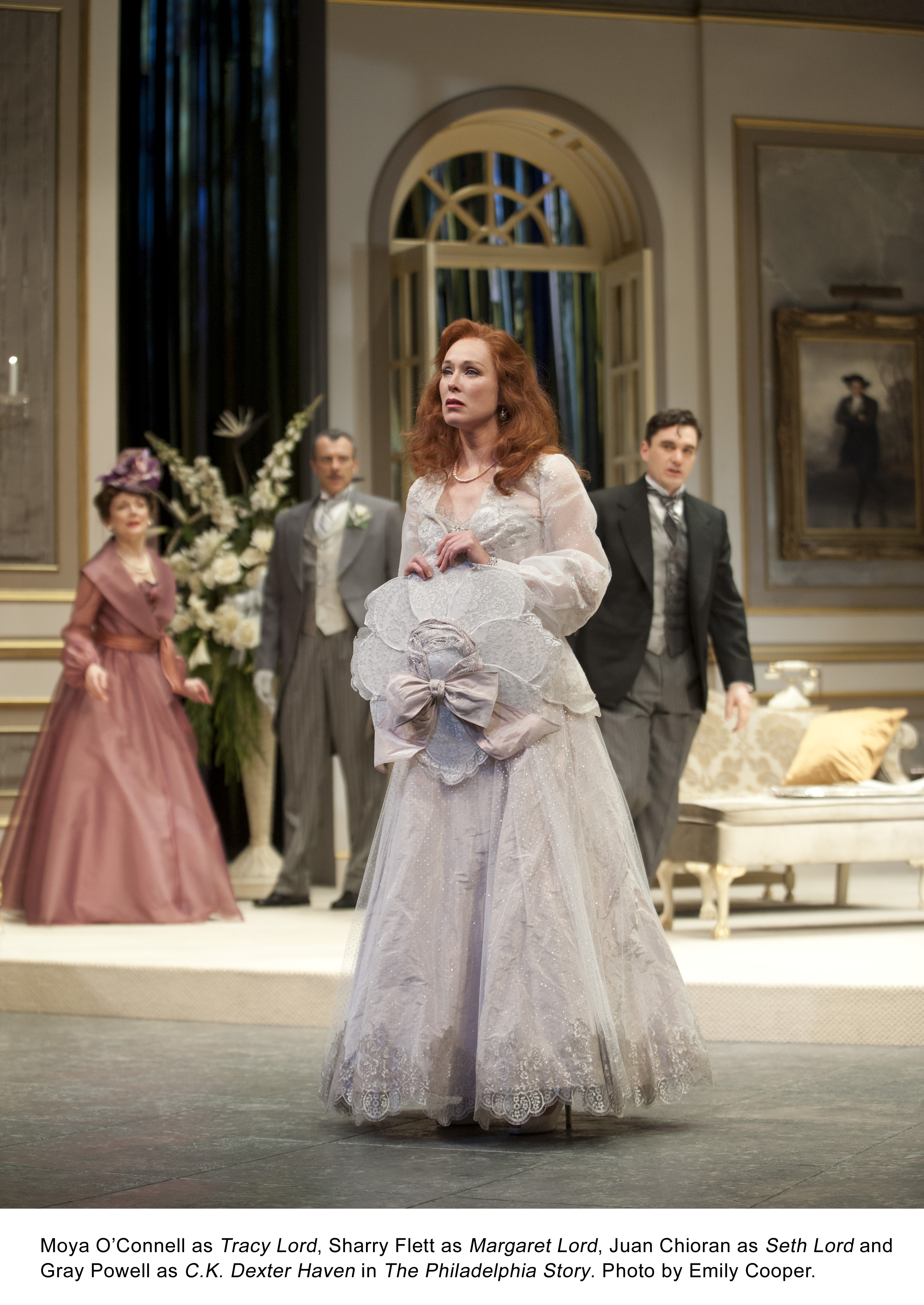
On the day of Tracy Lord’s second shot at marriage, we have a diverse bunch of mostly upper crust folks before us. Little sister Dinah is played bubbly with existence and prone to mispronunciation, in her saddle shoes, by Tess Benger. Sharry Flett’s Margaret, the mom, seems openly human but obviously secure in place like the splendid furniture about her. Brother Sandy via Jeff Meadows displays an appealing serious levity. Ric Reid’s Uncle Willie is slightly rough- edged and ever ready to pinch a young lady’s bottom. Juan Chioran’s father Seth maintains a somewhat regal air of remote caring.

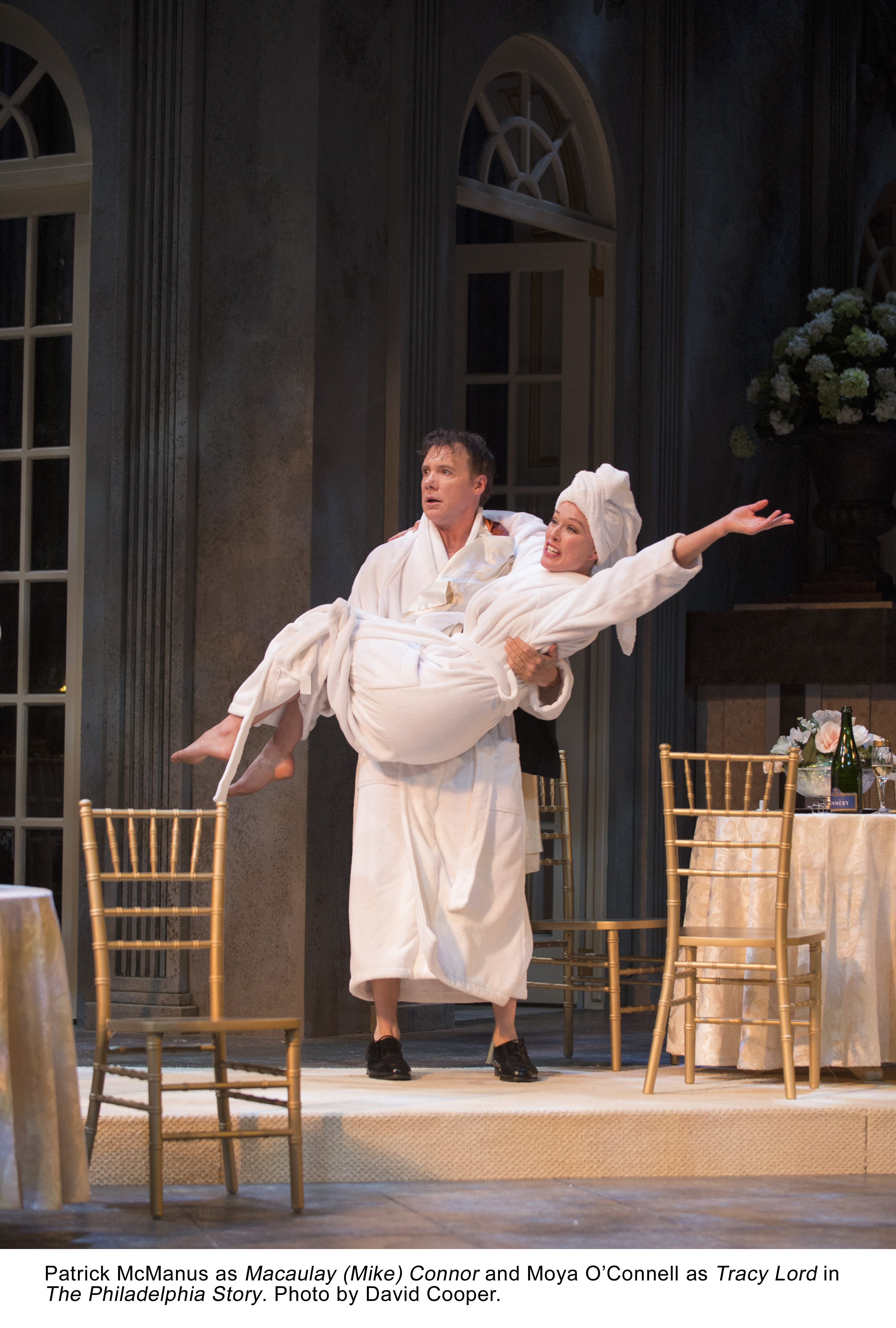
Enter husband-intended, Thom Marriott’s George, tall and tightly judgmental and given to huffy indignation, and then former husband Dexter, played by Gray Powell with an edgy charm that bites with bitterness. Enter Fiona Byrne’s Liz, who is cute and sexy with impending feminine savoir faire, and Patrick McManus as the almost cynical reporter Mike, a man of compellingly ambiguous passions that could find several outlets –social or female.

If the central role of Tracy Lord was intended as a career-saving vehicle for Kathrine Hepburn, Moya O’Connell here makes it distinctly and poignantly her own. This Tracy is a feeling creature who, though remote in privilege, reveals a frenzied vulnerability that speaks with big gestures and sends her inner emptiness in all directions. At first she seems a big, bright and somewhat artificial presence who almost has feelings, and is described by Mike as a “young, rich, rapacious American female.” This being the tail end of the depression, he also asks, “What right has a girl like Tracy Lord to exist?”

O’Connell certainly combines a dynamic and delicious delivery that is ripe with comic punch, but she also makes Tracy a personal creation. We sense an implied inner pain that will either explode or consume itself—remember O’Connell’s Hedda Gabbler of a few years ago? It’s hard to play an empty, self-centered individual who holds our sympathy, but as Tracy to us becomes a victim of inner futility who parades her superficial unrealized self about aimlessly, we watch her every move and, for some reason, care.

This is a relaxed world of people who live in shallowness –okay, think Kardashian, but with style. William Schmuck’s big, elegant, sturdy, grand set at first seems too broad an expanse for a play that explores inner turmoil and intimate relationships, but as we observe this almost undisturbable society, one that almost floats in privilege, we realize that its inhabitants seem to casually own even air and space around them as their exclusive property. This production, ably directed by Dennis Garnhum to create a sense of implicit restraint, an underpinning of humanity, and several shades of comedy, at times almost glides by.

These folks seem anchorless in a world of normal human values as they deny themselves feelings and never get dirty. Like Tracy, they exist in a grand expanse of their own reflection and they get lost in it. They don’t seem to breathe, they can’t be themselves, and when Tracy bursts, as free as she can be, we feel a long-contained sob in her now become laughter. We join in, although, thanks to O’Connell’s power of playing inner emotional turf in an ambiguous manner, we are not quite sure who she is or will be.

Posted in shaw festival, Uncategorized | Tagged , , , , | Leave a comment

A POIGNANT AND FINELY MODULATED JUNO AND THE PAYCOCK AT THE SHAW FESTIVAL

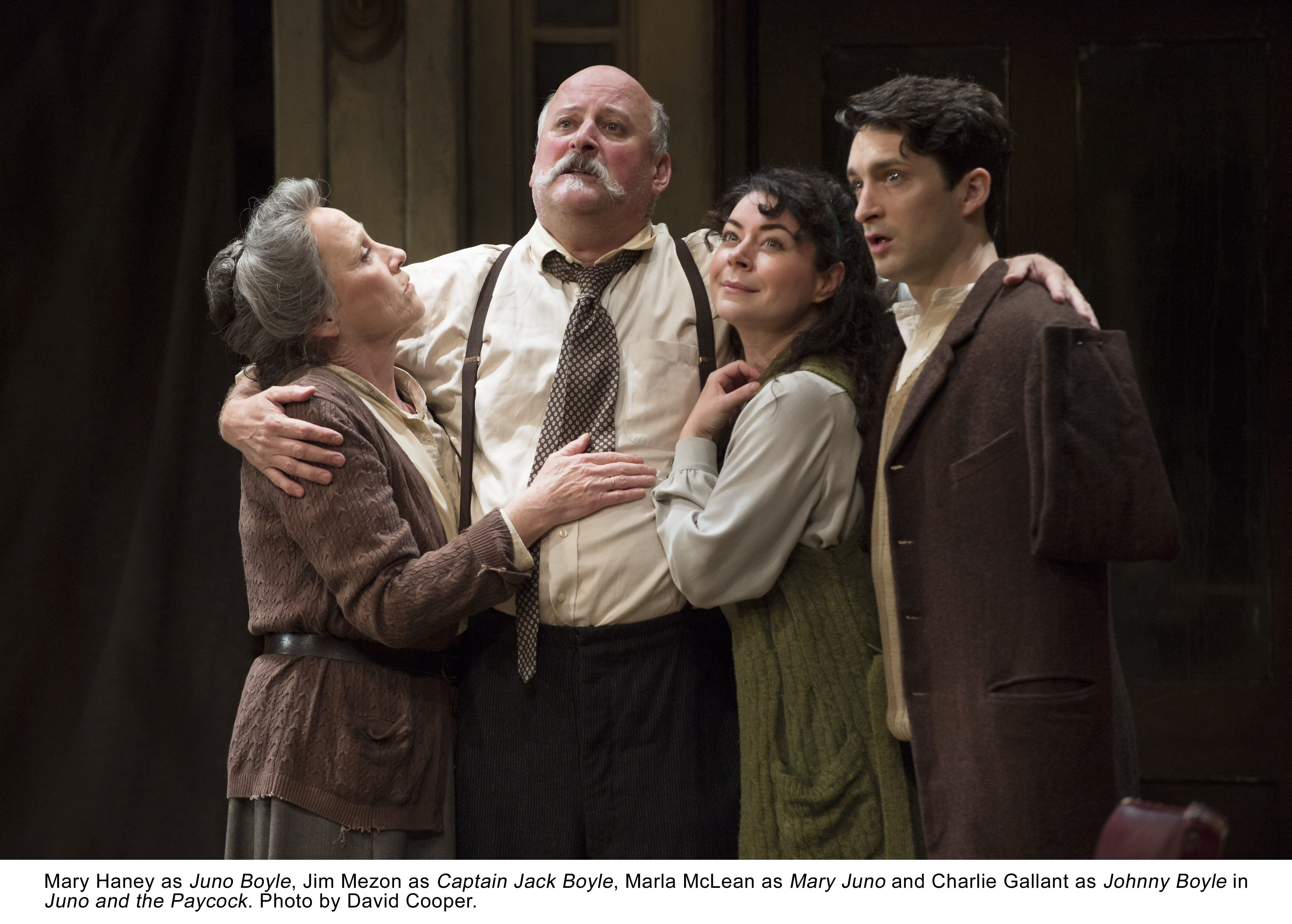
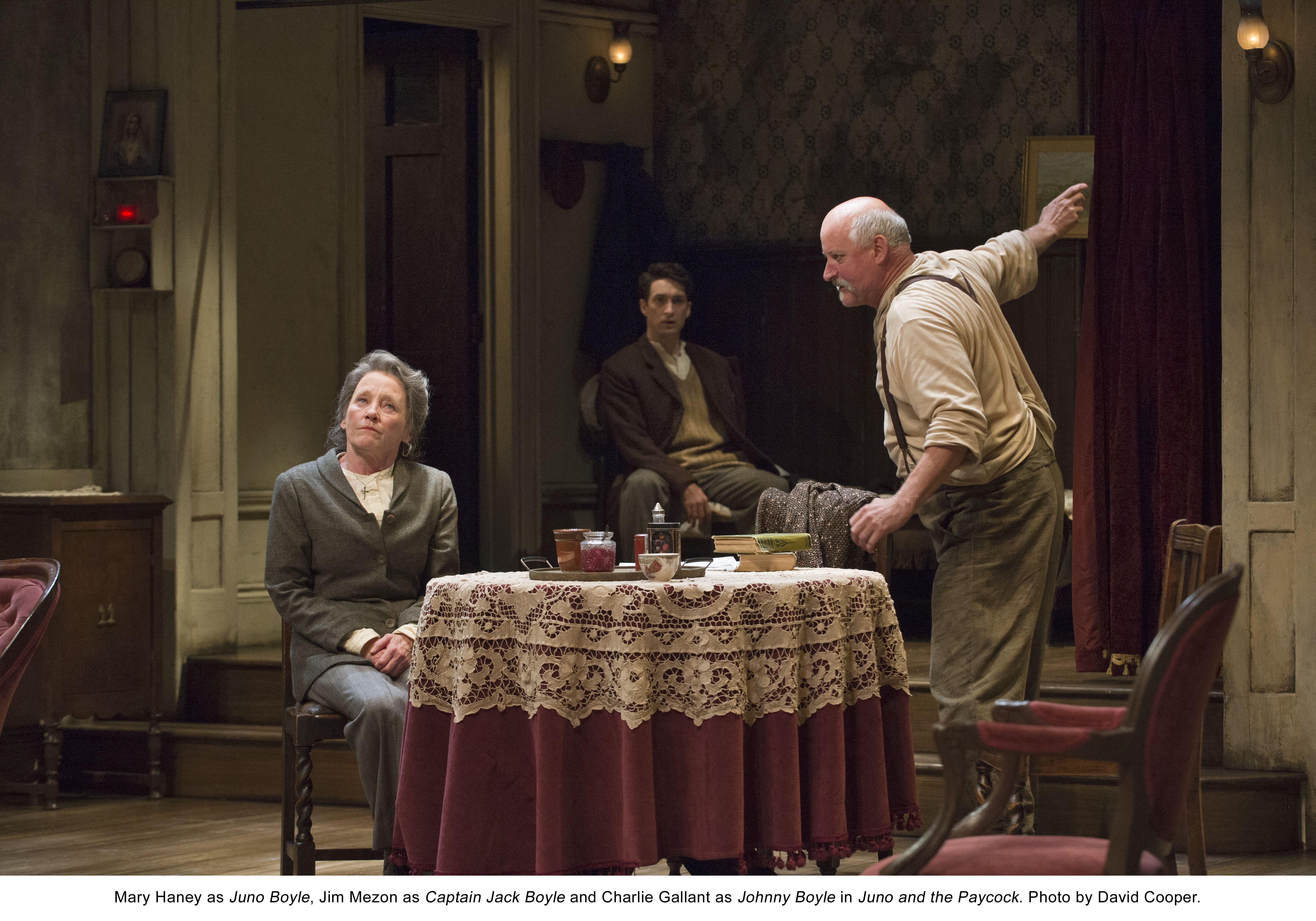
These are poor people in “the Boyle family’s two-roomed flat in a tenement house in Dublin,1922” and at the outset of Sean O’Casey’s Juno and the Paycock, Marla McLean as daughter Mary spiffs up her shoes with her bare hand. Mary Haney as wife Juno erupts in frustration at Jim Mezon’s Captain Jack who shows disinclination to do any labour for the family’s daily bread.

Son Johnny played by Johnny Gallant broods about with one arm and Jack’s pal Joxer played by Benedict Campbell lurks about for another drink preferably bought by someone else. If you have had any exposure to the devastating effects of alcoholism, you feel a chill at Jack’s and Joxer’s reliance on the booze and how it consumes them.

Still, gift of gab is a way of life in this openly communal world where lives overlap and salesmen don’t knock but simply open the door and inquire if there is any interest in their wares. There is also a respectful, even fawning, attitude to those who are educated, especially if they are potential suitors or, germane to the play, they bring news of a will that dumps unexpected wealth on the family.

In anticipation of the will’s solving all problems, it, still unseen, pays for furniture of much better quality and Captain Jack, never remotely near being a captain, becomes an even boastful non-entity, full of pretention and of fecal substance. Johnny, meanwhile, broods in hurt and misery, a “very touchy” and “tormented” fellow. If this is a life of poverty held together by a worn and resolute Juno, it also pulsates with Irish civil hatred and thus Mrs. Tancred’s son is found “riddled with bullets” although Jack states “these tings don’t affect us.”

In the end, tragedies prove devastating in this family, for one as both father and son as cruelly unforgiving of the pregnant Mary. “If Mary goes I go with her,” says Juno. “Well go,” says Jack who cares more how people will gossip about him than about his daughter’s humiliation. “The last few friends I have” to whom Jack refers are his drinking buddies, especially the sycophantic and opportunistic Joxer played pitch perfect by Benedict Campbell

Sean O’Casey’s play, although textured with the way poor people live just above sinking, devotes much time to a “keep song and dance going” attitude among these folks. It is a world where men take no responsibility and brutally blame their women. Even Jerry, poignantly played by Andrey Bunker, whose love for Mary has been constant and apparently deep, backs away in the face of her pregnancy. Meanwhile, it is said of Johnny, in reference to Mrs. Tancred’s son, that he “gave him away and sent him to his grave” and now faces an unforgiving justice for traitors. “Are men only drunks, protected, or killed?” asks Juno.

Director Jackie Maxwell, Irish born, opts for our slight distance from pain here, so, while feeling the accumulating wounds of these people, we can also weigh what their impact is in human and societal terms. Mary’s realization of her devastating shame is deeply sad yet to her “It’s my poor child must have a father” Mary Haney’s Juno, with a feisty feminist potency, responds “it will have two mothers.” If there is any element of hope in this patriarchal mess, we find it here.

Mary Haney does a very moving take on Juno. We can see in her resolute face that she has achieved a scarred nobility, albeit unnoticeable to others and unappreciated by them. Yet, against unconquerable odds, she tries to keep her family afloat. This is a penetrating and subtly-tuned production that, thanks to Maxwell’s direction and the cast’s spot-on portrayals, gives us some understanding of the cruel humanity that kills, betrays, shames and torments its kind, all with mercy spoken by only a few voices and by even fewer deeds.

Posted in shaw festival, Uncategorized | Tagged , , , , , | Leave a comment

A LOVELY SUNDAY FOR CREVE COEUR BY TENNESSEE WILLIAMS

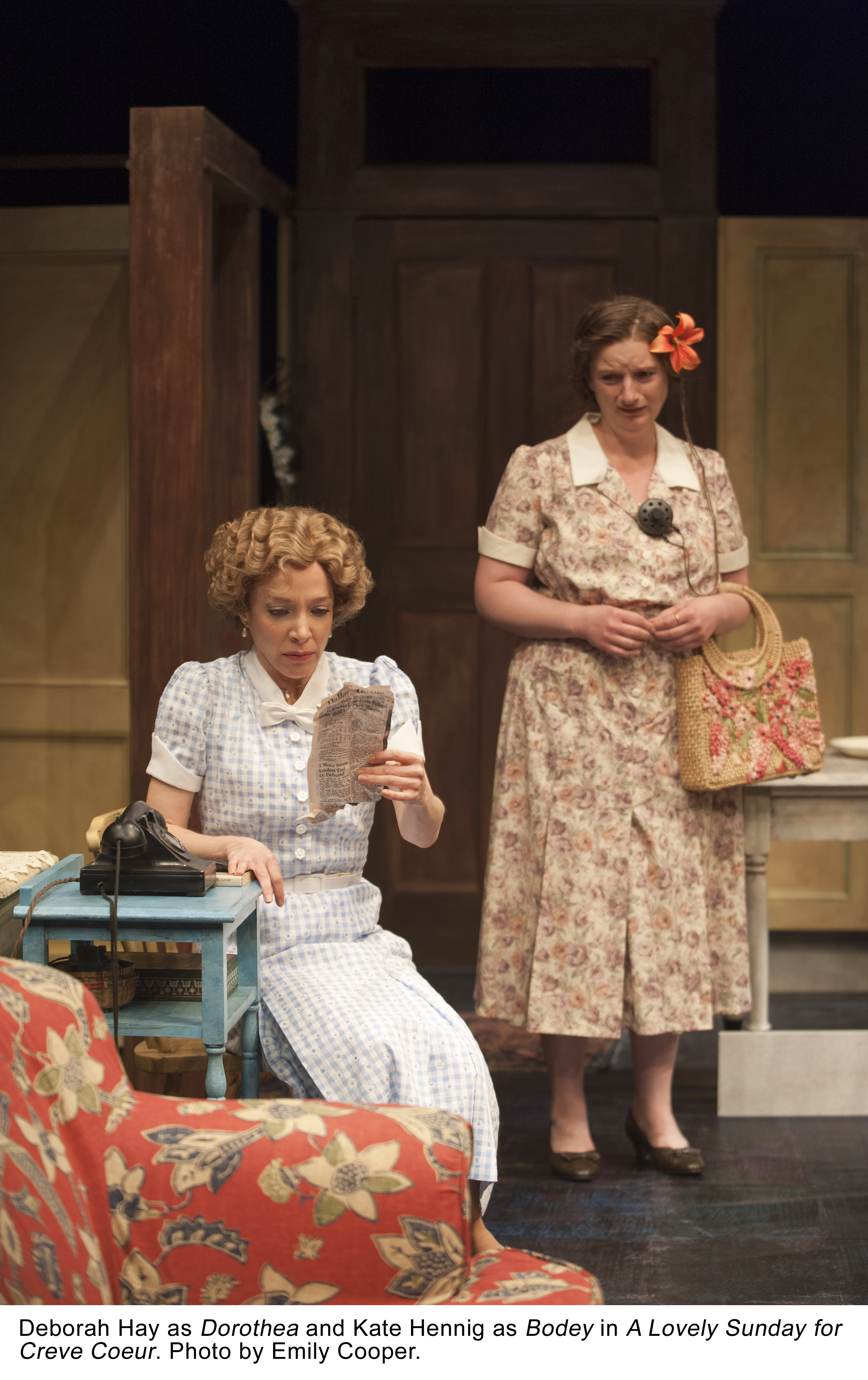
The stage brightens up twice for Tennessee Williams’ A Lovely Sunday for Creve Coeur, first through Louise Guinand’s lighting design and then, again, with the appearance of Deborah Hay as vulnerable Dorothea. Dorothea is wide-eyed and comically light doing her toe-touching exercises, fanning her arm pits, and then doing a series of ridiculously complicated sit-ups. Hay also chews into Williams’ lines with vigour and musicality as well and when Dorothea is forced to realize that her life must be fine as it is and that “we must just go on,” she is a woman of shattering emotional impact. Dorothea is an innocent creature who, when she “crosses the line,” has her big moment and can recall “the earth was whirling beneath me.” Then she crashes.

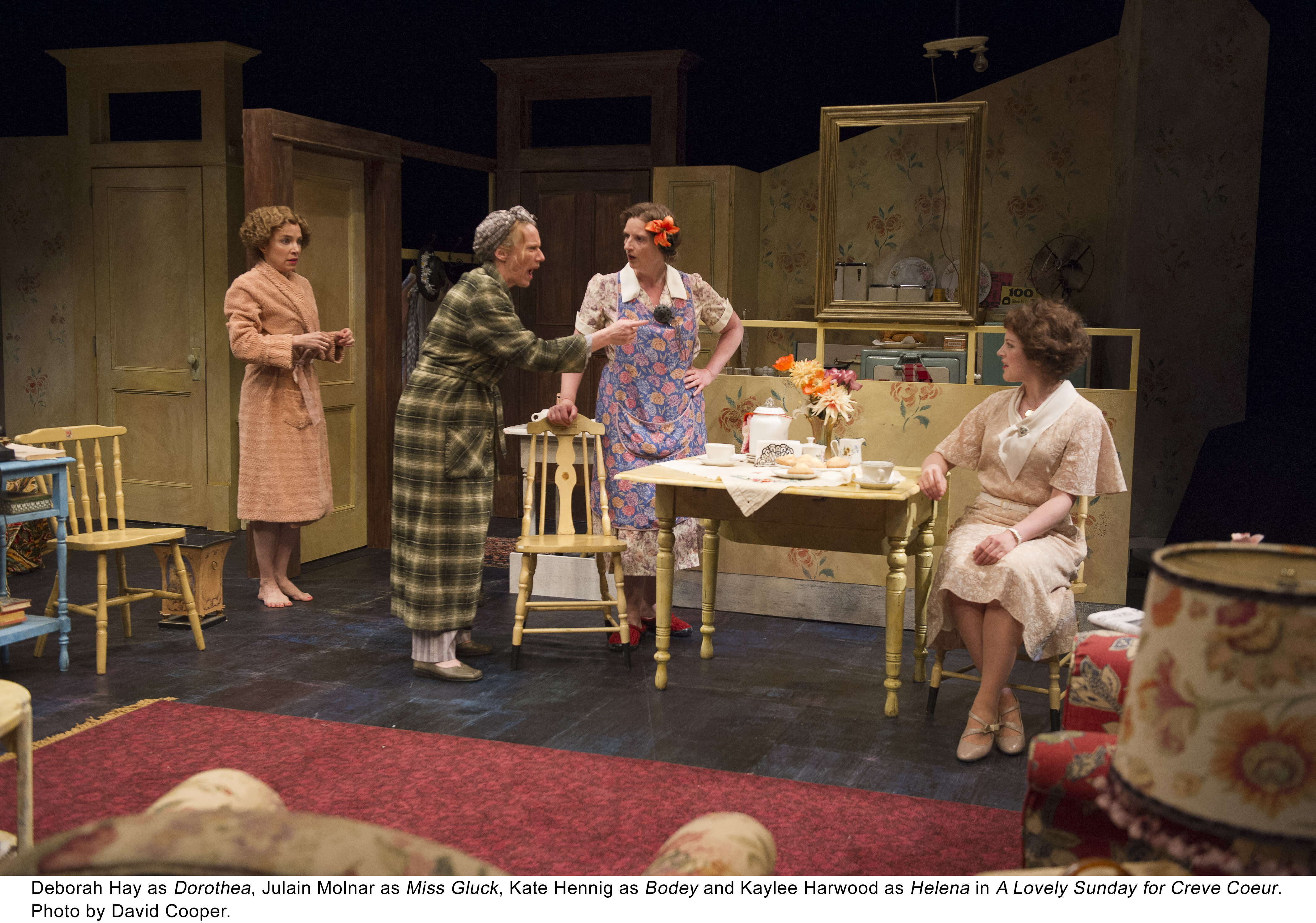
Director Blair Williams and cast do evocatively well with Tennessee Williams’ text, with earthy no-nonsense words, with words withered by desperation, existence, fragility, and daydreaming hopes. The play is –take your pick- either a tad drawn out or people actually do drawl their lives away in this manner and ooze all over the furniture with southern ennui. In any case Kate Hennig as Bodey, the roommate is an assertive, solid presence, a forceful counterbalance to superficiality who, in English or German, is street-smart and doesn’t buy into the dismissive pretention of Dorothea’s friend Helena, played hatefully snooty and oblivious to suffering by Kaylee Harwood.

Helena tries to use Dorothea and is cruelly unsympathetic to Miss Gluck, played by Julain Molnar, who is constantly weeping and hysterical. She sees Dorothea as “an emotionally fragile person who might collapse” and still tries to con her. Helena reeks condensation for those who shop on Dorothea’s side of the tracks and, meanwhile, Bodey wants Dorothea to marry her brother Buddy of whom the latter says “he needs a girl to fart along with him.” Buddy’s attraction is that he has cut down to eight beers a day from a dozen. We smell the sweat, in this flat, of the lives that live there. As often with these lunch time short plays, one is offered a fine production of a rarely seen gem that enriches our experience of theatre’s history and art.

Posted in shaw festival, Uncategorized | Tagged , , , , | Leave a comment

SMALL TOWN SNOBBERY AND SCANDAL IN SHAW FESTIVAL’S WHEN WE ARE MARRIED

Three decidedly Yorkshire couples, with each celebrating twenty five years of matrimonial union, are informed that, officially, they are not married. Prior to this shattering revelation, pretty devastating stuff for when the play takes place, it has been obvious to us that each relationship, festivities aside, is not akin to musical harmony but played instead, rather atonally, in the keys of resentment, suppressed anger and even contempt. Since they are no longer married, each of the six involved individuals no longer has to play the role or attitude till now assumed.

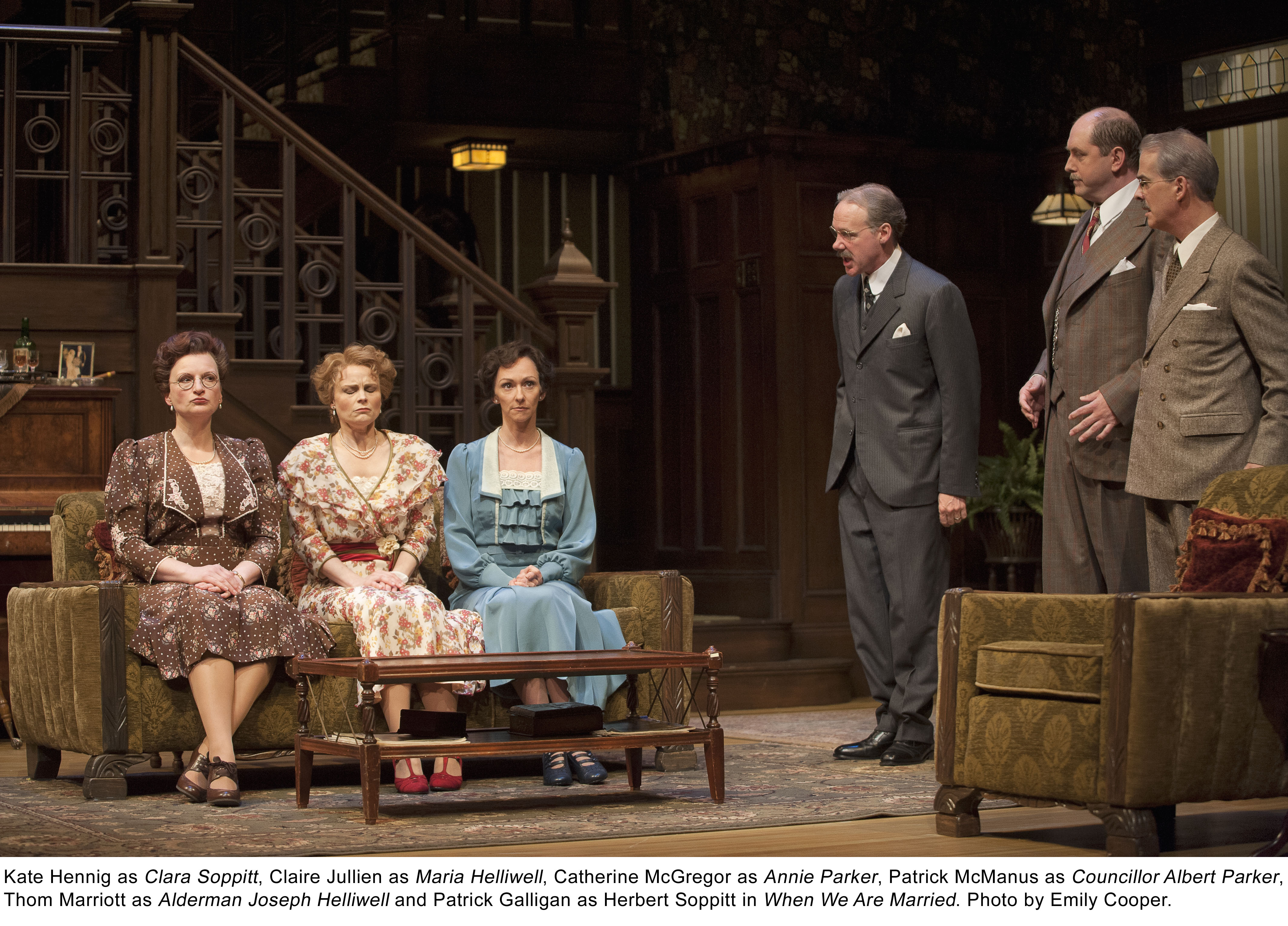
We have odd pairings here. Councilor Parker, a blatantly obvious asshole, lords his small town achievements over his poised and unsatisfied – in all ways- wife. He is extrovert with his venom and she is introvert with her patience. Alderman Helliwell, big and clueless in his own self-absorbed way, also takes for granted a supportive mate whose joie de vive, or anything else, has no welcoming place to go. Herbert Soppitt, a chap of some decency, is disregarded by his two friends because he lacks an official position and -no more be said- by his quintessentially ball-breaking wife.

In all of this, the audience gets to cheer, say, when wife of Parker has occasion to throw Parker’s asshole self back in his face or Soppitt gets to not only rebel against his bitchy mate, but to return the slap she gives him. Indeed, it’s not hard to take sides in this play. Yet within this hilarious situation, there emerges a touching and realistic depiction of the ways a once-blooming garden of marriage can become a hell of life-sucking weeds. And, as always, we have a richly populated Festival company that shines in ensemble productions with many individual talents from top to bottom—imagine Peter Millard or Norman Browning, say, doing just walk on performances.

Each performance certainly delights but also demands honest thought because no actor – thanks to director Joseph Ziegler’s creation of a humane underpinning – here goes for stereotype or cliché. Whenever we ridicule or despise some of these folks, we also become concerned that, with their human limitations, they have nowhere else in life to go but to pettiness, meanness or a smallness of being. In these three couples, thanks to playwright J. B. Priestley, we have six distinct lives that imply much about individual psychology and also social constraints.

Having said all this, we have a production that is very entertaining, very engaging, hilarious, unobtrusively poignant, and full of the playwright’s sympathetic understanding of his fellow beings. These are people who live with irritations, personal frustrations, their boredom with others, and secret longings, even as they practice their sometimes merciless small town prejudices. They do get their comeuppance and must endure Mary Haney as maid Mrs. Northrop twisting her mouth in glee at now having the upper hand.

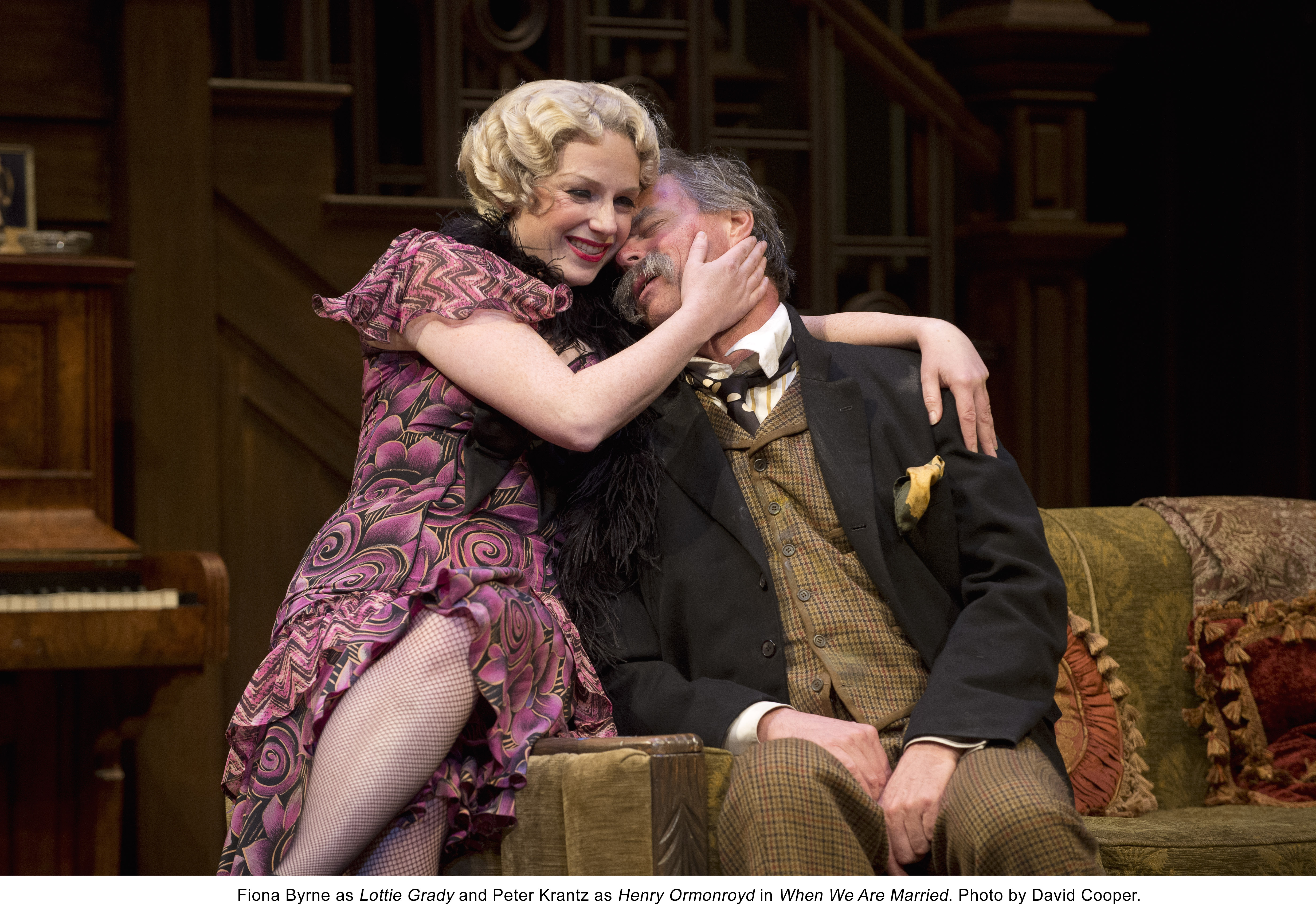
There is much telling detail in the insightfully portrayed marrieds here –Claire Jullien, Thom Marriott, Kate Hennig, Patrick McManus, Catherine McGregor, Patrick Galligan. Equally well-rounded are the big-mustached Henry of Peter Krantz who makes an art of seeming unwashed, the pleasingly tartish Lottie of Fiona Byrne, and the quick-retorting, chirpy, chatty, busty bullet of a maid Ruby of Jennifer Dzialoszynski who is so uniquely delightful that one smiles at her every appearance. Wade Bogert-O’Brien, Kate Bosworth, and Charlie Gallant add nicely etched humanizing touches in a thoroughly engaging production. No wonder that Priestley wrote the play “very happily and at furious speed” often laughing along with words he set down. As a result, we laugh a lot too.

Posted in shaw festival, Uncategorized | Tagged , , , | Leave a comment

THE CHARITY THAT BEGAN AT HOME: CAST AND DIRECTOR CHRISTOPHER NEWTON IN BRILLIANT FORM AS THE SHAW FESTIVAL RETRIEVES A FORGOTTEN GEM

If The Sea, though first produced in 1973, is set in 1907, the rarely produced The Charity that Began at Home by St John Hankin, another theatrical gem at the 2014 Shaw Festival, was actually mounted on stage a year before in 1906. Here it is directed, with acute awareness of social milieu and its conventions, by Christopher Newton, not as a forgotten relic of the past but as a very relevant criticism of social cruelties that prevail today. Here Newton and cast realize their insights with the incisiveness of a keenly honed knife and this too is a production one must see.

The play depicts an idle bunch from the privileged class of society with its implicit condescension for the lower classes, here represented by servants. If the uppers are indifferent to the lowers, they often can be snarky to their equals and say whatever they mean, however hurtful, as a matter of course. Their small world lilts along with insignificance as they assume that their trivialities should matter to the whole world. When they help others, they treat them as types not individuals and often find their sufferings an inconvenience. They are a class out to lunch or, rather, out to tea. When they deign to help the unfortunate, they abide no complexities. They are rather simple folk, albeit designed into textures and colours of elegance by William Schmuck.

Newton’s production, with its study of the chaos that ensues when one is ill-prepared to implement one’s charity, is both pointed and shaded in characterization. With all the superficiality in the air here, one starts to feel stuffed and claustrophobic from all the shallowness in thinking or feeling. One craves retreat into life’s realities, although this very superficiality here is one. We are reminded through Newton’s subtle guidance that humans too often become a naïve or mean spirited bunch in any circumstances.

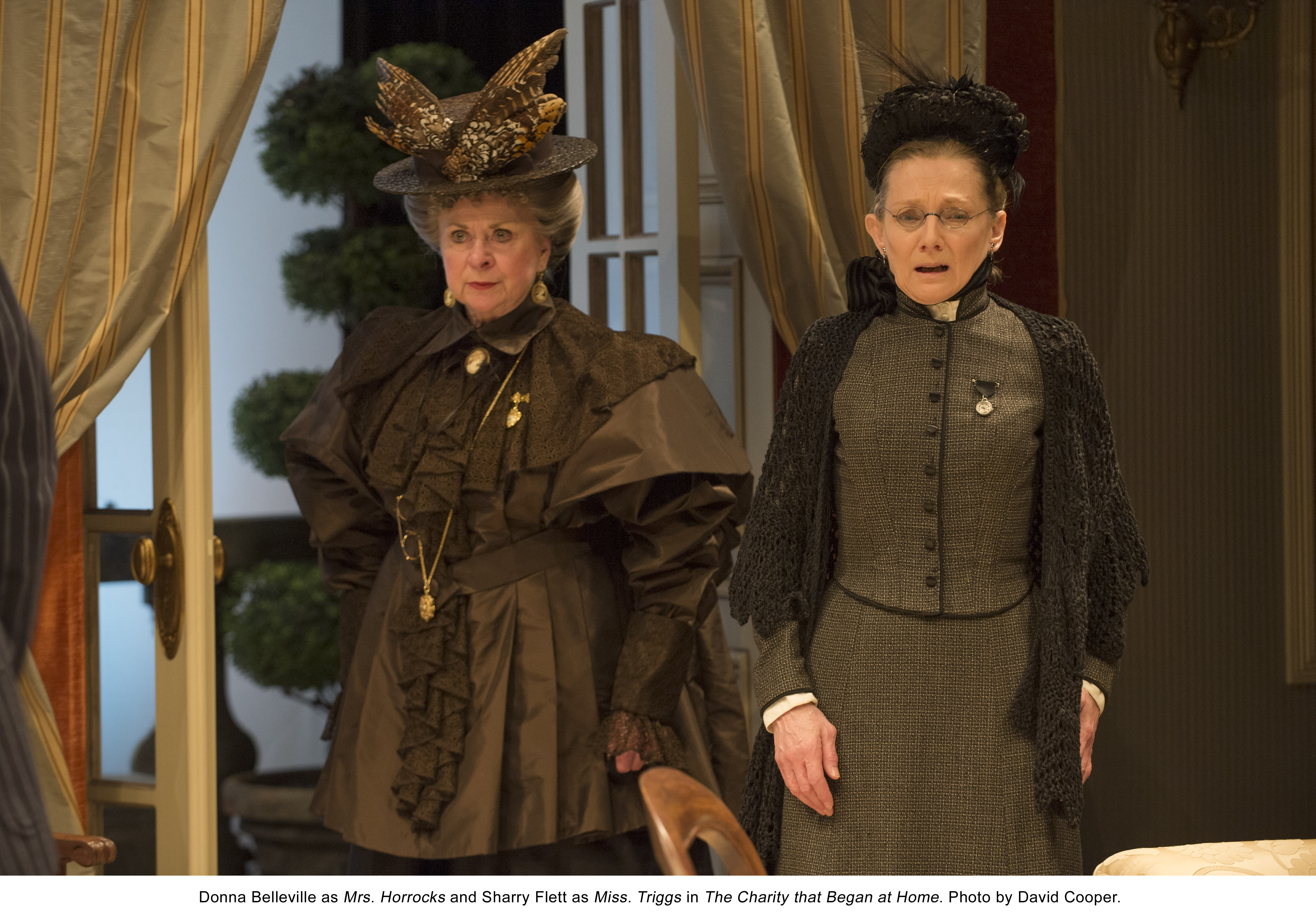
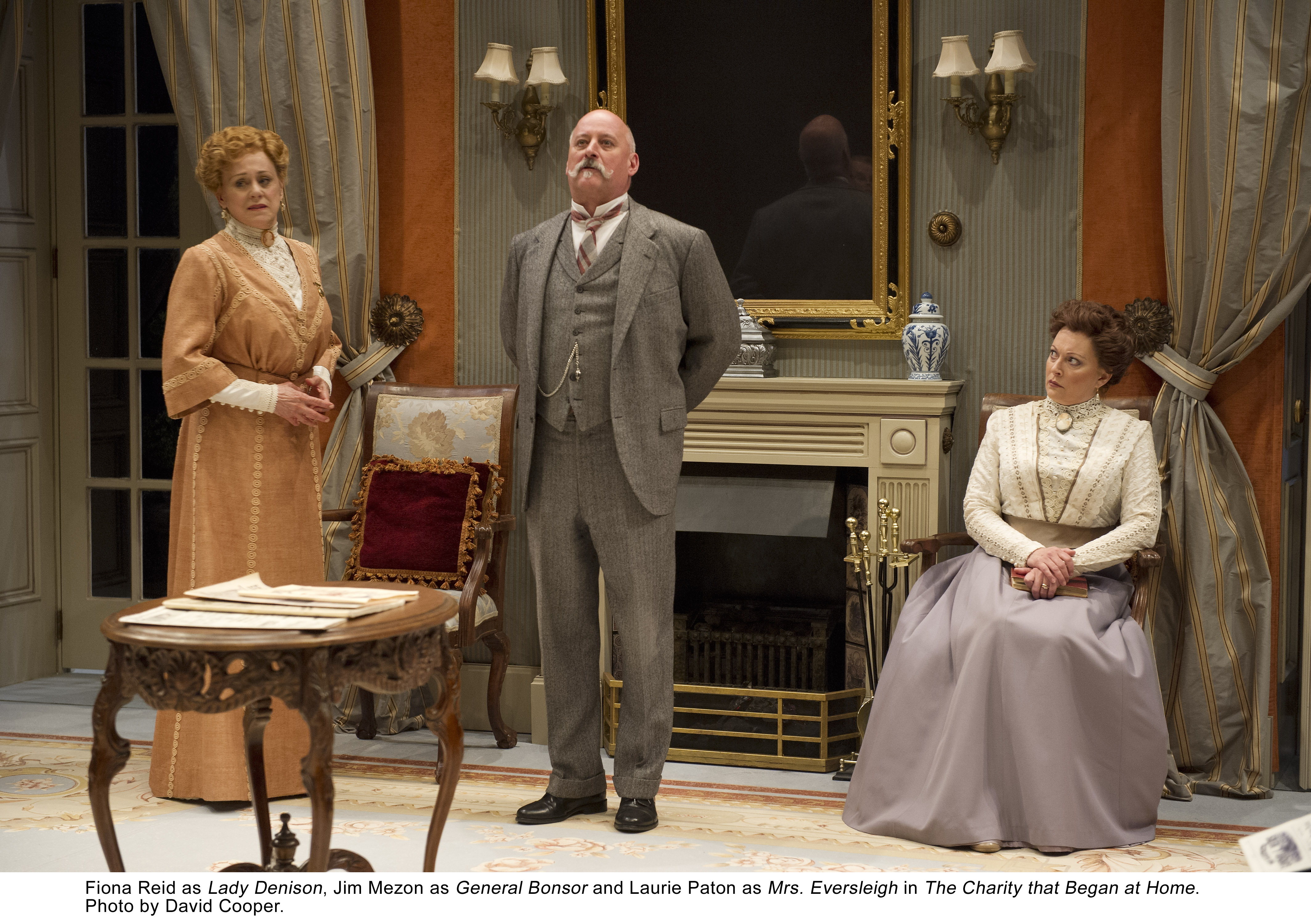
Fiona Reid’s Lady Denison is a fussy and hyperactive air head whose remarks, bent with extended vowels as they are, are not filtered by any consideration for others. Laurie Paton’s Mrs. Eversleigh exists in a judgmental and unforgiving mode that condemns in all directions and needs to punish others. Together, they seem to hold standards so as to prosecute others who are not likewise inclined. Add the humourless prune of Sharry Flett’s Miss Triggs, with her pinched bitchiness and indignation at life and the world, plus the broadly dominating manner of Donna Belleville’s Mrs. Horrocks and the haughtily colonial-ish General Bonsor of Jim Mezon, with his loudly tedious, self-satisfied laughs and oft told anecdotes, and if one weren’t so intrigued and entertained by these people, one would crave escape.

And what of the idealists who mean well? Graeme Somerville’s, Basil Hylton is screwed tight in ideals, but when faced with the realities of the world he, like the others, is out of his depth. He is obviously sincere, but sincerity is never enough beyond the confines of a cocoon and he so annoyed the lady beside me that she declared “I want to run up on stage and shake him into some sense”. Margery, played as effervescent with youth and poised in untested ideals by Julia Course, believes that “things go better if one tries to help people.” She is efficient and innocent. The last one like her, whom I met, avoided newspapers and the many descriptions of horrors in them and, instead, ran off to Bible college so she might learn to guide the world.

The Charity that Began at Home is subtitled A Comedy for Philanthropists and if Margery is of “perfect character” to the idealistic Basil who secretly loves her, she is too self-denying for Martin Happer’s Hugh Verreker, a charming fellow who is weathered with life and his past socially-unacceptable deeds. He is not “made for philanthropy” and finds it “boring” no doubt because, “selfish” and “cynical” as he is, he can assert that if one “knows enough about people, one always disapproves of them”. He doesn’t look forward to marriage and perfection with Margery because “marriage isn’t a thing to be romantic about, it lasts too long”.

This production with its politely riveting cast is a thought-provoking gem that gently dumps humanity, mean or idealist, on one’s lap. One can look away but one risks encountering oneself and one’s own foibles in a mirror of others sitting nearby. Happily, St John Hankin creates richly realized characters, very entertaining ones at that, and appalled as one is at the mean-spirited and deeply unfair social structures here on view, one does not look away because this is very entertaining theatre. Newton certainly knows how to bring this distasteful world to gripping life and his cast is exceptional in demonstrating the social inequities that are becoming more and more a reality of the modern world.

Posted in shaw festival, Uncategorized | Tagged , , , , , , , | Leave a comment

THE PHILANDERER BY SHAW AT THE SHAW FESTIVAL: “I LAUGHED WITH DELIGHT FROM BEGINNING TO END”

OR THIS…..

For maybe four decades, on every trip to London, I have made it a point to visit the National Portrait Gallery and sink, each time, into the gaze of one or two different female subjects who hang there as portraits. Two visits ago it was Lady Colin Campbell, done in oil circa 1897, who according to the Shaw Festival program notes was “an experienced and accomplished philanderer.” Relevant to the festival’s production of The Philanderer by Shaw, it is she who convinced Shaw to ditch his last act for a rewritten one. Happily, this production uses the original last act as the playwright had intended before Lady Colin, fearing social vulnerability, directed her deep, intense, and overpowering eyes at him and declared that the last act “ought to be put into the fire.”

This production, directed by Lisa Peterson, finds in Shaw’s play a high gear comedy with a sustained and sharply focused physicality driving the text’s every word. Verging on, but not quite screwball, it contains a subdued Keystone Cops energy that prevails at times. We here actually see through the action what Shaw’s words mean in this hilarious and crisp production and I laughed with delight from beginning to end. Shaw’s witty writing here becomes theatrically exuberant and assertive with comic energy. The sets by Sue LePage are elegant and appealing in their immaculate and done-just-right richness. Keven Lamotte’s lighting contributes to many strikingly defined and visually rich moments, especially in the last act’s creation of stunning silhouettes. Both LePage and Lamotte charm us into the undeniably seductive world they have created and hold us there.

The play this time begins with darkness and, within it, the pulsating sounds of committed copulation. Or maybe it’s intense foreplay -who knows, since, after all, it is dark? Whatever the case, this is a production in which words have a physical dimension, have a body to them, throughout. When the lights come on we see the sensual movements of shared senses and playful sexuality. “Is this really a play by Shaw?” you ask. Of course, cigarettes are lit, of course the conversation runs with “Is this your first love affair?” Grace, played by Marla McLean, is a woman of imperial sensuality and, for some reason, one thinks of an almost overly ripe avocado. Gord Rand as Leonard is a lanky fellow, boyish and charming, one who seems delighted in everything he says but is not one to commit. However, “half the women fall in love with me” he explains.

One of these ladies on his list of ever-readies is Moya O’Connell’s Julia, a woman of storming physicality, a woman who goes about like a detonator waiting to do its thing. Both the “he and she” relationships, we find in these situations, are rich with self-absorption, melodramatic passions, forced indignation, and implicit sexuality. Julia and Leonard don’t converse, but rather erupt at each other. She displays a mercurial intensity in playing out her desires while he, with asides to the audience and all, maintains a delightful contained hysteria. She is “a woman who behaves like a spoiled child” while he jumps about with agility, something like a harlequin on acid.

At the Ibsen Club—introduced by who else but Henrik himself singing about the pleasures of smoking—we meet the two dads of the two ladies and both are huffy, vesty, mustached, sexist, proper, and pipe smoking. For some unknown reason, they equate eating beef with manliness. As expected with the longstanding actors Michael Ball and Ric Reid, they are assertively present and suggest lifetimes in their two well-textured performances. We also meet and enjoy the ambiguity and playful confidence of Harveen Sandhu’s Sylvia. The production remains hilarious and sharply dynamic with dialogue paced up a notch. We find that Leonard’s face contorts three time on each consonant. As before, the sexual charge between Leonard and Grace suggests that clothing is an inconvenience. As before, Sue LePage’s immaculate sets show an appealing elegance.

After another delightfully quirky scene change, we find Julia to be a sprawling, tomboyish, lanky creature. We find Grace ever-energized sexually. And we meet potential mate number two: a hilariously starched and contained Victorian doctor, Percival Paramore. Shaw’s writing here is theatrical and exuberant as each physical movement bursts with purpose. The lively exchange between Grace and Julia bubbles with bitchiness. We are also required to wonder if a “womanly woman” is fit for the Ibsen Club. And we note that the book tossed into and drenched in the fountain is The Quintessence of Ibsenism in which –if memory still serves me well- Shaw sang the praises of the Norwegian playwright’s use of discussion as a theatrical method. No wonder that Paramore later protectively cradles the sacred volume.

And the famous rarely produced last act? We are immediately stunned by the set’s spare and commanding beauty—death black arches, death black tuxes and death black chairs. We find that the four year marriage of Julia and Paramore has its own very dark tones as in the exchange: “Do you like Julia?” “Do you?” “I don’t.” Or according to Julia “such things shouldn’t happen” or “everybody makes love to me and nobody cares for me. Finally Julia concludes “I’ve had enough of being a toy.” Meanwhile, the two fathers remain entrenched societal creatures and they compete, referring to their daughters, in a verbal tennis match. The young men get to ask “why do you women blame us for the suffering you conceal from us” and we hear also the distinction between playmates and helpmates.

This is a vigorous and thoroughly enjoyable production in which Shaw takes aim at critics, scientists, vivisectors, and audiences. If he skilfully takes on social hypocrisy, the playwright also shows insightful smarts in facing the impossibilities inherent in human relationships. Moya O’Connell adds a knack for broad physical comedy to her resume. Gord Rand, in a performance of implied private existence beneath his brilliantly executed degrees of agitation, both physical and emotional, is an unqualified joy. As said before, words and bodies are here one and the same and the invigorating result is a take on The Philanderer that you must not miss.

Posted in shaw festival, Uncategorized | Tagged , , , , , | Leave a comment

SHAW FESTIVAL PRESENTS A COMPLEX, INTENSE, FUNNY, AND THEATRICALLY BRILLIANT PRODUCTION OF EDWARD BOND’S THE SEA

A young man and a young woman, respectively, turn and turn a wind machine and, with increasing urgency, shake a metal sheet that one uses in theatre to effect a storm. They seem delighted with their theatrical devices and certainly, gradually, a raging wind and omnipotent thunder consume our senses in this intimate skin-clinging darkness that, at least for today, the Court House Theatre has become.

A huge dark curtain, as wide as the stage, puffs and billows like a monstrous storm-incited sea toward us and one readily feels devoured by large forces perhaps more monstrous than even humanity. Indeed dark figures – who are actually both human forms and menacing ambiguities– guide the curtain with balletic grace. They become one entity with the curtain, with the darkness, with the storm, with the sea and, as our imagination takes hold, with our minds. We have here a play and a production that own us in several dimensions.

Edward Bond’s The Sea -rightly directed as potently mystical, psychologically unsparing, and magically theatrical by Eda Holmes- has able collaborators all in this outstanding realization of theatre’s thrilling potency. Camellia Koo’s bold and undeniable setting does ever-seductive metaphorical duties and we feel the battering effect of the world and the unforgiving presence of the unknown on the human body and mind. We feel entered by what we see and hear.

John Gzowski ‘s sound design and music assertively negotiate their way in both one’s emotions and one’s subconscious. Kevin Lamotte’s lighting either isolates each existence or suggests the perpetual greyness of being or gives the ambiguous effect of death and redemption combined. The costumes of Michael Gianfrancesco for the most part feel dank with hard sweaty labour on the men or, whatever their elegance, as heavy as punishing clay upon the ladies. All these people wear their lives and their lies.

At one time our psyches become an unwilling participant in this demanding and decisively present world, even as our critical minds attempt to determine how these characters inhabit us. We thus evaluate opportunities for survival or escape and, as our sensibilities confront the blunt, brutish realities of our existence through Bond’s haunting creation, we laugh. Laugh? Yes, and heartily at the absurdities that we are. With all else in Bond’s creation that demands we find and know ourselves, this is a funny play, one that takes the implications of each life depicted to a logical and often painfully hilarious end. Each life is battered in its own way, each one finds the means to live another day.

Patrick Galligan plays Hatch the draper whose financial and emotional health depend upon the town’s ruling figure, Louise Rafi, easily seen as the embodiment of ever gluttonous, destructive and indifferent capitalism. Yes, the Sea was first produced in 1973 when Margaret Thatcher was beginning to do her part in polluting any kind of human spirit in the world and, yes, the play becomes more and more relevant in Canada each day.

In any case, Hatch believes fanatically in aliens as a determining force in human lives and Rafi takes every chance to dehumanize others, all the while with thespian aspirations directed toward the town’s annual production. Hatch has his followers and Rafi hers. And we first see Hatch as a hand ringing, sucky submissive who in time goes nuts with his ruin and the years of being stepped upon and humiliated that took him there.

Certainly Hatch is a passionately deranged fellow at the outset, consumed by the threat of alien domination, and Patrick Galligan takes him over the edge with a dark, fevered intensity that is gripping and unsettling. He is followed about by a group of simple minded gullibles, also with their own expertise in nastiness, but so it also is chez Rafi with her rather hair-brained sycophants. Hatch sees them as evil, and some of them are.

Fiona Reid does Louise Rafi as regally cancerous, as one whose perpetual demands are her raison d’etre, as one who lives and breathes condescension. Does she wish others harm or simply their submission into insignificance? In either case, she is a memorably horrifying creation who ruins both Hatch’s livelihood –“my whole life’s work is at stake” he begs – by reneging on a huge order she placed with him.

Rafi even uses a funeral as opportunity to display the melodramatic excesses she hones each year for the stage. No surprise then, she feels free, as queen of the town, to insert her rendition of “There is no place like home” into a tragic drama. And as a result, vowels too are twisted into painful submission while her vibrato takes on a will of its own, all as she glides about like one with an iron rod for a spine.

Bond also offers a richly conceived and diverse group of townsfolk who inhabit this “small village on the east coast of England, 1907” and this group of Shaw Festival regulars enhance each character with idiosyncratic individuality. As Jessica Tilehouse, Patty Jamieson meticulously oozes the melodrama, insincerity, and pickiness of a wannabe bitch. According to Mrs. Rafi “nothing has ever happened to you” but who will ever forget Jessica at the funeral as she flavours each line of “Eternal Father Strong to Save” with a high piercing screech that aspires to be harmonic embellishment. Equally funny in this situation of dissonant bel canto is the vocal duel-duo of Jessica and Mrs. Rafi. This is piss-your-pants-in-laughter stuff.

In this realm of unending absurdities and cruelties and frustrations woven tight, Evens (note the spelling) played by Peter Millard is a man of balancing presence. He is a polite fellow of weathered resolution, refreshingly subdued but rich in observations such as: “we all have to end differently” or “the truth is waiting; be patient and you will find it” or “I don’t know why I am not mad” Or, typical of Bond’s concise yet poetically evocative writing: “who can kill space or time or dust”. Evens seems a man who recedes like the sea into his own quiet mysteries while, in times of need, his ever handy booze fuels his survival.

Wade Bogert O’Brien as Willy – the one who didn’t drown- is, in this world of mundane fete accompli existences, the understated presence of potential, even hope, in human lives to escape elsewhere -and be more human than remaining would allow. He wonders and floats like debris on the waves hurled to shore and one struggles along with him to aspire beyond this stagnant, if entertaining, bunch. As Rose- she whose love has drowned– Julia Course offers a haunted ghost- like appearance of one partially inhabiting the world of the dead where her true love now dwells. “I am touched by death” she explains. She too eschews the hypocrisy of the others.

So much in this production lodges itself in one’s mind. Neil Barclay’s vicar, in a brief moment that says much of human aching, wonders about “burying one one has christened”. He is a man encased in a role that does not quite show his heart. Mrs. Rafi, a woman wealthy enough to be ridiculous in cruelty, has a breathtaking monologue in which she wonders “has anything been worthwhile? No, I have thrown my life away in this ditch.” In this monologue, Fiona Reid is again masterful in a way I’ve not seen before.

Patrick Galligan’s Hatch, in a Lear-like frustrated rage at being alive, is haunting. When Hatch repeatedly stabs the drowned corpse that now only spurts water, he cries aloud “still not blood,” and Willy observes “the dead is bait for a madman”. Here again we see the playwright’s instinct for a unique and gripping stage imagery that one cannot forget. Or, in a lighter vein, Jenny L. Wright as Mafanwy Price, who has been studying her dog Roger for mannerisms she might use in the play, now shakes her leg in the best canine fashion.

Bond’s writing throughout is colloquial and poetic, emotionally nuanced and boldly theatrical, comic and tragic, rich in depth as far as one wants to go. If his play, with its many engaging scenes, draws one into potent theatrical realities, one is also compelled to reflect and evaluate. Bond shows that, in our lives, there is no distinct place for sorrow or for laughter, no distinct place for peace or for roaring upheaval, and that they are all one and the same -like the Sea. And to witness this horrifying, paradoxical, and invigorating fact of existence, done here so memorably, gives us no neutral place to be. We are these people. Thus the play and the production, both so richly creative, verify why live theatre matters so much.

Posted in shaw festival, Uncategorized | Tagged , , , , , | Leave a comment