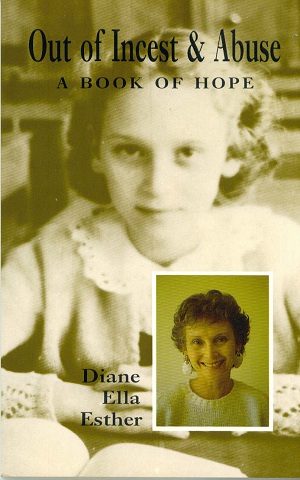
 James Strecker: We have so much to talk about regarding a very difficult subject which you know first-hand –incest. Okay, then, up to knowing you had to write a book, what happened in your life?
Diane Esther: I didn’t meet my father until I was 5 years old. I was born after he had gone to England in the 2nd World War. My mother told me how my Daddy was going to come home one day and we’d all be so happy. My first memory of him was on the evening he returned home. He had to stop beating my mother to come to the couch and hit me – I was crying hysterically. He continued beating her until finally she ran into hiding on the eve of their 50th wedding anniversary.
My brother was born a year after my dad’s return, and Mom did her best to keep Dad away from both of us. She tried to find reasons for me to take my little brother away from the house; she’d send us by bus to get something from a store. When my brother was only about 6, she’d have him go down the street to a friend’s house for as long as possible, to keep him away from my dad.
When I was 11, my father began sexually abusing me. Mom was working all day and my Dad was home, as he didn’t have a job. I had to come right home after school to begin making supper. I’d sneak into the house, hoping not to wake him up. One day he was there, waiting in his chair. Thus began 3 years of abuse. After the first molestation, he simply said: “Now, we won’t tell Mom about this, honey; it will be our little secret.”
When I turned 13, it took me 3 hours on a Saturday morning to finally find the courage to tell my mom what had been happening with Daddy and me. I only told her because I believed I was pregnant and I knew that she would eventually see my stomach grow and the secret would be out and I’d be in bigger trouble.
Her first response was: “Are you sure you aren’t imagining this, honey?” I finally convinced her that it was true and she took two days to decide what to do. She told me she was too afraid to leave him, saying he’d find us and kill her, so she put a lock on my bedroom door, and told me not to let anyone in. Now, instead of coming home from school to prepare supper, I walked to where Mom worked, and we came home together. For the most part, this saved me from my dad’s abuse. However, whenever I became ill and stayed home from school, he simply told me to ‘open your door, Diane’, and he got me again. I knew who had all the power. To this day, I have not told my mother about those times, as I knew it would still hurt her.
So many times I wanted to tell someone else my secret. I felt like I was bursting at the seams and needed to get it out of my belly. It threatened to literally vomit out of me. Throughout school, I had no close friends; I thought everyone could see there was something wrong with me and wouldn’t want to be with me. Once in a while a girl would let me walk with her, if she had no one else to walk with. I called myself their ‘spare tire’. One such day I tried my best to broach the topic of my abuse. I thought I was saying things that she would take a cue from and she’d ask me just what I meant. Obviously, my conversation had gone all around the perimeter of the subject because she didn’t ask. My secret stayed firmly inside until I told a psychiatrist when I attempted suicide at age 25.
The need to tell became a scream in my head. I so desperately wanted to talk, to write, to cry out, to share the garbage I stuffed inside, but there was no safe place or person. I had decided, on the day that I attempted to get it out with my friend, that no one wanted to hear. One day I began to write little thoughts on little scraps of paper and hid them away. At no time did I dare write of the abuse itself; I just couldn’t seem to put that on paper. But my feelings needed to escape. It was enough for the time being to scribble on tiny bits of paper – but one day I’d write my book and get the ultimate relief.
JS: How and why did the idea for a book about your sexual abuse form in your mind?
DE: My secret and my horror and shame were all kept stuffed down in my stomach and in my mind. I so needed a way to vomit them out to be rid of them. At age 11, when I began scribbling words on paper and squirrelling them away, I surprisingly felt a tiny bit of relief. The need to write soon became addictive.
Books had been my comfort all through my life. I could hide in the stories and forget my Mom’s bruises and my black secrets. I would even prop up a book in front of me while my Dad was abusing me from behind. Though I couldn’t have told you what the words said or what the story was about, it helped to focus me a little away from the here and now. Words were my relief.
In high school, I began writing random stories and asked my English teacher to evaluate them. They weren’t for any class project, I just wanted to write – anything. And they certainly weren’t about my abuse. Oddly enough, one story came back with the remark: “a little gory, Diane?” Only then did I realize that I always wrote stories that had someone suffering great violent tragedies and I came to their rescue. A little telling for my role in later life, I know.
Twenty five years later, after I completed my therapy, one of my own counsellors asked me to co-run groups for survivors of abuse. My connection to these women was immediate; they felt safe with me, as I was ‘one of them’. They didn’t have to explain their pain; it was as if we had lived it together. When they spoke of their own poor self-esteem, I would assure them that this was so very common amongst survivors. When they confided their need to commit suicide, I told them that most survivors of sexual abuse attempt it, since it was the only way out of our pain that we could find. After a while, I wondered if they thought I was a phoney and was just saying these things to placate them. It then occurred to me that if I had written a book, I could say to them: “Just look at page 26 – yes, we all feel like we’re in a black hole!” This could help them to understand that they are not alone in their thoughts and feelings in this world, that they are not crazy. My book and I could stand witness to their reality.
JS: How did you feel about putting out something so personal in public?
DE: At age 44, I was itching to tell the world about abuse and how it ruins so many lives. I wanted to tell survivors there really was hope and to help therapists, doctors, friends, families, to see the ugliness of our abuse. For so many years I had to fight and claw my way over mountains of misinformation when trying to find someone knowledgeable to help me stay alive and work through my ‘leftovers’ from abuse. When I came out the other end, I hated the thought that other survivors should have to battle and fight and search for help all alone.
My decision to go public came the very week after I had confronted my parents about my secret. I had kept it all inside for those all of those 44 years. My father had never known that I had told my mother, as she made us keep the secret as ours. My mother had never been made aware that her role in keeping me in the house with my father and having to hug and kiss him in order to make us look like a normal family was killing me inside. I came away from 3 hours of giving all my burdens back to both of them – where they belonged – and I felt powerful for the first time in my life. I knew when I left their house that I had to start making people listen and to tell them that there was a way out of abuse.
The day I chose to go public came through a serendipitous opportunity at a seminar on abuse that I wangled my way into. Before 150 professionals – social workers, police officers, teachers, and others – I stood up at question period and announced my name and said that I was a survivor of sexual abuse and I wanted them to know how difficult it was to get help for us. The rape crisis centre and women’s centre had 18 months waiting list for groups, which was shameful. I said I was thinking of putting an ad in the Hamilton newspaper and just say: ‘come to my house and we’ll talk’. All 300 eyes had suddenly shifted towards me, in disbelief that someone had actually talked of her sexual abuse in public. In 1984, very few people were healed enough to say it out loud.
At the lunch hour, a reporter from the Spectator came to me and said: “I’ll save you the cost of an ad, if you’d let me do an interview with you.” I took a deep breath and say OK. Within a few days, my picture was on the front page and a 2 page article told my story.
Having taken that first huge leap to be in the public eye, I knew I would write my book. I just didn’t know how to make that happen yet.
Allow me to add here that completing therapy should not to be confused with completing my growth as a survivor. I’m always finding new places in which to make change. The difference is that now I don’t need to put myself down or hate that I’m not perfect, and I have the means to move forward to make even more progress in the road out of abuse.
JS: What exactly did you do once you decided to do a book? What did you go through in order to write such a difficult book? Tell us –using that dreaded term- about your creative process that brought the book into existence.
DE: Knowing that I desperately wanted to write a book filled me with panic. I didn’t know how to start; I didn’t have that much confidence in myself yet to think that I could write it alone. I’d only written high school stories, what did I know about a real book? But, I had heard of an author in Hamilton and decided to beg him to do it for me. I searched out James Strecker, phoned him and asked for an appointment. I was so shocked and elated that he would see me – imagine me, talking to a real author! He was my only hope.
I took a bundle of my mixed-up scraps of paper and notes, handed them to him and said: “Will you please write my book? I don’t care if you put it in your name, or as a ghost writer, or with me as co-author. I just really need it to get out there.” He said he’d think about it and let me know. An agonizing week later, he called and said: “I won’t write your book.” Gasp! Then: “But I’ll teach you to write and you’ll write it yourself.”
For three long years, through endless cups of cappuccinos, James dragged me along. Each page came back from him with more lines crossed out than not. Many months in, I began to despair and doubted myself more than ever. Then came a ‘Eureka!’ day. James suddenly recognized that my writing style simply didn’t fit well for prose – it looked like poetry. As I transferred each piece from prose, the poems felt like they wrote themselves -with tons more editing by a very patient James, of course. But there they were, the words I needed, perfectly describing the filth and turmoil I had felt inside and the long journey to life after abuse.
JS: In what ways was it difficult to write your book?
DE: As I described above, the first challenge was finding my own mode of writing. Once that became clear, this new path let in the joy and despair that I imagine every author feels – the high of finding that one word, the despair in re-reading and thinking it’s garbage. Well, I prefer to think that most of us go through that process.
The style of therapy that I had been so fortunate to find had taught me a process that allowed me to go inside my head and body in order to re-feel the emotions of each age I wanted to write about. With James’s tutoring beside me, I seemed to be able to discover that girl/wife/mom voice I needed to convey.
JS: I was asked once during an interview if writing the book was a therapeutic experience for you. What would you have answered, since I’m sure you’ve been asked this question many times?
DE: Writing the book as I chose to do, in first person, present tense, would have taken me to a bleak, desperate place, if I hadn’t dealt with my past so thoroughly in therapy. Every poem had me living those moments of a horrific childhood over and over, in minute detail. The therapy I had experienced had already led me back there and taught me how to dig my way back out again. The re-telling of the days and nights in my book would have been overwhelming for me if I had not completed that process. I did want the reader to be right in the moment with me, at each stage of life. I felt that it wouldn’t have had the same impact if it was describing what had happened in the past tense. Writing the book was definitely not an exercise in healing for myself, it just felt like the most effective way to take the reader into the life of every survivor of abuse.
JS: The book is now in its 10th printing and a few printings ago you added a whole new section of poems. Why did you do so?
DE: The original book ended in 1998, with me at age 58. By 2011, many new challenges and changes in my life had occurred, and there were many more thoughts and words I now needed to put out there. Some of the new poems talk about the past that I hadn’t included in the first edition. I also needed to let survivors know another lesson I had learned in that interim: that because we’ve completed our therapy, we’re not necessarily finished growing and will need to keep using those skills we learned as our life goes on.
JS: One sentence I’ve heard a number of times from you, long after the book had been published, is, “I want to make some changes.” Why do you sometimes feel the need to change the poems and not leave them as they are?
DE: I guess hind-sight really is 20-20. Reading the book over the years, I have found a couple of new ways of expressing myself. In some cases, a line just felt that it needed a word or two changed, mostly for better impact and understanding. In others, something just didn’t seem to be as clear as I had thought.
One small example is the poem entitled: ‘Sword Fighting’ – in therapy, I say to my husband: “No! I refuse to wash on Mondays.” Someone at one of my lectures asked me to clarify that line; it was confusing for her. I smiled as I realized that I was describing an era when we housewives did our laundry every Monday. I changed the line to read: “No! I refuse to do laundry on Mondays.” I guess I needed the right jargon to fit the current decade.
JS: Your book has been on several courses at McMaster University for quite a number of years. What are all the ways that students respond to your poems?
DE: When I look out at my audience, I can see the impact quite clearly reflected in many of their faces. Most of the students have read my book and are aware of the intense feelings it will evoke when I speak. Thankfully, the Professor has previously given permission for those students who would find the presentation too difficult to skip the lecture. As I talk of the psychological implications and the results of abuse on children as they grow, I see faces red with anger, to the point of rage, for the injustices in our -and possibly their own- lives. Many are holding back tears; disbelief is evident by shaking heads. Most of the students look right in my face, but I see so very many who will bury themselves in their books and i pads. I believe this is their way of taking themselves away from this recitation that is so difficult to hear. I am painfully aware that in this class of 500 students, there are dozens of survivors of abuse, both male and female. I inwardly praise them for using whatever means they need to protect themselves from this hard topic.
JS: You’ve told me many times how, after the end of each of your reading-presentations, students line up to talk privately with you. What do they say and what do you say?
DE: They talk of their own abuse, of a friend’s abuse, or ask how to help someone or get help themselves. Sometimes they need me to expand on something I have said. I have had many people confide in me about their abuse and say that I am the first and only person they have ever told. My heart swells to know that they now have found this one safe place to whisper their secret yet it breaks as I hear their anguish.
I do my best to assure them that there is a way out of abuse and if I made it, so can they. I have already spoken of the years of self-doubts that survivors of abuse live with. I’ve described the family dynamics and power division that puts the child at the bottom of the barrel, the years we spend searching for the way to heal and grow into the person we were meant to be if we had been born in the house next door.
Quite often I have a student who has brought their mother or a friend to hear me speak, and they come to introduce themselves. These are the people who are usually working through their own trauma and needed to come together for the information I’m providing. Sometimes the student tells me that when she finally broke her silence and told her mother about her abuse by her uncle or grandfather, her mother confided that he had abused her as a child, as well.
The majority of those who come to talk to me praise me for my bravery in speaking out. I find that so sad.
I have been speaking to classes for 32 years, and the class still find it a source of wonder that someone can be so public about their abuse and they consider me to be brave. I would rather that I was ‘old hat’ and that I am just repeating what they’ve known and have heard for decades – that my book and my presentation were obsolete. Thirty-two years later, and nothing has changed regarding the exploitation and abuse of children that still remains unspoken in society.
JS: What should a person who has been or is being sexually abused do about it? What should people who suspect that sexual abuse is going on do?
DE: The road ahead of a person who is ready to do something about their abuse may be a hard and lengthy one, I’m afraid. There are rape crisis centres, women’s shelters and centres, but so often there is a waiting list for therapy or groups. In order to provide information for this question, I went to Yellow pages and attempted to follow numerous links that are listed in Hamilton, for help. I found that 5 of the links provided were not in service.
I e-mailed The Women`s Centre at Interval House, Hamilton, and they replied that they have a group that explores the topic of living through an abusive relationship. They offer individual counselling but none of their services specialize in therapy for child sexual abuse survivors.
There is the Sexual Assault Domestic Violence Care Centre that provides services covered under OHIP. http://www.hamiltonhealthsciences.ca/body.cfm?id=281
These services are at the General Hospital and the Juravinski Hospital in Hamilton and McMaster University Medical Centre: (905) 521- 2100 ext. 73557 Business Hours only. I telephoned them at 4:30pm for further information regarding counselling and got their voice mail. I left a message which was returned the next day. I missed that call, and as of two days later, I’ve left 2 more messages that haven’t been returned.
Additionally, I found the SEXUAL ASSAULT CENTRE, SACHA at 75 MacNab St. South, 3rd floor, Hamilton Ontario L8P 3C1 PHONE 905.525.4573 For 24-hour crisis support please contact SACHA (905) 525-4162
I do not know the types and calibre of services from these organizations.
Because abuse, especially sexual abuse, is still kept secret, there is very little opportunity for people in any of the helping professions to learn exactly how to deal with a survivor in crisis. It is a catch 22 situation: we can’t talk about it, so nobody learns how to help us ‘get out the other end of abuse’, thus we fall further and further into despair and still can’t talk about it.
If one suspects that sexual abuse is happening to a child, do not hesitate. Tell the authorities immediately. Call Police, Children’s Aid or other Child Protection Services. The mandate in Canada is that when an abuse is reported, it must be investigated. I have had several battles when reporting abuse of children and three Children’s Aid offices told me that their mandate is that they cannot investigate without evidence. Just what evidence did they expect me to gather? No one will witness the abuse going on because it’s always behind closed doors. They were wrong. They must investigate even without evidence.
If a child has confided in you, your first response must be: “I believe you. I want to help you. I will be with you and keep you safe now. You are safe now.” Then follow through. Don’t stop making those calls and don’t leave the child’s side until she or he really is safe and protected. This all sounds the natural thing to do, but it will be difficult. You will face obstacles, such as I did when trying to get help. As I mentioned earlier, the danger is not in pulling families apart, the danger is in the child not being heard and taken from harm.
If the person is an adult, your response should be very similar: “I believe you. I want to help you. Do you want me to go with you and be with you while we find a safe place? You can talk to me anytime.” Say these things only if you mean it. It will be a long journey with that person and this cannot be solved quickly. Her -or his- abuse didn’t begin and end in a week or month and her healing work may take years. You may get tired of hearing about the issues; you may think that she isn’t working hard enough; you may believe that she’s just asking for pity; but I promise, as tired as you are, she is 1,000 times more weary of fighting. There may be calls in the night, on weekends, and when it is not convenient for you. Perhaps it will help to remember that you may be literally saving her or his life. Statistics tell us that 84% of child sexual abuse victims attempt suicide. Find your limits and talk about them with her. Help her find the services and a hot line that can take your place if you aren’t able to be with her.
JS: One woman I know who was sexually abused was told by her father to live with it. What do you say to people who tell you to get over it?
DE: People often use one or several pat and hurtful phrases when a survivor talks of their difficulties in life after abuse. If I had a nickel for every time someone said to me “just pull yourself up by the bootstraps,” or “but after all, he is your father,” or “it’s all over now, just forget about it and move on,” and most often: “you must forgive and forget in order to have peace” and these comments come from family and friends. We would love to forget about it. Most survivors spend years hearing these comments and thinking that ‘maybe they’re right, there’s something wrong with me that I can’t just forget or forgive, I must be so rotten that I can’t stop thinking and feeling this way.’ I know most people who have never lived through abuse just cannot fathom the depth to which it affects a person’s entire life and persona. Maybe they think they are being helpful, but I call their admonishments one thing: re-victimization. I hope that everyone reading this answer will make a decision to eliminate those comments from their vocabulary and calmly tell your friend: “I can’t begin to imagine what your life is like. Is there any way I can help?” And then just be with them and listen. One day, after much therapy, that person may be able to explain it properly to you, and they will move on in life on a healthier path.
When you speak of the abuser’s comments, I’m not surprised. I have worked with several survivors who in some way tried to confront their perpetrator, and were rebuffed each and every time. Sometimes I think there is a hand-book for abusers, their defences are so similar. The first time I confronted my father, when I was 44 years old, I told him that I remembered what he did to me as a child. He replied that “I just looked at it as a lesson in sex education.” The next time I told him that I was coming to talk and get all of my abuse out in the open with him and my mother, he said: “I’ll just deny it, just say it was your imagination”. As for “this will be our little secret” – that one would be at the top of the list for perpetrators responses.
The prime example of denial was on a TV show with Phil Donahue. He had on his show the father who was the abuser, the daughter he abused, and his wife. The father had admitted his guilt, he and the family had received therapy, and the daughter had forgiven him and they were now a happy, healthy, open family. During the interview, the father said all the right things, how he was ashamed and contrite, took the blame for tearing the family apart, and was now cured because of the therapy. The audience applauded his honesty and his recovery. In the final moments of the show, Donahue asked the father to give his advice to the fathers of daughters in the audience. He said: “Never let your little girl get into bed with you.” The audience applauded him again.
I admit to wanting to confront the family, Donahue and the entire audience: Did they not understand that he had just given the responsibility for his actions to a little girl? That he could only resist being a pedophile if the child didn’t come to his bed? And that their therapist could accept that level of completion and consider the family cured? And his daughter and her mother bought into his rationalization?
My cousin was abused by her father and my father and many other men over her childhood. When she finally confronted her father, he said: “but you climbed into bed and called me your ‘sweetheart’.” Blaming the victim; much easier than taking responsibility for his own actions.
I have worked with adult male abusers and heard all of the same rationalization from each of them. When a survivor is not healed enough to realize that their predator must try to shift the blame, it can be devastating. One woman who came to me didn’t think she should really be in the group for abused women. Her father had just sat on the side of the bathtub and soaped her all up, front and back, when she was aged 8 to 15. Survivors of so-called subtle abuse don’t realize that there are repercussions in later life. This woman was afraid to bathe her young daughter but didn’t know why.
JS: What about the accusation that you are milking your experience for your own benefit?
DE: The benefit to me over the past 32 years has been the fact that a lot of people have listened and learned so much more about the effects of child abuse, and how to help someone, than they would have if I had not put myself and my book out there. The moment I decided to speak publicly about my abuse, I calmed my fears by repeating a new mantra: ‘NOBODY should ever have to go through this alone’. I hope one day there will be survivors who come in contact with someone who heard me speak or read my book, and who now has a better understanding of what their needs are. I have admitted to being excited when I see so many people walking away with a clearer understanding of survivors. I’ll continue doing so until I can’t talk anymore, even if it is called milking it.
JS: How does an eleven year old feel as she waits for her daddy to molest her?
DE: Are there any higher impact words than terror; heart-stopping fear; panic to the bone? I wish I could find the way to express what is inside us. I made my way from school, a mile away from home, living these pounding senses every step. There were no friends to distract me; it was just me and my pulse getting harder as I got nearer to the house. I couldn’t stop living the last time he did it; I couldn’t stop visualizing the back door, leading through utility room, leading through kitchen, leading through living room -and to his chair. But one day he wasn’t there. Relief almost had me sagging to the floor. Until he called me to his bedroom. Now a new trail led to my horror. Try to conjure up the very worst fear you have faced in life; now try to put words to it as you re-lived it 5 days a week for 3 years. Oh, but in summertime there was no long walk of anticipation because it was waiting there the minute I awoke. Now I re-lived it all night long, waiting in a sweat for morning. I tried begging God to make it stop. I tried putting every blanket in the house, even my Mom’s old winter coat over my head, trying to keep out the images. Nothing worked. Nothing made it quit. Maybe putrid is a good word for the feeling.
PART II
JS: Your life has been very difficult, having your sexual abuse, a marriage that ended, an adult son who needs your constant attention, and your own physically painful condition to live with. Tell us about each of these, other than the abuse, and how each has played out as a factor in your life.
DE: My life seems to have been lived in sections, some of which you mention. Each of the stages was linked to and marred by my abuse as a child. Until age 55, when I left my marriage, my rock-bottom self-esteem permeated every one of my phases.
I left my father’s house at age 20 to get married. I had spent my teen years pining for a man I thought would rescue me and bring me everlasting happiness. I never had an inkling about the sad ways in which my next 34 years would be lived. It seemed to make my husband happy to put me down and deny me whatever might make me happy, even kind words. As I saw him waiting for me down the church aisle on our wedding day, I thought to myself: “this man will never make me happy.” I knew I could never do any better and walked towards him.
He made me cry almost daily, and I believed that I deserved the put-downs and insults. Many years into our marriage, I’d meekly try to tell him that he’d hurt me; he’d just huff and walk away or say he was just kidding.
Therapy for my child abuse spelled the demise of my 34 year marriage. As my self-esteem began to grow, I could no longer keep my eyes closed to his emotional abuse. It took many years and many failed attempts before I felt strong enough to hold my own against his denials. I finally told him that I was aware that I had changed the roles in the middle of our marriage, and I was no longer the Diane he consented to wed. I at last convinced him to go to marriage counselling with me, but he fired 3 therapists in a row– they were calling him on his abusive behaviour so he walked away. In the end, he refused to go any further in therapy and I chose to end our marriage.
Our first son was born after a difficult pregnancy, when I was 23. He has been diagnosed with everything from retarded to developmentally disabled, to autistic, to cerebral palsied, to pervasive developmental delays, and has epilepsy. Through fighting for help for him, I found a tenacity that I had never had before. Hundreds of programs, professionals and exhaustive routines had taught me not to take no for an answer, at least regarding his needs. I suspect that newly found drive had carried over into my own quest to seek out the right people and programs for my own healing and to not quit until I found what I needed.
When I sought out help for my abuse after yet another suicide attempt, the psychiatrist explained for the first time that child abuse would have many ramifications later on. I was shocked and delighted to hear this news. I had no idea that abuse as a child would be affecting me as a grown woman, since, after all, it was all over now. Since I knew where my problems came from, I could go home and be all better because there finally was a reason for my crazies. He didn’t tell me to make another appointment so I carried on alone for another 9 years.
My next attempt at suicide led me to a different psychiatrist. I told him on my first visit that I had been sexually abused as a child, because I knew one must tell one’s psychiatrist everything. I went to this man for 7 long years, and we never spoke of my abuse again. He actually thought he could fix me by teaching me how to be a better housewife and cook.
One day I saw an ad in the newspaper for a class on Assertiveness Training and wisely decided I could use some of that. I asked my psychiatrist for his permission to go to the course and thankfully he approved. That was the last time I saw him. The class was taught by a woman who knew a therapist who used what my husband called ‘hocus-pocus’ theories. Her methods were, indeed, unorthodox for the time: role-play, Gestalt, imagery, and other modes as she saw fit. This was to be 18 months of the hands-on work that I wish every survivor of abuse to experience. This was the spring board to the rest of my life Out of Incest & Abuse.
The physical pain I now endure doesn’t seem to be a blessing. It certainly makes every move a challenge and affects my life in quite a negative way. I am learning yet another life lesson: it’s OK to take one day at a time and not lament the days that seem to be so unproductive. Notice the word ‘learning’ – that means still working on it. I will not let it stop me from my lectures and am hoping to find a way to use blogs and YouTube to continue to reach out to people who want to learn more about child abuse.
JS: What effect does previous sexual abuse have on a marriage?
DE: There are likely as many ways that sexual abuse effects marriage as there are marriages. I know women who are called: cold, frigid, non-sexual. I also know some who are highly over-sexed. When a little child is sexually abused, they are sexualised at an early age and this can run the whole gamut of outcomes.
In my case, I was very shy, and not only in regard to sexual activity. It wasn’t that I was afraid of men – I was afraid of both men and women. Afraid because I felt inferior to them intellectually. With my husband held so high on the pedestal I placed him on, naturally I was afraid to displease him in every way. I responded sexually in a non-aggressive, what would be considered then, a normal manner. It was in the 60’s, after all. He was as inexperienced as I was, so our sex lives were satisfactory to both of us.
For many years, the physical act of intercourse threatened to take me back in my mind to the days with my father. I quickly learned to repeat the mantra: “this is not my father, this is Al; this is not my father, this is Al.” The words kept me in the present, at least.
The major effect my abuse had on my marriage is explained in the previous question. I was so sure that I was stupid and he was so very smart that I let him run roughshod over all of my feelings and emotions. He soon learned that he had all the power and felt it was his right to please only himself at my expense.
Sadly, these positions we held in our marriage extended to our sons. I allowed him to be the absent father. Early in our marriage, when my boys were aged 1 and 2, my husband moved us to Detroit, Michigan, with no discussion with me beforehand. We spend 8 years there, where he worked 7 days a week, 12 to 14 hours a day. And I thought this was the way a marriage worked: he was the big important bread winner and I was the dutiful meek housewife keeping the children quiet and away from him when he came home tired. As he rose to prominence at work, these roles became more engrained in each of us. Neither of us stopped to look at the impact this would have on our sons later in life.
JS: Care to comment about the helping professions? In fact, please evaluate how they succeed and how they fail in helping people who have been sexually abused.
DE: It has been a lot of years since my involvement with the therapeutic community. When I speak to the classes, I hear from my audience that there is still a wide range of expertise – and lack thereof – in therapy being offered. Sexual abuse survivors are most often expected to partake in talk, or cognitive therapy. While this method certainly has its place, it is usually not enough for survivors of abuse. We also need more hands-on types of work. We need to express ourselves more physically, in a safe, controlled setting, with a knowledgeable practitioner. I have taken part in several styles, easing into them with delicate guidance from my counsellor: from talking to little Diane on a pillow, to beating up my father on a big cushion, to confronting my mother on her role in my abuse. I don’t hear about those forms of therapy being widely used for survivors, and I wish there were more places for counsellors to learn these methods. Unfortunately, if we are able to find a person who provides these very unique and powerful styles of therapy, there is almost always a fee for service. This puts these methods and people out of reach for most of us. Survivors are once again left to battle alone.
The other issue I have with some therapists is their lack of understanding of the depth of harm that was done to the child. They actually have grown impatient with their clients because of what they perceive as lack of progress. One young woman had attempted suicide for the 3rd time. Her therapist told her: “You always lean towards suicide, don’t you?” Another was told that her therapist of several years couldn’t treat her anymore because she was so ‘negative’.
Again, I must mention that the understanding of the inner workings of a survivor is not often taught in schools, because there aren’t enough of us who can talk about what we carry inside, so there are very few books that delve into those black holes. But I wish they’d listen and look a little harder in order to find new ways to help us.
JS: Do you also deal with male victims or survivors of sexual abuse? While we’re on the choice of words, which should we use –victim or survivor- and why?
DE: Several years ago I was asked to work with both adult and adolescent male offenders of abuse. This was at Thistletown Regional Centre in Toronto. The programs they offered there were originally for young offenders who had been caught abusing children, most of whom were their own sisters or step-sisters. Over the course of their therapy, the boys confessed that they had also been sexually abused. Therefore, the Centre was mandated to report the men who perpetrated abuse against these boys. They then began running therapy groups for the adult men as well. It was soon realized that the non-offending parents and the siblings and victims of the boys were in need of support groups, as well, as their lives had been turned upside down by the incarceration of spouses and sons.
Thus, I began workshops for the boys who were both abusers and abused, as well as the adult men, plus the women and siblings groups. I was so impressed with the calibre of treatment for every one of these groups. While working with the young offenders, I took hope in their progress. I saw that the majority of the boys were really making great strides in their work. As I worked with the adult offenders, I didn’t get a sense that many of them were serious at making change. They still did a lot of blaming, denying and they reminded me of the man on Phil Donahue’s show: talking about progress but trying to turn it around to the victim.
My sense of the words ‘victim’ and ‘survivor’ has changed over the years. In the beginning of my own therapy, I thought of myself, and called myself, a victim. Slowly, over the course of years, I preferred to be thought a survivor. Perhaps each individual needs to use the term that they feel fits them better. I automatically follow their lead, but in my speaking and writing, I use the term survivor -who deserves that description better than one who has lived through hell and is still able to put one foot in front of the other, even if the footstep is wobbly?
JS: How did you feel about yourself at age eleven and how do you feel now? Why the change?
DE: I’ve mentioned my own nicknames I called myself at 11 – right through until age 44: ‘a piece of shit under my father’s shoe’ and ‘a spare tire’. I couldn’t look anyone in the face. In school, I’d bribe kids with my desserts just to have them around my desk for five minutes. I assumed that every friend I had was just killing time with me until someone better came along. I did all the contacting, even in my adult life. I felt the need to keep connections with people who should have remained just a passing acquaintance. I visualized myself running down the street, wrapping my hands around people’s legs and begging them to be my friend.
The change came slowly, as I went through my therapy. It didn’t come in one fell-swoop, it had to grow – I had to grow. I went through life with the feelings of a 13 year old, even to age 44. This isn’t unusual, by the way. It is proposed that a survivor of child abuse stops growing emotionally at the age at which either the abuse ends, or becomes its most traumatic. For myself, I thought I was pregnant at age 13, told my mother, and she attempted to protect me, so the abuse was only sporadic afterwards. Therefore, my abuse became its worst at 13, and almost stopped at 13. I was aware of all the above child-like behaviours; I just couldn’t stop them from happening.
As I grew emotionally in my group work, I learned how to like and then love the 13 year old Diane. Another trick I learned in therapy, I used to love red licorice as a kid; so whenever I had to do something scary as an adult -even to the point of being petrified to go to a lawyer’s office to sign a will- I carried a piece of licorice in my pocket and would touch it to remind myself that I was there for little Diane and I would protect her when she was scared. Slowly, my therapy helped ‘her’ to grow into adulthood with confidence and appropriate behaviours.
JS: Tell us about one of your poems that means a great deal to you and explain why it does. Feel free to quote, if you wish.
DE: Only one? There are two that are equal in my heart, and for completely opposite reasons. The first poem in the book, Definitions, was written after I thought the book was complete. After 3 years of slogging, I decided it was done at last. I sat on my deck in the sun and tried to relax. Something kept niggling at my brain and wouldn’t stop. I tried pushing it away, but eventually I said out loud: “Oh, alright!” I went to my typewriter and the poem rushed out of my fingers onto the paper all by itself. Seems I had subconsciously worried that there would be some people who could read my book and just not ‘get it’, meaning the truth and the depth of the impact that sexual abuse has on a child’s life. I wanted to hit them between the eyes with a piece that they would not be able to ignore or deny. It is a vicious piece, for which I do not apologize. This is the life of a child victim, like it or not.
The poem that ties for my favourite is: Life Present.and here’s a quote: “Life. I choose Life. I pursue Life. I missed you, Life. Before I knew we could be friends, I missed you.” How exciting; I could love life at age 54. This is the present I wish for every survivor. I wish them a life free from tears and fears, no matter what age it begins. And I am living proof, at age 75, that it can be done and that it is worth the struggle and whatever time it takes: “Sorrow? I feel none. I search my heart over and find not one regret to whittle away our today.”
JS: I’m sure you hear many accounts of sexual abuse from many people. If you don’t mind, please tell us about a few that have troubled you most.
DE: The ways and means that perpetrators invent to abuse are way beyond believable – to the point that society really does not want to hear about them, as much as the victims don’t want to live them. Turning away and not reading or listening will truly be adding to a victim’s anguish. We need you to listen, to believe, and to walk through our reality with us. If it makes you sick, try living it daily.
There are three ugly, too true stories that I will relate here.
1) The 12 year old girl comes home every day after school to find her older brother and three or four of his friends waiting for her – she knew they would be. The brother charges them admission. They enjoy themselves by first raping her, then they play the contest they had invented: insert a broom handle into her vagina and measure how far each of them could lift her off the floor. Winner gets bragging rights.
2) The little 6 year old girl cringes as her Sunday ritual begins with Mom lowering the blinds in the sun porch. 6 men arrive and take their seats around the room. These men include my father, her father, her father’s 2 friends, her uncle and her cousin’s husband. They each rape and pass this little girl around the room, twice. Mom ignores her cries and goes about doing her household chores.
3) My cousin was sexually abused by her two brothers for many years. It was actually a family affair: Mom and Dad were the leaders, and they had begun abusing the little girl by age three. They also abused their sons, and taught the boys to sexually abuse their sister. This went on for many years.
When these 3 cousins were grown, one of the brother’s two teenage daughters confided in their auntie that their father, her brother, had sexually abused them most of their lives.
This man had divorced, remarried and now had 2 new little babies. His teenage daughters were so afraid of him, even though they had left his home, that they would not speak up or add their own charges. My cousin was so petrified that he would also assault his two new little ones that she decided to charge her brother with her own abuse, in the hopes that Children’s Aid Society would investigate his current family. She prayed that they CAS would remove the children from him and take them to safety.
The court case was long and brutal for my cousin. After some time, her brother was convinced to plead guilty to lesser charges, in exchange for a lighter sentence. So he admitted in court that he had sexually abused his sister for many years.
Upon this admission, Children’s Aid went to his home and spoke with the two little children – they were only 2 and 3 years old at the time. The father was removed from his home for the weekend while the examination occurred. The outcome was that the social worker found no evidence of abuse and allowed him to return to his family the same day.
He was given 3 years probation plus 3 years mandatory counselling in mental health plus 3 years in a group for pedophiles. He did not spend one day in jail.
An aside: this cousin was the little girl who lived in dread of Sundays in the sun room.
JS: What do you feel we should do about the sexual abuse in our society? And what about the misconceptions about sexual abuse –how should we handle these?
DE: Believe it or not, we could eradicate all child abuse in our society. Here is a poem from my book that should give each and every one of us the clue on how to do that:
LONG STORY SHORT
Reads like fiction:
Little boy
born unwanted,
out of wedlock,
beaten, abandoned.
Teenage boy
impregnates girlfriend.
Denies his son.
Young man
has a daughter.
Breaks his wife’s spine.
Grown man
rapes daughter
and niece and who knows
how many more.
Old man
charged with rapes
after 31 years.
Pleads not guilty.
Guilty man
blows out
his brains.
Not fiction:
My father’s obituary.
They say it takes a village to raise a child. Our villages choose to turn their backs on anything that smacks of ‘something doesn’t seem right in that family.’ They are all so afraid of getting involved, whatever that means to each of them.
An example from my own life: my picture and article had been in the Hamilton Spectator shortly before I attended my 30th High School reunion. Over the course of the evening at the reunion, I spoke with 3 men I went to school with and who lived near me as we grew up. Everyone was talking about their lives, where they worked, what they were doing now. To each of these 3 neighbours, I mentioned having written a book on abuse. One man simply turned and walked away, saying: “Ooh, I can’t talk about that.” The other two each put their hands up against their faces; one said: “You know, I thought something funny was going on in your house,” and the other: “I always thought there was something wrong between you and your father.”
The 9 year old girl in me wanted to screech: “WHY THE HELL DIDN’T YOU DO SOMETHING? WHY DIDN’T YOU SAY SOMETHING! I would have given the world to have someone tell an authority of their suspicions and either taken my father away or taken me to a safe home.
I mentioned earlier here that many times the organizations that exist to protect children do not follow through properly. They don’t wish to disrupt the family. They worry that an innocent person might be harmed by an investigation. They don’t seem to realize that the danger is not in causing an innocent person some grief; the danger is in allowing a vicious, perverse individual to have free access to a helpless child.
Years ago, there was a program in some Ontario kindergartens that was teaching those little ones how to identify an ‘uh-oh’ feeling in their tummy. They were taught that those feelings could mean they were scared or uncomfortable with someone or something going on around them. They were advised to go to someone safe to talk to and tell about it. What a wonderful way to allow children to listen to their gut instincts.
Wouldn’t it be perfect for each and every one of us: neighbours, friends, relatives, acquaintances, to listen to their ‘uh-oh’ feeling inside when we hear or see something unusual going on in a child’s life? And then to act upon it?
What if teachers look at their kindergarten class today and realize that one in every three little girls and one in every 5 little boys sitting there are going home to be abused? What if my father’s teachers had not turned away at his bruises and black eyes when he was 5? We know that approximately 33% of abused boys will become abusers. Since we’re aware of this fact, it is the shame of society that we chose to ignore the signs that stare us in the face every day. We are the adults who have the power – why are we so afraid to use it to protect our little children?
If we keep in mind what I have written about, in my book, and said in this blog; if we chose to leave our misconceptions behind and remember exactly what child abuse looks like and feels like, and believe that the ramifications of those heinous acts do last for the rest of the child’s life, perhaps we wouldn’t be so hesitant to take the side of the children. I know it sounds like Nirvana, but we really could stop abuse in its tracks by taking the scary steps of identifying, reporting and taking every abused child to safety. With appropriate intervention and therapy, these children would be allowed to grow up into healthy adults who have no propensity for abusing others. We can break the cycle of abuse – we can fix this.
JS: I know you have a great deal on your plate, but what are your plans for your immediate and distant futures?
DE: As always, I want to continue to speak out. There are more avenues now than I’ve had in the past: blogging, face-book, video blogs. I’ll continue lecturing on courses at McMaster and hopefully, energy permitting, expand that to other Colleges and Universities. Reaching more people through my book is also a dream.
At age 75, I don’t dwell on the distant future – I’ll accept and use up every year that arrives, take a deep breath and keep on talking.
JS: I almost forgot, one last question: “I loaned a copy of your book to a woman who had suffered sexual abuse in her family and she felt that Out of Incest was negative and just dragging up horrible memories that were best forgotten. ‘So what good does this book do?’ she asked. ‘It doesn’t give us any hope.’ What is your response?”
DE: Out of Incest & Abuse is designed to take the reader through the child’s life, from her horrible youth, right through the years of struggle, and to be with her into her growth in therapy. These early poems certainly are the difficult ones to read. In these pieces, we see her attempts to forget those days and forge on alone. It is soon evident that trying to stuff it all away is not working, as witnessed by several suicide attempts by age 40. She, too, wishes she could just forget the wretched past. Believe me, every survivor of abuse has tried their best NOT to drag up the memories.
The hope begins with her first step at seeking help, in an Assertiveness Training group. This is where we begin to find the positive messages and that glimmer of joy. She knows that she must move on from standing still and letting waves of black, smothering shit from her past engulf her for the rest of her life. At age 40, she knows that trying to forget is not getting her anywhere except to more suicide attempts.
Read and watch as her newly found hutzpah and daring allow her to take the first hesitant steps at moving forward by confronting her past realities – that is the way therapy works. With a trusted, knowledgeable and compassionate guide, she begins to feel movement forward. After each tiny move, there is elation, in spite of the mess she must look back into first. She wants to take another and another and another. A good therapist will never leave her in a despairing moment; they will find a way to celebrate the progress made, no matter how tiny, knowing there will be more good days ahead as they work together.
My way of completing my journey out of incest was to confront my parents, as described in the book. Each survivor will find their own needs and methods, and I have been with many of them as they performed their own ceremony or celebration at the end of their road. And not one of the people I’ve been privileged to accompany on their way would wish that they had stayed with their memories inside. The risks were worth the rewards, a thousand times over.
Whenever I give someone my book, whether they are a survivor of abuse or not, I tell them that it is not a nice, fireside read. It is a difficult book to read from the beginning, where the bleakness may be overwhelming. It was a wonderful survivor who told me that when she read it, after about 4 pages she threw it across the room. Good for her, looking after herself. She later went to it, picked it up and started reading from the back to front. That way, she was hearing and feeling the power-taking days and the positives that came about due to the healing in therapy.
I thought that was brilliant, and that is exactly what I tell my students and audiences, and anyone who will be reading the book. Perhaps your friend may find hope in the poems that follow the survivor through those clearly empowering days as she moves into a life free from the ‘left-overs’ of abuse.
JS: We have to end here and there is still so much to talk about, so, since I got to ask one last question, is there anything you yourself want to add that we should know?
DE: I’ve mentioned survivors who have had multiple abusers and how common that is. I never did tell my mother about my abuse at the hands of my great-grandfather, my brother and my minister. In my mind, these were rather inconsequential incidents compared to my dad’s daily abuse. When I was that young, I could put those molestations to the very back of my mind and they became little niggling secrets that I could almost ignore.
When I was a child, little girls wore pretty dresses, which made it easy for my great-grandfather to sit me on his lap, on top of his erection, so he could fondle me in secret. I didn’t know that was what it was called then, of course, I just knew it didn’t feel good. On top of that, we were actually sitting about 5 feet away, opposite my great-grandmother as she lay in her casket, with family and friends all around. Thankfully, that was the only time he managed to get to me.
My minister used to have us little girls into the manse for tea – one at a time, of course. There, he’d fondle us as his wife was at the church making preparations for Sunday’s service. I didn’t know for many years that I wasn’t the only one. Eventually, someone told on him and he was shipped to another parish.
My brother was known by all the girl cousins as having WHT -that’s Wandering Hand Trouble. As my older cousins warned me, “Don’t get too close to him or he’ll grab a handful -of breast.“ A couple of times he took me to into a culvert that was surrounded by trees, within shouting distance of people passing by on the sidewalk. But I didn’t dare shout while he had me fondle his penis and he played with my genitals. About the third time this happened, I did manage to run away and walked up behind some people and stayed with them for several blocks.
I relate these stories here to help people understand that very seldom is a child abused by only one perpetrator. If we’ve lived a life that included any form of abuse, we begin to take on the persona of a victim. I hate to put it that way, but sadly, that is the truth. I walked to school and home, looking down at my feet. I was the girl who played alone at recess, twirling my arm around the flagpole. If we pretend that a potential abuser was looking over that playground to find a victim, don’t you think he would choose a girl like Diane, rather than a bouncy, hollering, in the middle of the group little girl? We were just so easy to abuse.
 One tends to believe Diana Panton when she sings. In a prevailing cultural environment of massively marketed popular singers who strain for effect in whining or blaring a single attitude, Panton the jazz singer gives a solid impression that what she truly feels is what she sings, that what she feels is what you get. She mines both adult and child experience for their shades of emotion and her voice suggests that she knows deep within the feelings she sings.