SHAW FESTIVAL: J. M. BARRIE’S THE TWELVE POUND LOOK & MOSS HART’S LIGHT UP THE SKY

THE TWELVE POUND LOOK
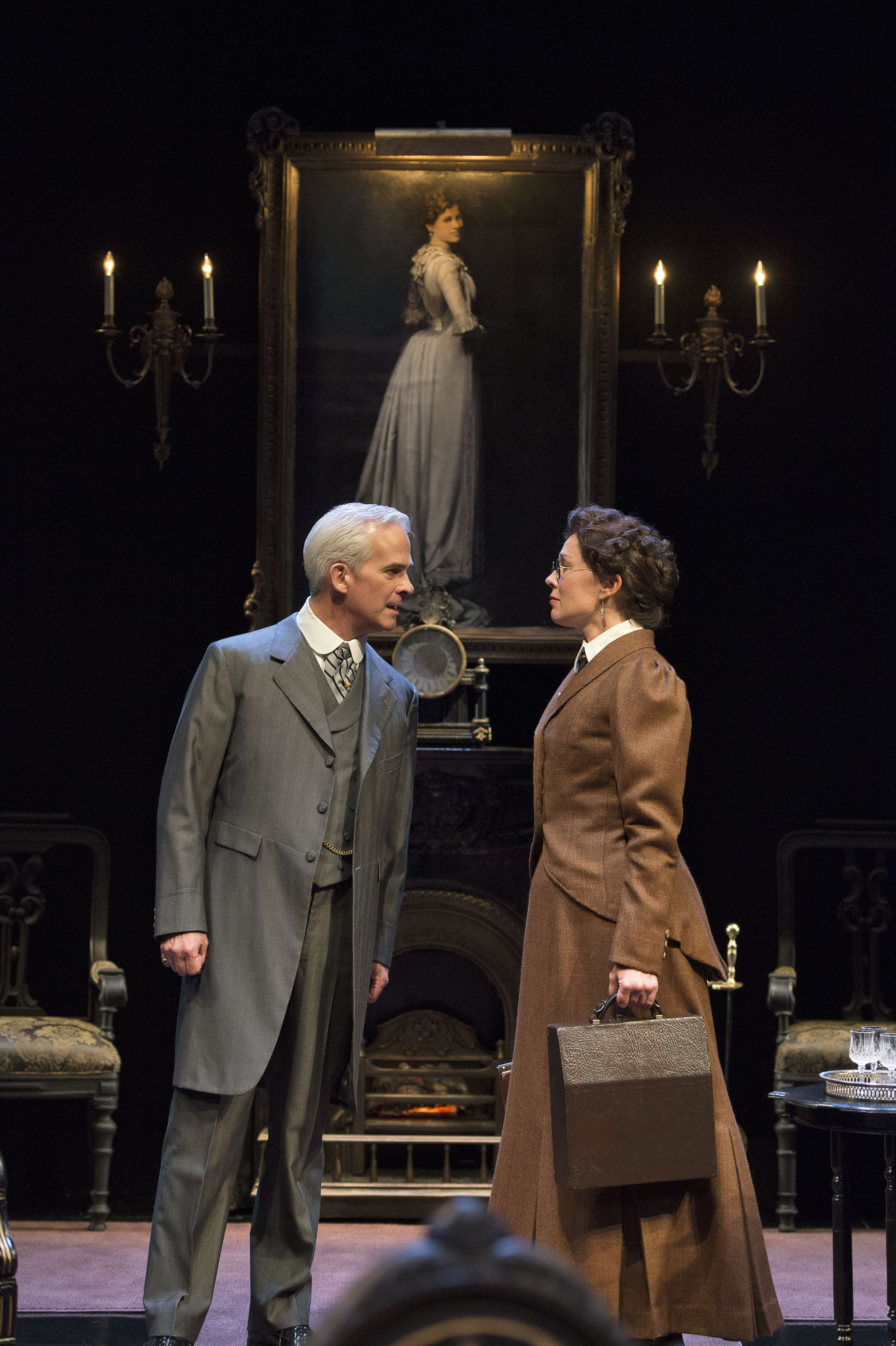
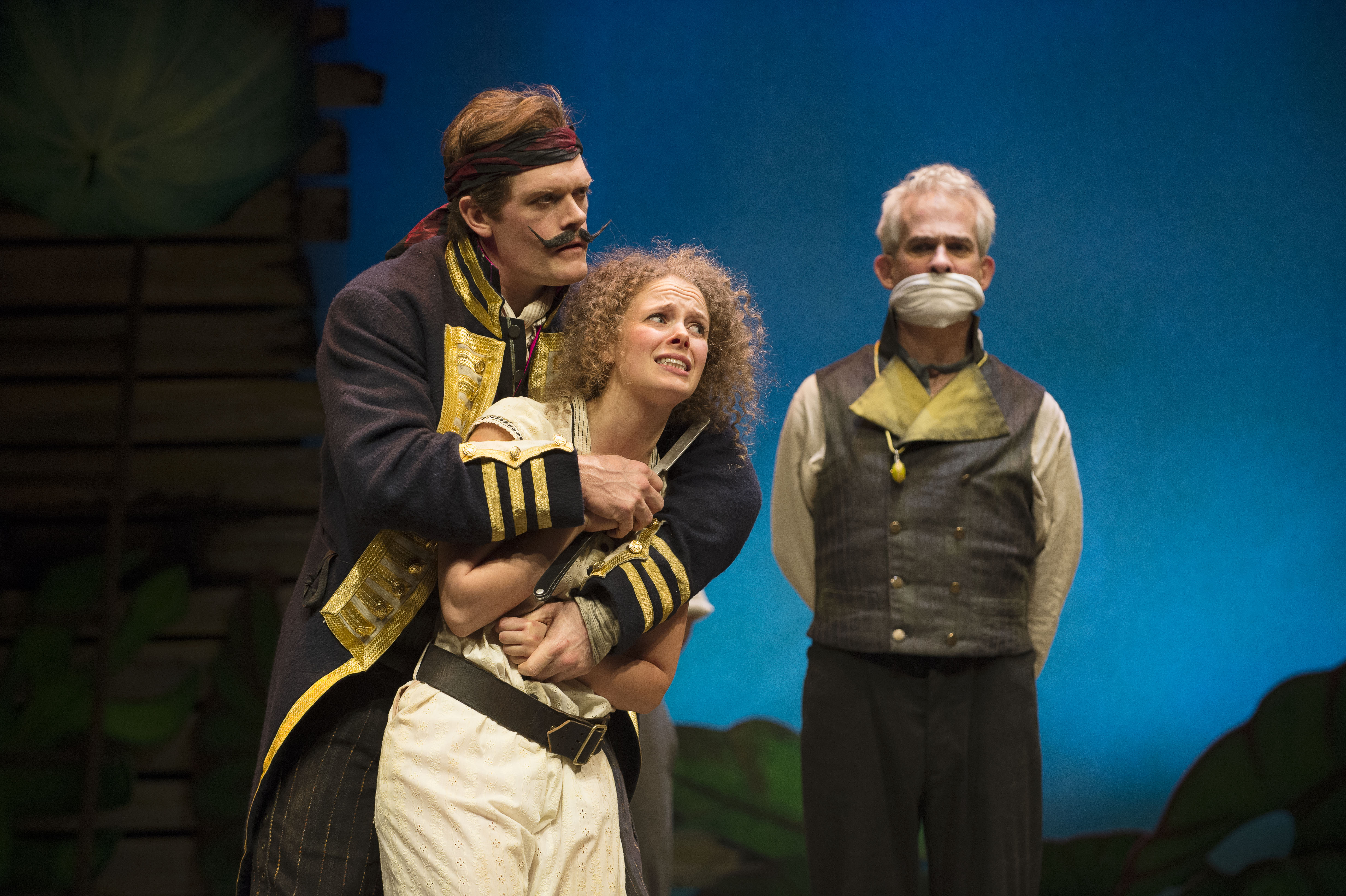
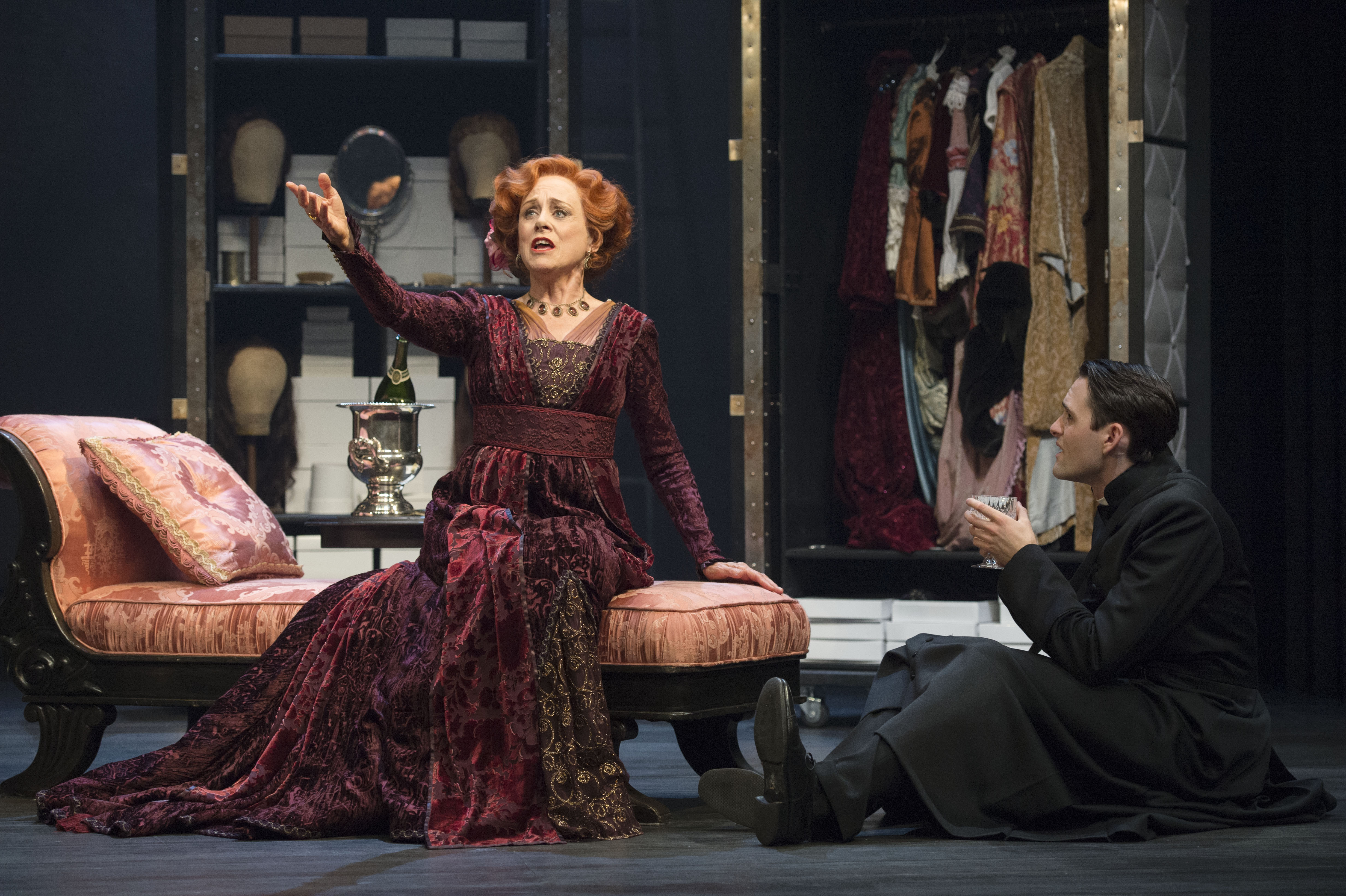
The typist, Kate, played by Moya O’Connell, is unknowingly hired by Lady Sims, played by Kate Besworth, to do some work for Sir Harry Sims, played by Patrick Galligan, and Kate turns out to be his ex. Before her arrival, however, Sims and Sims rehearse his knighthood ceremony and before that Tombes, Neil Barclay in fine voice, sings a song about “Eve and the apple in the bush” followed by Harveen Sandhu, as the maid, who bemoans how “women pay for what was done by Eve”.

Lady Sims then enters in regal attire to Rule Britannia on the piano. The levity here, in all of this, is unforced, seductively amusing, and acted with natural polish. When Sir Harry and Kate meet, he speaks with a clipped authority, which Galligan always does so well, and gloats that she now comes to him “as my servant.” She, meanwhile knows the score as a working woman and comes clipped in her efficient manner.

There is much unresolved in the several relationships here between Sir and Lady and between Sir and Kate. As Kate, O’Connell, while indicating there is much unspoken in her, suggests an ability to draw the flow of their mutual drama into her being. Meanwhile Galligan’s Sir Harry seems on the verge of explosion, both inner and outer. They each imply the intimacies that existed between them and how the effect of their separation still lingers for both. She finds a playful side to their drama, while he remains locked within a wounded rage.

The inner workings of their relationship makes for a palpably believable connection and, as it stands, Sir Harry likes to boast that he understands women and that he is a good husband while, in truth, his religion was a “success”, a success that was “suffocating me” Kate says. And, of course, we soon realize that a man of so little self-awareness might soon lose his second wife much as he did the first. This is a warmly human production of a warmly insightful and honest play, acted by all with keen sensitivity. Highly recommended.

LIGHT UP THE SKY
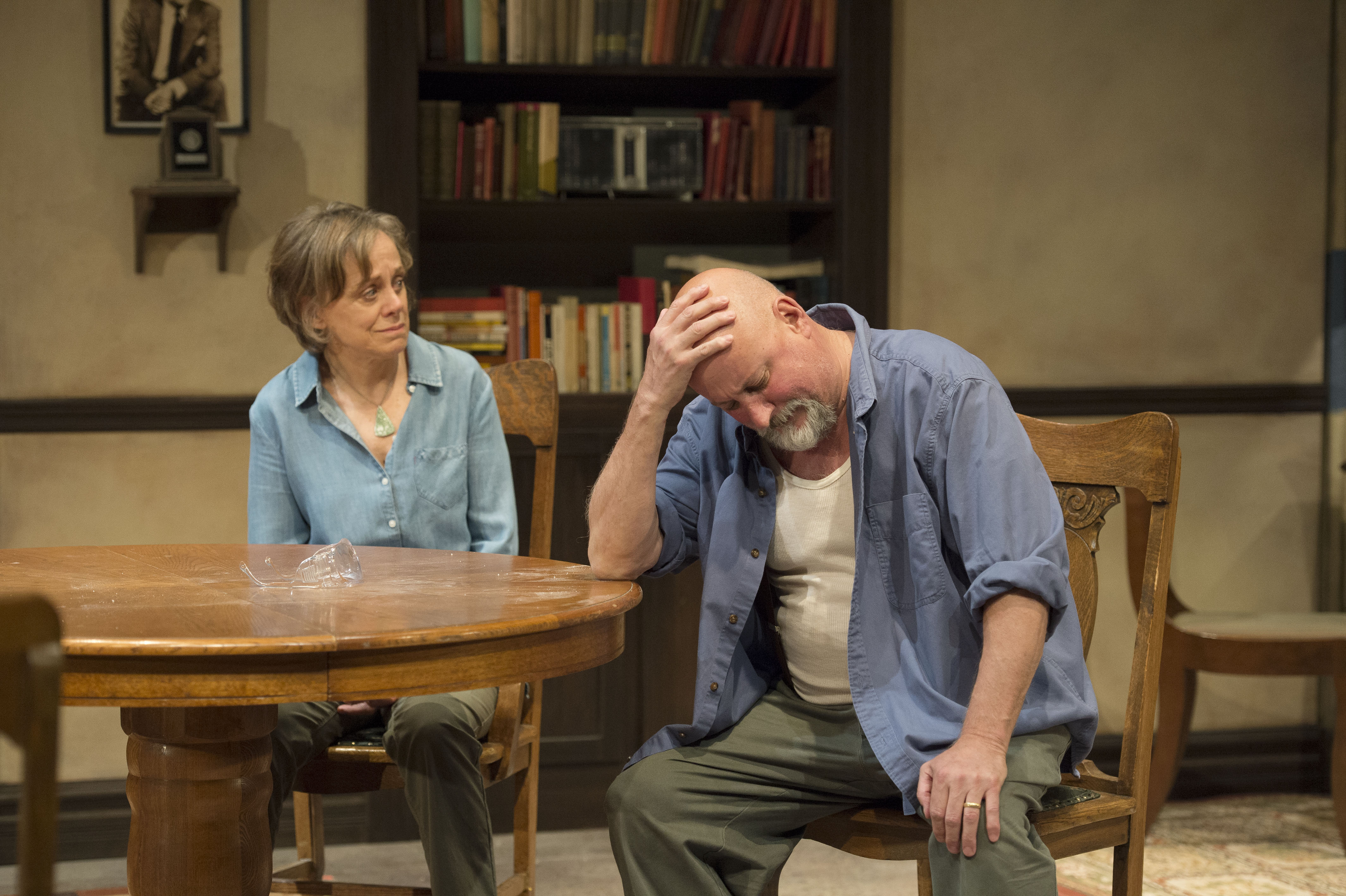
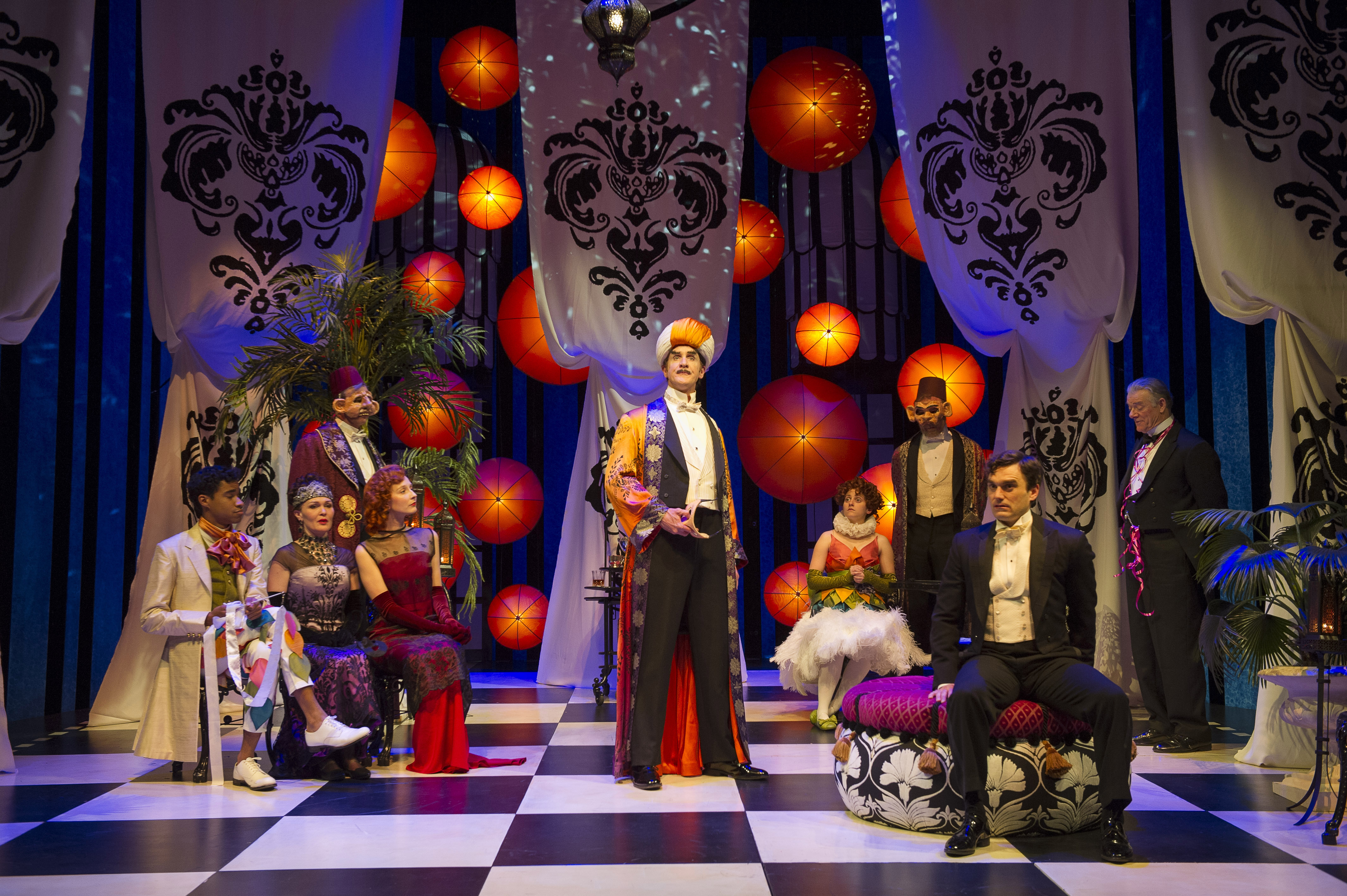
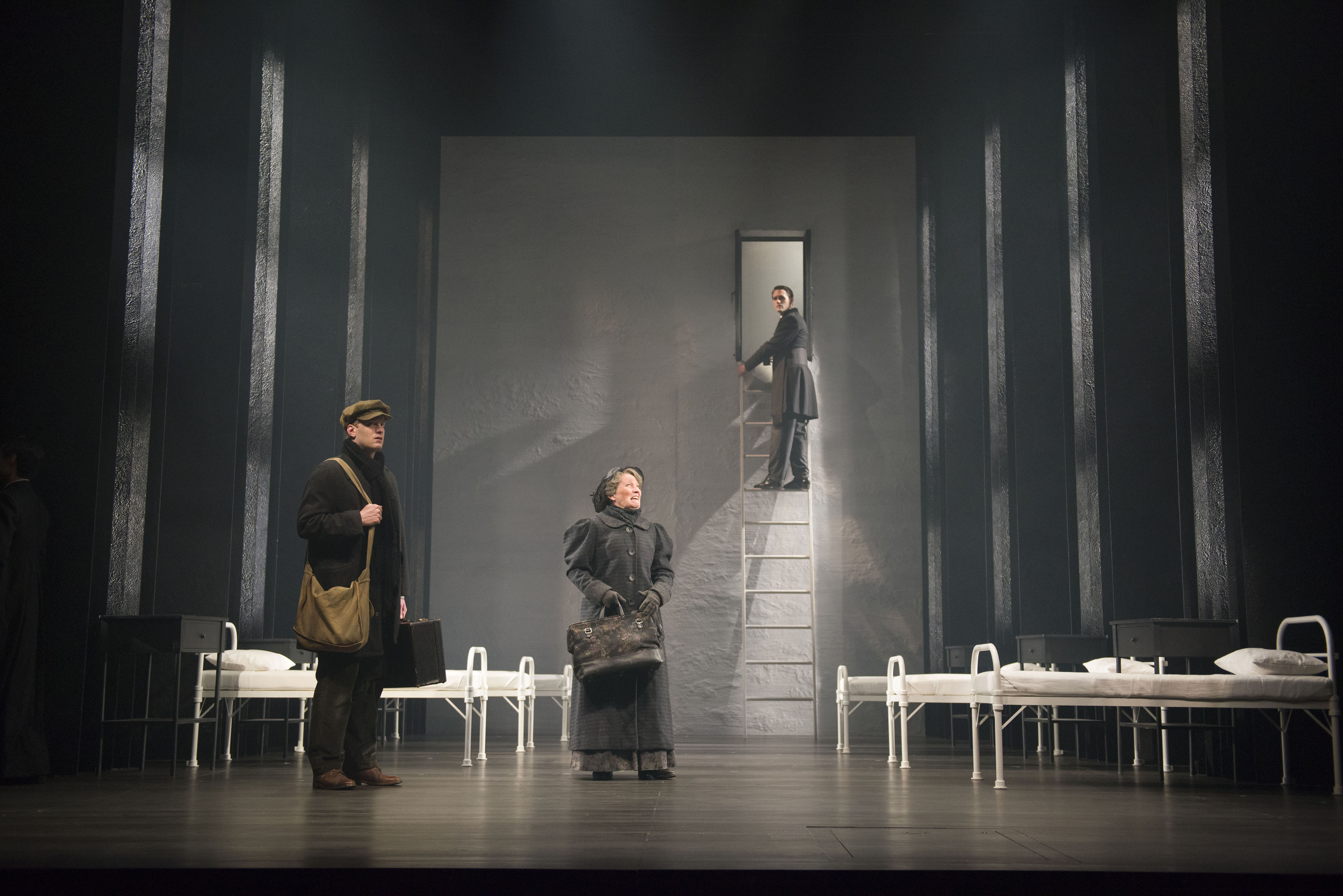
The Shaw Festival production of Moss Hart’s Light up the Sky, from 1948, albeit with some obvious enjoyment among others in the audience, is a frustrating experience. For one thing, Hart’s creation about a Boston, pre-Broadway run of a new play seems a repetitive and belabored attempt to extend the comic potential of a plot that, at least as we observe here, hasn’t enough to offer to keep us alert. We do not have much of a workable situation here with the possibility of engaging turns or complexities in plot or insights into comic character, but rather a situation of predictability.

Thus, in a nutshell, they all feel excited about the new play, they curse the play’s apparent failure on opening, they praise the play now seen for its box office potential. In the first act, all the laudatory talk about “your play” comes to sound like a set up hammered home. The presence of caged parrot who keeps repeating “Thank you, darling, SRO” seems too obviously an overdone device. Most troubling, the self-referential manner of some of these folks remains unearned and unexplored, an imposed cliché about theatrical people that doesn’t ring true.

Are we troubled by the play or its production? Indeed, one’s perceived failings in the play and those in this production at times blur together. Yes, we have stereotypes, but director Blair Williams does little to probe the human reasons for one’s becoming a stereotype in the first place. We, in some cases, have characters meant to serve a function of some kind, it seems, but it is hard to connect with a function that apparently had no option to be otherwise.

As well, with Hart’s given format of talking about the play in each of three acts, Williams doesn’t snap up the pace to keep his audience engaged in such repetition, but allows the play to rely on clichéd types to carry the humour. When he sets a level of frenzy, it seems imposed and even formulaic, not an extension of comedy in the text. These characters are given many things to do, but these seem outward directed by them and not inwardly born.

All the effusiveness, all the fake humility, all the shallowness of these theatrical types cannot go on so long without some indication, in each case, of why it exists. Who are these people? What are the possible reasons that they behave as they do? Even shallow people have a life. Even shallow people have something that we can sense is really at stake, no matter how small, when they resort to pretension or nastiness.

Given the above, we do have several characters who are realized as genuine human beings of implied human depth. In their cases we believe they live actual lives elsewhere, even as they function in service here of stage comedy. As the budding playwright, Peter Sloan, Charlie Gallant is subdued, vulnerable and also initially naïve in his belief in show biz people. Graeme Somerville, as the world-experienced playwright Owen Turner, does a compelling blend of semi-suave and human heart, all the way down to a lower register that implies sophistication.

Turner’s voice-of-experience encouragement for Sloan – “I felt the way you do now, but I stayed”- is genuinely touching. Fiona Byrne’s Miss Lowell is a lesson in understatement and silence implying a great deal. The rejected Stella of Laurie Paton also rings humanly and – humorously – true at the table, and we sense some wound in her bluster. Kelly Fox’s Frances certainly implies a life lived, ergo an always available edge in her manner of speech and movement. Whether the play really needs the characters of Stella and Frances, however, is another question.

On the other hand, one suspects – what is it? –a wrong call of sorts or even miscasting in conceiving some parts or situations. Claire Jullien, being an actor of a usually generous presence, doesn’t find in herself a completely self-centered and selfish bitch of a diva who selfishly wants all. She doesn’t dominate with an indifference to others. We sense no ice in the presence of her ego. Steven Sutcliffe, always capable of subtly suggesting much, is here given one note to play. Both characters have more to offer.

Thom Marriott is an actor who can reveal several inner processes simultaneously at work, but here, flexible and versatile as he is, at times seems more inconvenienced than driven as a money-hungry s.o.b of a producer. It’s an enjoyable performance, but should it be so enjoyable? Meanwhile, the playwright seems to coast or take unnecessary side-excursions, at times, with characters who distract. It is indeed arguable how sharply comic a production this might have been but, as it is, we are left to wonder.

Posted in Shaw Festival, Uncategorized | Tagged , , , , , , , , , | Leave a comment

BUFFALO PHILHARMONIC ORCHESTRA, THE GREAT DEBATE, PETER AND THE STARCATCHER, TOP GIRLS, AND A VEGAN WEEKEND AT THE SHAW FESTIVAL –PART III

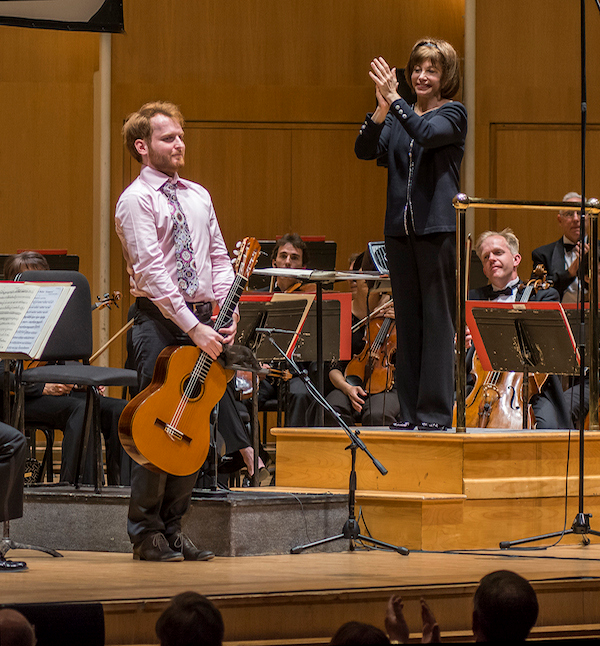
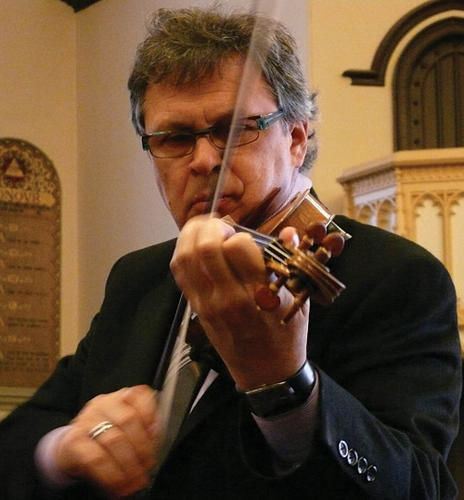
Above: Guitarist Marko Topchii, conductor JoAnn Falletta and the BPO  Below: Violinist Atis Bankas

BUFFALO PHILHARMONIC ORCHESTRA
The Sunday July 20 performance by the Buffalo Philharmonic turns out to be the first ever symphonic concert on the Shaw Festival Stage. I have long wanted to make the trek to Buffalo to hear the BPO and after this performance I will certainly still be inclined to do so. We begin with the Barber of Seville Overture, which in the early stages, with JoAnn Falletta conducting, reveals a surprising lightness of being that verges on ethereal, a clarity of purpose overall, and a distinct balance of all sections. As expected, this Rossini favorite offers a charming sense of fun that, done lightly, is even more fun in not being obviously intended as such. Still, conductor and orchestra produce an underpinning of almost frenzied delicacy.

Next, a front row seat allows a detailed observation of guitarist Marko Topchii’s fingers at work. Yet with all the scales, with which composer Rodrigo shapes the musical contours of this famous work, one soon, at a dozen steps away, sinks into delighted awe at the soloist’s unshowy mastery of his instrument. Once again, the clarity of articulation in all the sections makes the composer’s intent seem more subtly deliberate in effect than lush. Falletta’s conception seems intended to have the listener realize the concerto’s emotional underpinnings through its musical development, all without being told what to feel through blatantly used orchestral devices. We are made to be freshly involved in this concerto we’ve heard often.

Thus, we pay attention to what the music has to offer, both intellectually and emotionally. Thus, also, we as listeners are gradually worked over by the mutually supportive elements at play here before us. One feels an implicit sense of anticipation in the music and, at the same time, an emotional undercurrent, as if the past is now giving voice to its unfulfilled self in the present. That is indeed an engaging effect. Falletta guides Rodrigo’s delicate musical threads with insightful deliberation and guitarist Topchii, with unflinching technique, gives the solo part for guitar an assured and almost conversational quality.

Topchii returns for an encore and, born in Kiev, offers the Great Gate of Kiev from Mussorgsky’s Pictures at an Exhibition in which the guitarist’s many variations comprehensively and brilliantly explore the guitar’s potential in tone and texture. At one point, he offers an impressive simulation of a balalaika orchestra, but seemingly played by feathers. When Topchii bows to the audience, I shout Хорошо, to which this much-awarded guitarist partially, and almost shyly, smiles.

After the intermission, with solo violinist Atis Bankas in two selections by Tchaikovsky, conductor Falletta establishes a discreet but firmly present delicacy in shaping orchestral colours. Meanwhile, violinist Bankas makes ripe and rich linear statements in waves of emotion and one realizes how assured he is in developing such meaty and assertive musical offerings. One of Falletta’s skills, again, is her precise placement of orchestral values, without imposing them upon us. The listener is keenly aware of each work’s inner workings, as a result, and thoroughly engaged.

In Mozart’s Prague Symphony, Falletta stresses both inner humour and inner lyricism without pointing directly at either. We realize gradually this effect. At times one senses an orchestral suspension above a vortex of some kind, all the while sensing too a poised restraint. If this be a classical statement, within prescribed musical boundaries, such restraint nonetheless exudes anticipation with a twinkle at its core. Falletta may at times seem to prefer a clarity of musical purpose at hand over horizontal musical thrust, but then she also finds what seems like an awakening chirping in the woodwinds, for example, or what seems a bombastic indignation in the tutti passages.

In sum, Falletta’s precisely conceived musical intentions, and the BPO’s meticulous responsiveness, along with two technically impressive and delightfully imaginative soloists, all make for a memorable beginning to orchestral concerts at the Shaw Festival. Need we say “Encore?”

THE GREAT DEBATE: FAMOUS OR FORGOTTEN
The Great Debate is hosted by former Shaw Festival Artistic Director Christopher Newton. Four musical experts constitute a panel with this question in mind: What of today’s classical music will people be listening to in a hundred years? William Littler selects Rachmaninoff because “a good tune is important” and the composer created his music “not with head but with heart”. Rick Phillips adds that “piano music will be the reason that Rachmaninoff will survive.” Littler for his second choice opts for Korngold who “had a ballet mounted at age eleven at the Vienna State Opera.” Korngold influentially created a symphonic style of film music that “speaks directly to the heart.” Tom Allen adds that Korngold went to Hollywood as a “score doctor” and it’s agreed by all that “we have to move past prejudice against Hollywood music.”

Peter Hall notes that “rap is popular because it is rhythmic” and, arguably, “we wouldn’t have rap if we didn’t have Igor Stravinsky.” Rick Phillips states that “polytonality and harmony are what make Stravinsky influential” and Littler adds that only a handful of Stravinsky’s works are heard anymore. Peter Hall then says that “those who write for the stage know how to reach an audience” and his next choice is Leonard Bernstein. Admittedly, some of Bernstein, like the Chichester Psalms, is “unlistenable,” but West Side Story will certainly endure because we all have an immigrant background. Littler adds that not much other than West Side Story by Bernstein is being played nowadays.

Rick Phillips next chooses Prokofiev for his innovation, energy and lyricism and then Dimitri Shostakovich because most of his music is “unbelievably good,” although he did write bad stuff like the Oratorio on Reforestation. Littler adds that Shostakovich is played more in the West than in Russia these days. Tom Allen’s selection is Benjamin Britten and he notes that the gay composer’s opera Peter Grimes is full of beauty and terror. To this Rick Philipps adds that “Britten wrote a wide range of music and he was one of the most clever of 20th century composers.”

Rick Phillips also notes that Britten intended Grimes to be a poet and hated the anger in Jon Vickers’ interpretation of Grimes. Publicly, however, Britten was more discrete when asked about Vickers and responded “I’m sure he followed the score, so he was fine.” Allen ends with Bela Bartok and notes the composer’s background in field recordings of folk music, ergo his use of folk music in classical works. He notes too that Bartok wrote music to teach children.

No one mentions that all these composers have been dead at least twenty-five years (Bernstein) up to seventy-two years (Rachmaninoff) nor that we have a decent number of composers alive and composing or recently departed who too might be given repeated listens in 100 years. Meanwhile, I find myself looking eagerly ahead to the Borromeo String Quartet doing Bartok: The Complete String Quartets on August 6 at Toronto Summer Music. You don’t get that opportunity very often, all in one night, and I’ll be there.

NOTES ON A VEGAN’S WEEKEND AT THE SHAW FESTIVAL
Stayed again at the King George III Inn. For tormented souls who rise very early, what better option than to begin writing for the day on the second floor balcony overlooking the marina with sun rising over the Niagara River and gradually intensifying in one’s eyes, at which point one moves? This is a different world than one often gets with all its fluffy pillows and floral patterns up toward and beyond Queen Street. Or in Stratford which can be even worse in its studied quaintness. I have sat on the balcony here and imagined Walter Johnson or Christy Mathewson throwing a fastball across the Niagara to the American side, I don’t know why.

Breakfast again at the Tiara Room one block up the street at Queen’s Landing, a room which promises and delivers a large, sunlight-filled space and a great view. I like a quiet corner here where I can write before and after and sometimes during my oatmeal, juice and endless coffee. The music on the speaker is 50s and 60s Sinatra which I and the waiter appreciate. It turns out that he prefers lighter plays and not the more “morose” ones that are sometimes produced with all the yelling and fighting. He wants to be “entertained.” I overhear a couple from the USA who have just spent a week at Stratford and now one at Shaw, and they say “we are so lucky.”

The NOTL Tourism Office is located in the same building as the Court House Theatre. I ask for leads on a vegan meal and the lady says “Zees Grill.” “Any others?” I ask. “Zees Grill,” she says. This is not accurate, since on several occasions we have enjoyed Ginger Restaurant with its two exquisite vegan options, one including my beloved staple tofu, plus helpful service and warm ambiance. For lunch I’ve been having my eggplant, roasted pepper and avocado sandwich (sans cheese) and gazpacho at Epicurean for years, usually on the shaded and very pleasant back patio. You can order ahead a vegan supper here and once I had mine while chatting with actor Bernard Behrens at the next table.

Fan’s Court which used to provide a number of vegan dishes, some with tofu, is long departed from NOTL. A soup and sandwich eatery, one that served vegan chili and vegan salads, lasted maybe two or three years near the Courthouse. A restaurant near the Royal George where the past two years I ate stuffed peppers or pizza, both vegan, is now closed or demolished, although I did try Bistro 66 next door for a salad one night. My discovery, however, was Little Red Rooster Restaurant on Mary Street near Hwy 55 which serves a huge “Veggie Stir-Fry” with a mound of rice in the middle.

The owner of Little Red Rooster is delightfully engaging and soon, although she is Asian, she confessed to inability with chopsticks. Each day she also provides a list of vegan pie offerings, with a crisp tasty crust, and I enjoyed apple the first time and strawberry-rhubarb the second. “Do you go to plays at the festival?” I wondered, to which she responded that she didn’t have to since many of the Festival’s actors eat at her restaurant. Later I enjoyed my second discovery, Il Gelato di Carlotta, at 59 Queen, which offers about six vegan gelato options each day. I love to sit outside on a bench with my surprisingly filling gelato and enjoy the warm and slightly haunted atmosphere of Queen Street on a warm summer’s night. The tourists are elsewhere, you can hear single footsteps, and the air feels ghostly, misty.

Posted in shaw festival, the arts, Uncategorized | Tagged , , , , , , , | Leave a comment

PETER AND THE STARCATCHER, TOP GIRLS, THE BUFFALO PHILHARMONIC AND A VEGAN WEEKEND AT THE SHAW FESTIVAL –PART II

Photos by David Cooper

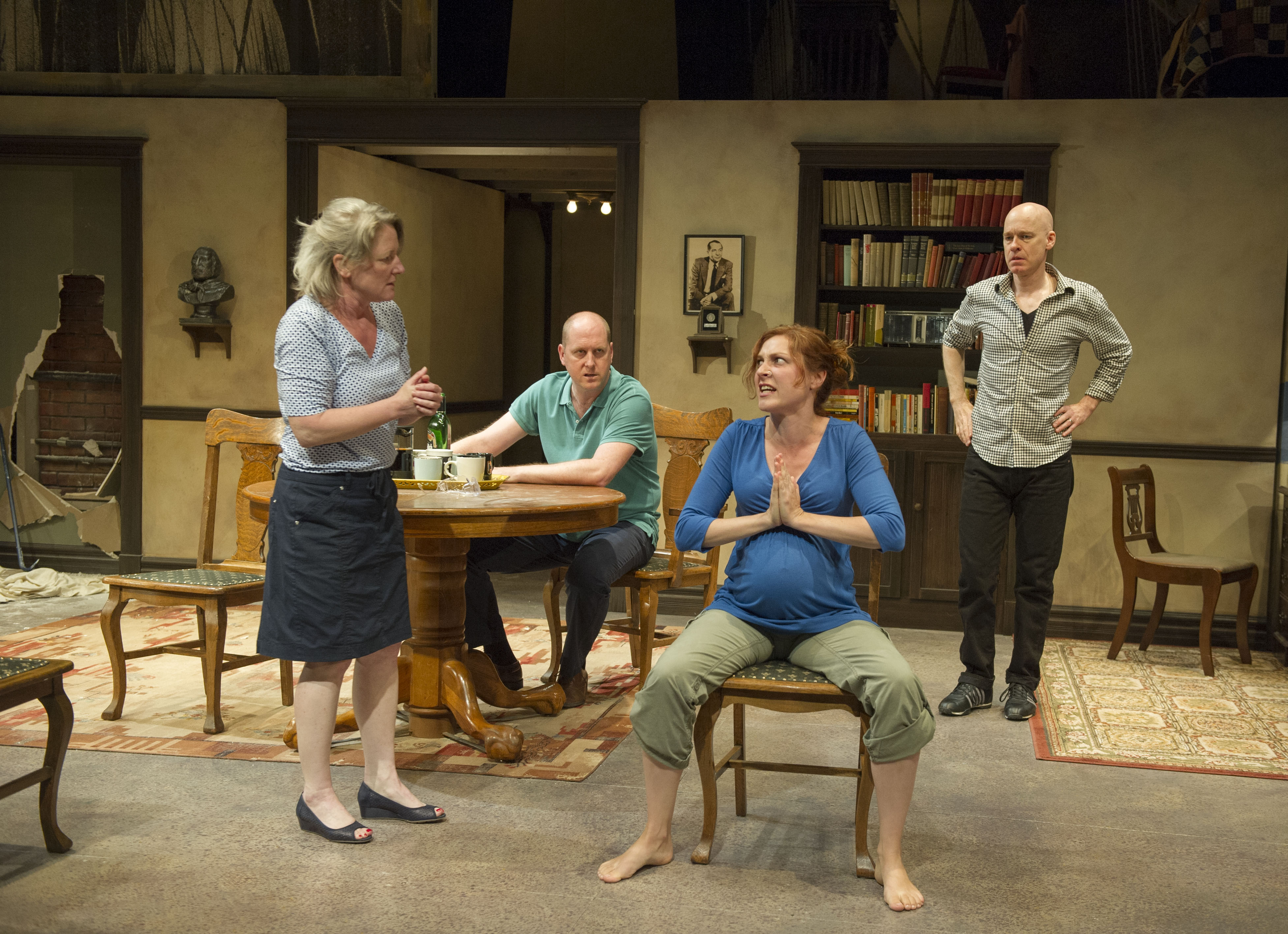
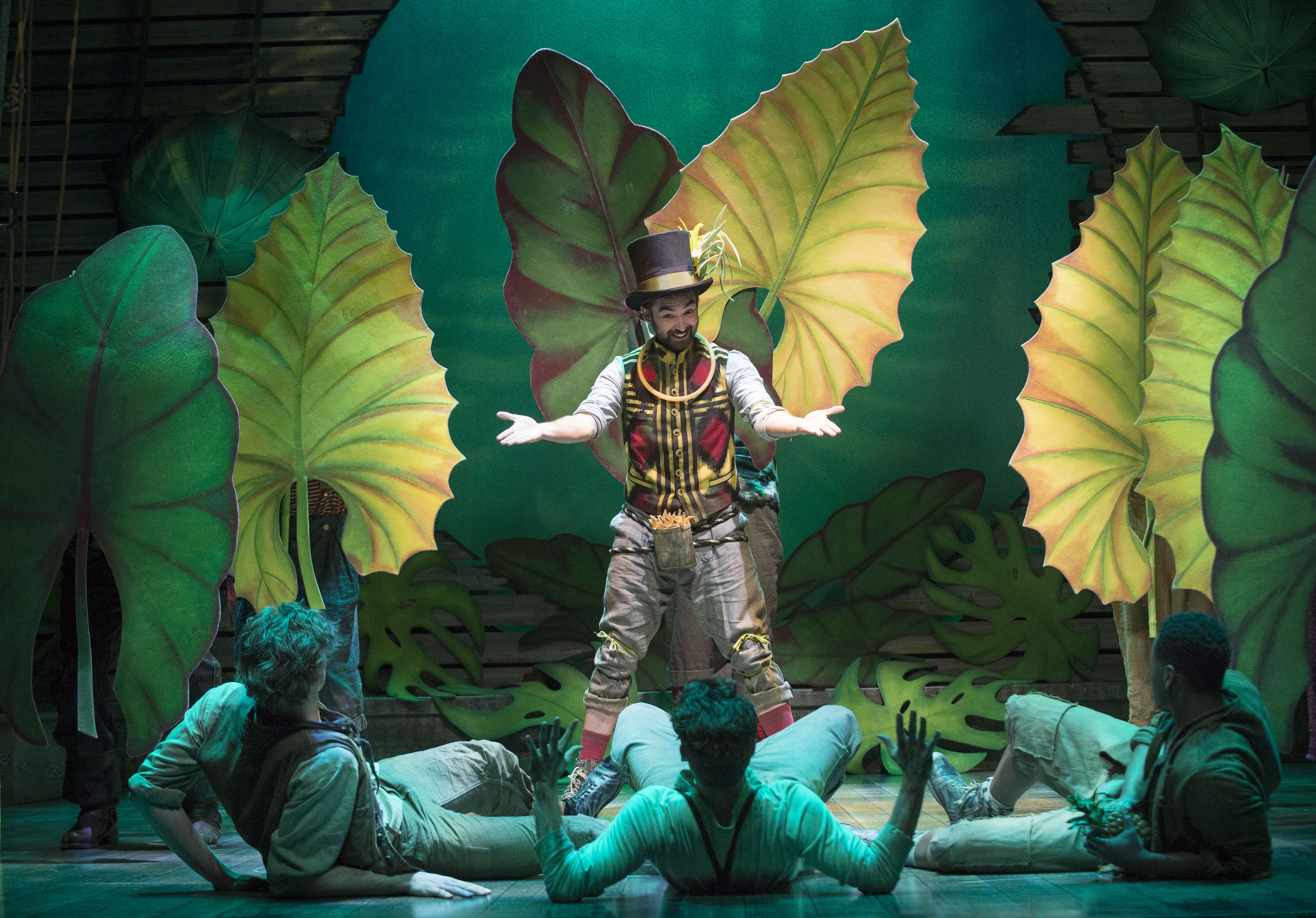
It’s like a playful dare when Jenny L. Wright as Teacher turns to her audience and says “You may think we have gone too far.” But that is the point of Jackie Maxwell’s production of Peter and the Starcatcher, with its guiding purpose of blatantly going farther than too far. Maxwell establishes a high level of energy in this tightly controlled silliness, one which remains delightfully overwhelming throughout and without a pause for anyone to catch a breath. Her cast is dynamic and fluid and each one delightful in all-directions-at-once movement. They are always high voltage, assertive, and politely in your face. A tone of eagerness prevails, of youthful openness to wonder. One easily submits to the overall seductive silliness (that word again) of the thing.

Well, actually, one doesn’t submit, one is sucked in by the continuity of energy (that word again) and surprise, as story line hangs on hard and is almost demolished by myriad asides from this always clever bunch of pirates and children. The cast members display an agile and self-mocking physicality, a remarkably unforced inhabitation of kooky gestures and postures, all the while maintaining a concisely etched take on adventure tale characterization. Valerie Moore’s movement direction ensures that this is a kinetically bubbly show in which each movement surprises us. Keven LaMotte’s lighting ensures that shadows have physical presence and that figures are sculpted, sometimes eerily, by light.

Peter and the Starcatcher is projected as a large theatre show, but one that is squeezed a tad into the smaller Royal George Theatre venue. The result is one of impending joyful explosion and tightly compacted insanity. We have fifty shades of neon costumes of sexual and species ambiguity, and a set of, for one, huge body sized leaves. Two ships colliding is depicted, on the other hand, by two small scale models poking at each other at arm’s length. Meanwhile, director Maxwell keeps characters interesting and engaging in their dual purposes as dramatic individuals and as vehicles for clever text and action. At the same time, Judith Bowden’s design dances fantastical and gives us not a few colours selected from a palette but, instead, the whole damn palette itself.

This happily overwhelming production aims to be all things for all people and here are some: Inspirational as in Molly assuring Boy “To have faith is to have wings.” Sentimental as when Dickensian orphans explain that they can’t be told bed time stories because they have never had beds. Romantic as when Molly says to Boy “Write when you feel like it”. Childlike as when Lord Aster and Molly speak in “Dodo” or we hear repeatedly “I hate grownups”—this in a play that is sprinkled with many grownup references, say to the likes of Ayn Rand. Crude as when a fart is introduced by the crew and it becomes an ambiguous sounding motif throughout. Indeed, we receive a good portion of groan material as in “You’ve made your bed, Pan” and, of course, “Shall I compare thee to a summer’s day” comes, at least in this show, with a kick in the balls.

The humour in this prequel to Peter Pan is always unanticipated and often current. Given a can of worms to eat, one lad requests “a vegetarian option”. When one pirate is called of all things “a thug” he has a much out of character cry and tantrum in reaction. We have reference to Myley Cyrus and twerking and the complaint that “The English invade the island and now nature has been focaccia-ed.” We also hear the warning “Don’t you touch one hair on that woman’s legs.” Naturally there is reference to theatre as in “Iambic is box office poison” or in this exchange, “He is chewing all the scenery” “Not in my scene he ain’t.” All this and much more comes at a fast clip while much chaotic stage movement -kitchen sink included- is going on. We are zapped with cleverness and characters who thoroughly delight. Praises to each cast member for pulling off a big show in a big way. As a result, we are happy.

Posted in Uncategorized | Tagged , , , , , , , | Leave a comment

TOP GIRLS, PETER AND THE STARCATCHER, THE BUFFALO PHILHARMONIC AND A VEGAN WEEKEND AT THE SHAW FESTIVAL PART I

Photo by David Cooper

Top Girls

Not long ago, I met a university student who very confidently declared, “I like Stephen Harper.” “And why is that?” I asked, incredulous. “Because he gets things done,” was his answer. “And at what human cost?” was my next question, but he didn’t seem to understand my meaning and this time he had no answer. He was a business student, wired no doubt for the “excellence” promised by universities hustling potential graduates nowadays for the corporate world. He seemed intent on quickly climbing a ladder to a career and had no time for either introspection or for human lives discounted in a culture whose ethos is financial gain. I thought about this student while watching Caryl Churchill’s brilliant play Top Girls at the Shaw Festival recently and realized how very relevant a play it still is.

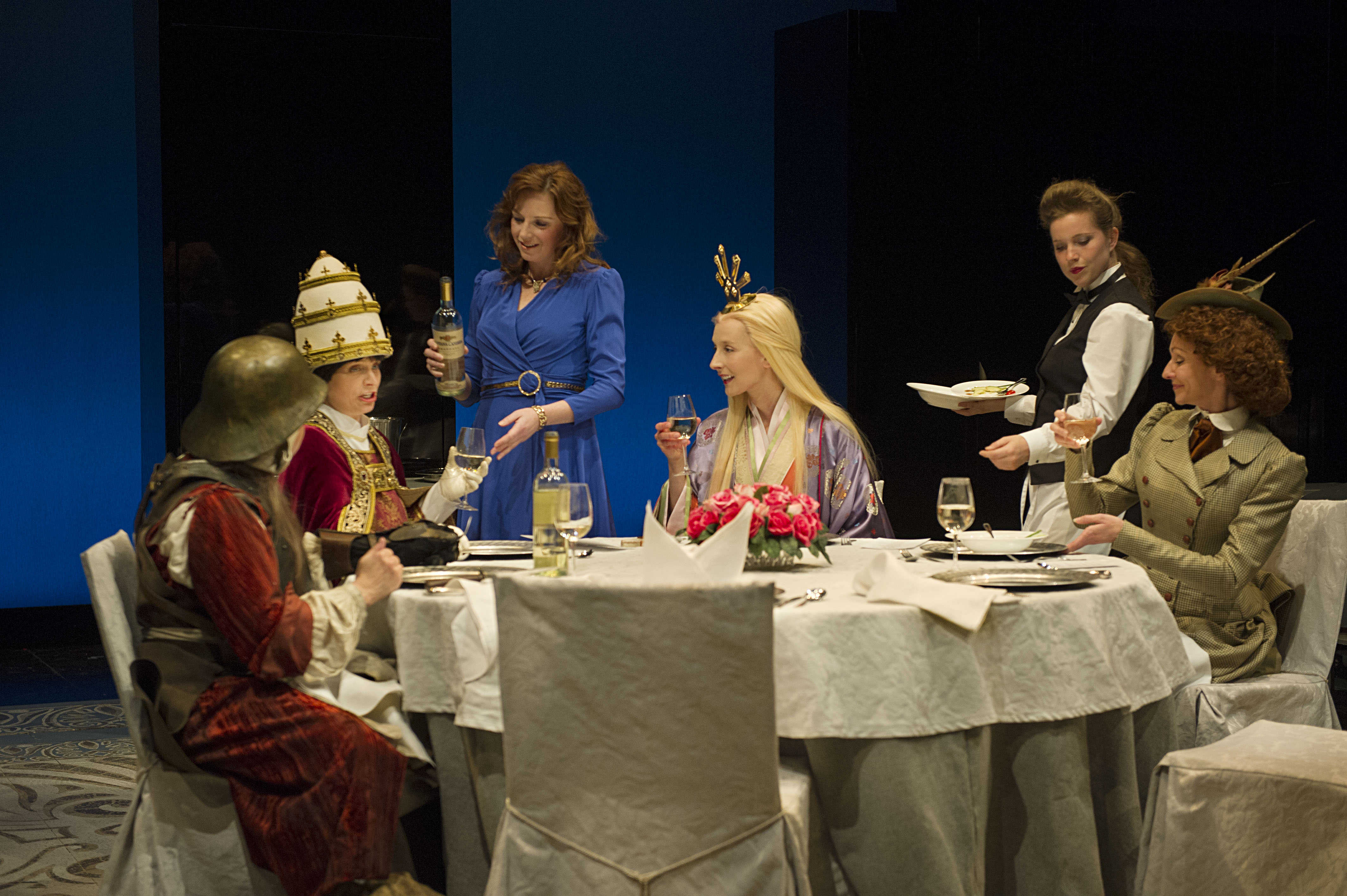
Top Girls, from 1982, is a product of the Thatcher era in Britain, a time when a Conservative government was geared to “get things done.” As such, we have Marlene, now newly appointed as a managerial director at an employment agency, who soon declares “I hate the working class,” the very class from which she came. Her cost, we later find, is the loss of her daughter. Indeed, the theme of maternal loss of one’s babes is established by a remarkably-conceived opening scene, one during which we meet five other women selected from history, art, or culture.

These women too were compelled to give up their young children, their own flesh and blood. They include the legendary “Pope Joan,” a thirteenth century Japanese concubine, Isabella Bird who was “the first woman to address the Royal Geographical Society,” Dull Gret from Bruegel’s painting “Dulle Griet Leading an Army of Women to Pillage Hell,” and Patient Griselda who, as verification of her obedience to her husband, gave up two of their children.

This opening scene is gut-wrenchingly potent with its emotional complexity deftly realized by an incisively able cast. We have Claire Jullien as Pope Joan, the one who gave birth during a papal procession, played with invigorating and unwavering bite into her character, plight and all. There’s Lady Nijo of Julia Course, serene and evocatively understated as some of the women in Kenji Mizoguchi’s films. Isabella Bird is played by Catherine McGregor as dynamically poised and fiercely proper, while Laurie Paton’s Dull Gret is defiantly crude and blunt and unbending as she stuffs food into both her mouth and her bag. Meanwhile, Tara Rosling’s Patient Griselda seems the womanly embodiment of sky-infused earth.

The accounts of children taken and murdered, from all five, are deeply touching and, as Lady Nijo declares, “Nobody ever gave me back my children.” She also describes how women were beaten so they would deliver sons. Meanwhile, Fiona Byrne’s Marlene, the one who imagines and hosts this gathering, reveals an underpinning of wistful psychological need, even as she enjoys her authority over the waitress played distinctly herself and quite present by Tess Benger.

There is much overlapping chatter here as these women bounce emotionally off one another and gradually touch our hearts and make us compassionate to the wounds of their painful lives. This chatter, sometimes impressionistically-delivered as vague sounds and sometimes stiletto-precise, gets cut off often by a listener being distracted by another speaker seeking a new set of ears. The implied indifference to a woman speaking from her guts is subtly obvious for us to hear.

We pay close attention to the experience of five figures from the past, accounts of women suffering brutality at the hands of a patriarchal culture that always called the shots. We see the bottom side of male domination with its humiliation and dehumanization of women. But take us up to today, still with its unfeeling attitudes to human dignity, and we find that sisterhood does not yet prevail, that compassion for one’s fellow woman is not the norm.

If we are told that “men are such bullshitters,” we are also shown often in this production that women can be mean shits. Take this encounter: a female employment counsellor interviews a 46 year old woman who has “spent 20 years in middle management.” The latter, played by Tara Rosling, now sees young men she has trained rising above her in position. She notes, however, “I don’t care for working with women” and then, as a sign of her worth, adds, “I don’t drink.” To this, the counsellor, played by Claire Jullien, declares with a dismissive iciness that is quite palpable, “Good for you” and we sense now a war of generations within the ranks of women.

When Howard’s wife, played with exquisite shadings of feeling by Laurie Paton, comes to see Marlene who has won a position coveted by Howard, she explains that her husband will have a hard time “working for a woman.” She implies a need of special consideration for “a man of Howard’s age,” and even that Marlene should step aside for the male to take her new position. Howard’s wife soon deems the uncompliant Marlene as a “ballbreaker” since her own survival requires that she stand by her man and the patriarchal system, woman-suppressive as it is, of which he is a part.

At one point, two women in conversation each declare, “I’m not very nice” and indeed we see women at war with one another throughout Churchill’s uncompromising play. Young teen Angie declares to younger friend Kit, played by Tess Benger with an easy precision that is most believable, that she wants to “kill” her mother. We see a love-hate connection between the two friends – and between mother and daughter, when the former declares, “You fucking little cunt, you can stay there and die.”

Later, when two colleagues of Marlene congratulate her on her new position, their “We are happy for you” reeks of insincerity. When Marlene observes Angie, she declares, “She’s not going to make it,” and does so not with maternal concern but with bureaucratic dismissiveness. Love-hate is also the norm when the two sisters, Marlene who is now getting things done in the Thatcher world and Joyce who remains defiantly working class, have it out. Here we have not only longstanding familial animosities, but political ones too, in this confrontation. It is a tense scene full of rich emotional human fibre. We discover that terms like feminism and class struggle indeed have a very human dimension, one that might get lost in university seminars that ponder the past.

This Shaw Festival production is often gripping theatre. We have a variety of intriguing characters, implicit dramatic issues that no matter the tension cannot be resolved, potent interactions of all kinds, a first act that is one of the most theatrical and heart-provoking in the dramatic canon, a cast of sometimes inspired performances, and relevance for today without question. We have a play, though in something of a distracting production of it, that shows how the best way to comprehend an era is by understanding the lives who live it, the lives who interact with others in a similarly trying or quite different situations.

Two issues, then. Director Vikki Anderson’s decision to have these women at dressing tables and getting into both makeup and character –yes, we ‘get it’ that women have been forced to play roles in male-dominated societies – feels unnecessarily gimmicky. It’s as if directorial concept wants to prevail over the playwright’s passionate, evocative, and humanly precise writing for these characters.

Equally distracting is the very loud blast from the past soundtrack of golden oldies which, with their blunt familiarity, are much an intrusion into Churchill’s engaging subtleties of characters whom we slowly come to understand. Why would one use such devices and force the play to be dramatically removed from our lives and even turn it into an artefact from the past? Plays from any past that have the guts to face their time will always be a relevant inspiration for us to face ours.

Posted in shaw festival, the arts, Uncategorized | Tagged , , , , , | Leave a comment

CHRISTEL BARTELSE: AN INTERVIEW WITH WRITER, PRODUCER, CLOWN, TEACHER, COMEDIAN – AND CREATOR OF “ONEYMOON” NOW ON ITS WAY TO EDINBURGH FESTIVAL FRINGE

Canadian Comedy Award Nominee Christel Bartelse, now appearing at the Hamilton Fringe Festival, will soon be taking her new show, “Oneymoon,” to the Edinburgh Festival Fringe. This interview took place in July of 2015.

James Strecker: Actor Ed Asner once told me the famous story about a comedian who, as he was dying, was asked if it was hard to do, to which he responded, “Not as hard as comedy.” So tell me some of the reasons why comedy is difficult to create and perform and how you overcome these difficulties. Or is comedy easy for you?

Christel Bartelse: Comedy is brutally hard, but, when you love what you do, it makes it easier. I love to make people laugh. But really, I write what I know about and try to find the funny in the situation. Of course, what I find funny, may not be what someone else finds funny and therein lies the challenge. I’m constantly re-writing and tweaking to get the most out of the joke, or the moment. I also know and spend time with a lot of funny people who inspire me and keep me sharp.

JS: I was amazed last night at your performance of “Oneymoon” how physically demanding a show it is. How do you keep your body fit for a performance like this and also how do you keep your voice in good condition?

CB:I have to admit I am tired, but then I remind myself that in the UK I’ll have over 22 performances so, if I’m tired now after 9 shows, I’m in trouble. I do a lot of yoga and stretching, which I have to do, but luckily enjoy. I’ve always been an active person and a physical person, it is what I love doing, this pushing myself to new levels – although, with each passing year, I’m noticing my age. Ha! Last year I tore my ACL, which was both terrifying and painful. Since then, it’s just slightly affected what I can do on stage. But this show keeps me fit. The show is my exercise during my run. As for my voice, I do worry. What tires it out more than the show, however, is the constant flyering I do, which will of course be constant in Edinburgh. I’ll have to take good care of it. Resting when I can, lots of hot tea, and the occasional whiskey. I love talking and never stop, but I do have to force myself to. If I do over 10 shows or so, I usually get myself a Mic, which helps take some of the strain off the ole vocal chords. I actually have always wanted to create a silent show, but no one believes I could do this, ha!

JS: In this one hour performance, you have to maintain an arc for your character and a development of the story while, at the same time, realizing all the potential of each scene, so how do you satisfy all these demands and what pitfalls do you face as you do?

CB: That’s funny because the night you saw it, I actually think I blanked. It’s so frightening as a performer when this happens. Luckily, I love improvising and playing with the audience, so I just incorporated it into the show. Also, Caroline Bierman, my character, is strangely my alter ego, so she’s just a heightened version of me, so it’s not too much of a stretch. The hardest part is that I often go off script, and sometimes I get carried away and have to remember my place in the script and make sure to bring it back and not risk undermining the arc of the show.

JS: One thing I like about the show is your implicit but subtly understated understanding of how people struggle to live and what becomes of them as they do. Could you explain how you manage to pull this off in such a very funny show?

CB: Why thank you. I didn’t know I did that so well. Again, I just write what I know and then try to find the funny. I think this show has a universal message because we all struggle to find love, and we all struggle with loneliness. And often, even in a relationship, you can be lonely. I think the show has something for everyone and that’s why people can relate or enjoy it.

JS: Something else I appreciated was your sense of timing, the length of time you pause before speaking again. How does one know whether to wait three seconds instead of two, say, and how does one learn such an essential skill?

CB: Timing is so important. I actually am well aware when my timing is off. I was speaking after my show to Colette Kendall, who does The CockWhisperer, and we were discussing that it’s amazing how aware you are when this happens. You just have to get it back. But sometimes you just have an off night. It happens. This is something that does take time to figure out. You can do a joke one night, and then again the next night with a little more of a pause and it may have more impact. You play and find this as you go. But it’s quite obvious when one’s timing is off. Breathing is key. I do teach my students to B-R-E-A-T-H-E. And in every show I remind myself: “Take a breath. Pause & breathe.” You also are hoping for laughs, so once you get your show in front of an audience, the timing changes. You don’t want to barrel through the laughter either. Enjoy the moment and just as it’s dying off, give them the next one. It’s a continuous process, you are constantly learning as you perform, especially with a relatively new show. When I did the first show in the run, it was around 50 minutes, and now it’s closer to an hour, so right there you can see the impact of timing and how it is constantly evolving as the show evolves.

JS: You teach in several areas, so maybe you could tell us what is difficult for your students about learning the following: Improv? Movement? Physical Comedy? Clown?

CB: I love Clown and I love teaching Clown, but it’s definitely the hardest art form to teach. It’s all about listening, listening, listening. To yourself and most importantly to the audience. And when you get a laugh, repeat. They always want to move on to the next thing. I say “We liked that, do it again” What’s difficult for my students is that most of them wish to be standup comedians, so in the beginning they don’t have the awareness that a joke can be funny with a physical punch up, an action, a pause, a breath. It’s really being in your body and not just in your head. I talk a lot about impulse and listening. And most of the work in my class is done in silence. It’s more about the physicality and facial expressions. A lot of my students end up loving Clown, but in the beginning I think everyone has a fear of “What the heck is this?”

JS: A few years ago, a clown from Cirque du Soleil explained for me how a clown in performance must be acutely tuned in to an audience and able to intensify their state of involvement, so could you explain some ways that a performer manoeuvers an audience to where the performer wants them to be emotionally and mentally too.

CB: My “signature” in all my shows is audience participation. But I know this isn’t for everyone. Luckily I do think I have a gift for this. I love bringing people up, but making them shine. Never to embarrass them. Making them have a moment on stage, where they helped the show along and the audience thinks, “Wow, that person was great. “ But yes, I need to be so acutely attuned to my audience and listen to who I bring up. I scan the audience right off the top of the show, I look at who would be great and who’s into the show off the top. Really looks like they are open to the entire experience. Once I have them, I coach them in the best way possible to make them shine. This run in Hamilton, I’ve been blessed with some of the best audience participants ever. Each night is a gift. But don’t get me wrong, I have a couple of great stories where I wasn’t so lucky. Not sure it was bad luck or maybe I wasn’t in tune that night and really picked the wrong person. In this case, the show often takes a dive. Then you have to hope to win over the audience again. I think that by having a close relationship with my audience it can help develop their empathy for the character. This is a particularly crucial element for my show – it won’t work if they don’t care about Caroline or aren’t invested in her emotionally.

JS: It’s gutsy to incorporate an audience into one’s performance, as you do, so please tell us what other risks there are for you and what you do when an interaction with an audience member isn’t working.

CB: I once had an audience member who wouldn’t leave the stage. I brought him up, his bit was done, it got a laugh and he just refused to leave. I think he wanted to carry on the “relationship” or the show with him in it. It got really awkward, but eventually the audience started yelling at him to get off the stage. They were totally on my side. Once he eventually returned, I made a joke and moved on. And I love the risk each night of picking someone. I do teach my students, however, if they are going to do this, you must always praise the audience and thank them for coming. I’m so grateful for anyone who comes, because they are helping me advance the show.

JS: How does a performer learn to “read” an audience and also how does one bring a somewhat dead audience to life?

CB: Someone once said to me, “Don’t ever blame the audience” and I do try to stick to this motto. If the audience is “dead,” it’s my job to get them to wake up. But I have to say, sometimes you just get a weird vibe and sometimes, no matter what you do, they may just not be with you, although, sometimes, silence just means they are listening. However, on the Fringe, you’re doing your show at so many different times that if you do get a noon audience or a midnight audience it can be different than an 8:00 pm show.

JS: What are all the reasons that your gig at the Edinburgh Festival Fringe is important to you?

CB: This is huge for me. I’ve always wanted to go. I was always curious to see what this Festival is like and I’m finally going. So in a sense, I’m making my dream come true. That’s important. My top reasons for going are to check out the festival and see what it’s really about. To be inspired by so many artists. I also want to experience the UK market and to understand what direction I need to move in to create even stronger work. And, of course, to see how my show goes over there and the reaction among that audience versus North American audiences. I’ve been playing Canadian audiences for so long, and I L-O-V-E them, but I wonder what it will be like with a group of Scottish people in my crowd.

JS: What do you enjoy most about your career as a multi-dimensioned artist? What do you enjoy least?

CB: I love what I do. I feel so fortunate that I get to be doing my work, to paying audiences, and that if I can impact or change someone’s life or have them entertained, this brings me great joy. What I do find challenging is, because I have many focuses and do so much, it’s hard to sometimes throw myself fully into what I do 100%. I’m trying to write, produce, and perform and it gets to be a lot for one person. Which is what I probably enjoy least. So many times I do wish I had a solid team to help me. I’m so grateful always for my director, my tech, but it’s all the publicity and getting bums in seats that I do on my own, and it would be nice to get some help.

JS: I have to tell you that, when I’m feeling blah, I play the two minutes of your show “Chaotica” on YouTube, because it is one of the funniest takes on our absurd empty-headed culture that I’ve seen. What are your feelings about the place of absurdity in theatre – and in life in the world for that matter?

CB: That’s so awesome. I love that bit in Chaotica. I actually love that show, but it’s just hard to tour. But that aside, I love absurdist humour. This is what makes me laugh. It is important, both in life and theatre, to step outside the convention and norm and this is where true creativity comes alive.

JS: I know you have worked on and reworked ‘Oneymoon’ over several years and that you’re even now doing some revisions to it, so please tell us why a work takes so long to create and if one can ever be finally satisfied with a work one has created.

CB: I don’t think I’m ever satisfied. That’s just me. I think it can always be better and it’s never finished. But what I’m also learning is sometimes, we have to let it go. There is probably some danger in constantly changing it nightly as well. But I love that a show continues to evolve. As I grow, my show needs to change and grow.

JS: We certainly get an impression of you as a person from your performance, whether this be accurate or not. So how does your comedy reflect who you are and what is there about you that one might not guess from seeing your shows?

CB: I’d love to hear what impression you have of me. The fact I’m a high-energy neurotic, crazed perfectionist? That is about right. As I said, Caroline is a bit of my alter ego. So many of my reviews always state I’m a strong, confident performer. What one may not know is that I’m actually incredibly insecure about my work, and that I suffer from extreme nerves. Once I’m up there, I’m in my happy place, but before any show, is not a pleasant state for me.

JS: What do you want to be doing in five years from now?

CB: Five years from now, I still want to be performing. I don’t think that will ever go away. But I hope I’m getting better and better and would love to play bigger stages and have a producer. Someone who really believes in me and wants to support and help me 100 %. And maybe I’ll be playing in the UK. That’s one of the other reasons I’m super excited about Edinburgh. Oh, and of course, I’m hoping for financial security. I keep promising my husband and my family that one day the payoff will be huge –say I with a wink- but at the end of the day, it already is, as from a personal perspective, that I get to do what I love and that is something not a lot of people get to do. The security will follow……I hope…

Posted in Interviews from Theatre, Uncategorized | Tagged , , , , | Leave a comment

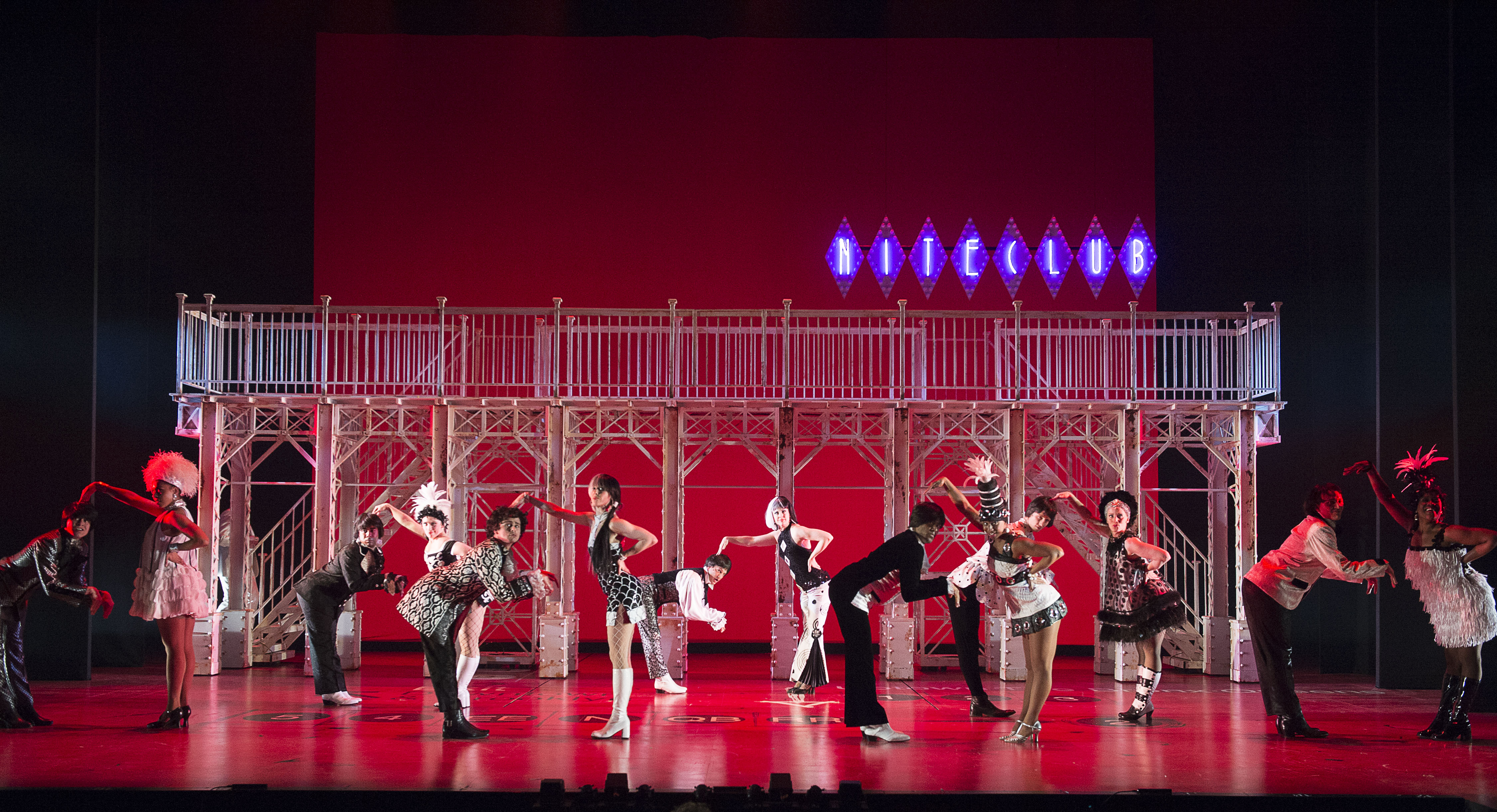
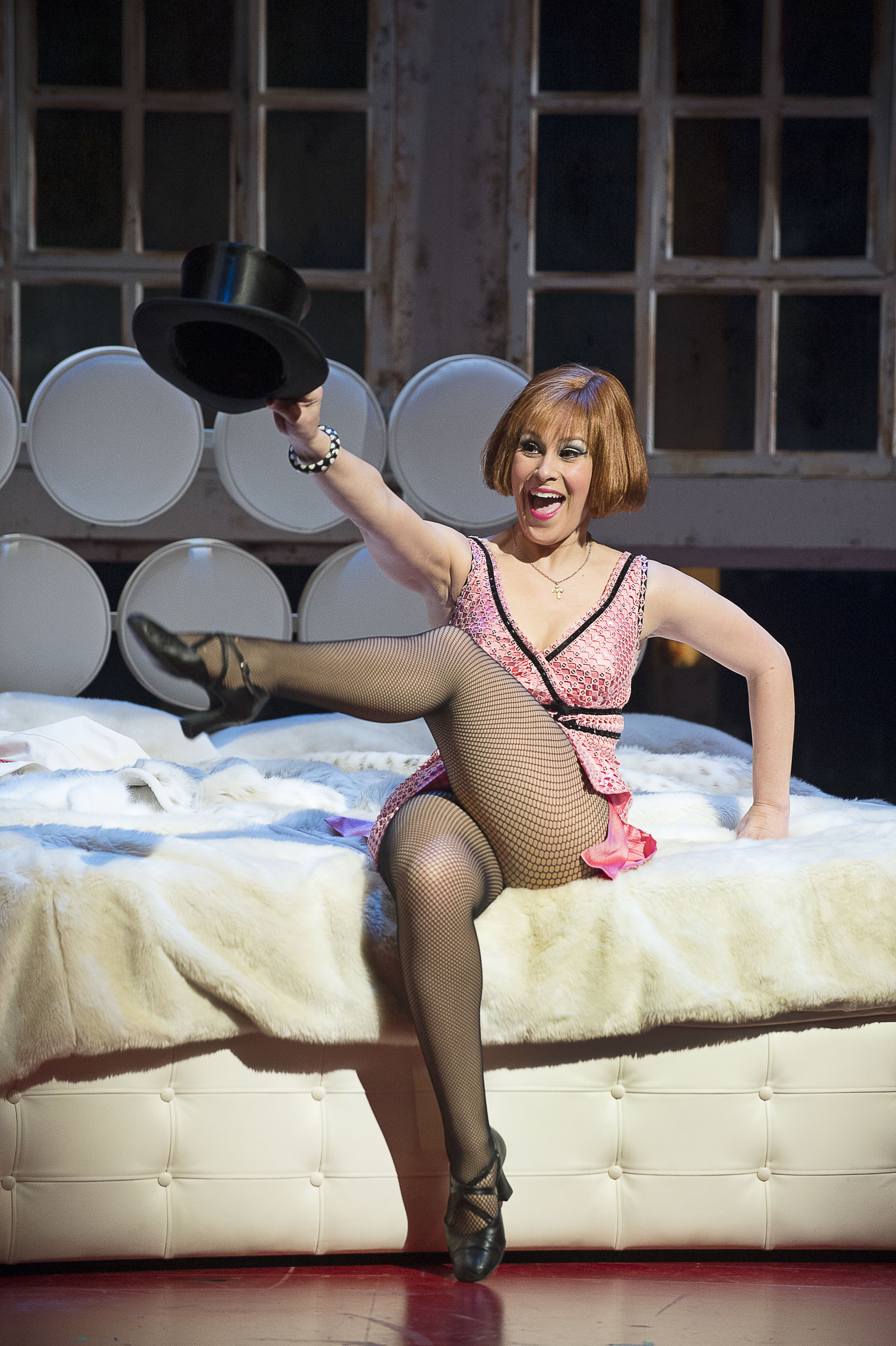
SWEET CHARITY AT THE SHAW FESTIVAL: ENERGY WITH A HUMAN HEART

In the Shaw Festival production of Sweet Charity, director Morris Panych and his impressive cast reach under the stylized and safely distant entities that musical characters can easily become and find there a vibrant and unforced humanity. I took almost instantly to this warmly energetic production and could well understand both the standing ovation at final curtain and the enthusiastic buzz in the lobby afterwards. The audience doesn’t applaud only because they have been thoroughly entertained but, as well, because they have connected with the humanness of these characters and been moved by people like themselves.

In Julie Martell we have an instance where actor, character, and performance blend together to define the very active heart of this production. Martell’s Charity is loveable and loved and not simply because she is supposed to be. She isn’t the embodiment of the glitz of New York, but rather an ordinary and flawed human being who is trying, with all her cards on the table, to survive in it. Her sometimes tentative dancing seems the attempt of an endearing young woman to go with the flow in a town that is indifferent to her.

Martell’s Charity doesn’t dance with the clipped elan of a Broadway hoofer, but more the fun seeking enthusiasm of an ordinary person who must earn a living and find happiness as it comes. Dance isn’t a natural physical language for her, but an extension of her natural spontaneity. She is physically fun in all places and in the scene with Vittorio we get the impression that she would be thus in bed too. However, when she has this Italian heart throb on very human, albeit start struck terms, he of course goes for his estranged babe instead.

Charity Valentine is somewhat unpolished, even though she is a dance hall hostess. Her New Yorker’s qualities are her keenly in-tune ability to banter and her hip physical gestures, no pun intended. She seems like a child let loose in a store of goodies, as when, in the Italian celebrity’s bedroom where she asks, with a mixture of push and doubt, “Is there anything I can do for you?” He doesn’t pick up on the sexual cue but suggests instead that they eat, which they do. When Vittorio’s current squeeze turn up, he and Charity are like brother and sister conspirators.

Julie Martell’s Charity is someone you like, but might not at first notice. She seems to be a wandering innocent who goes all places and, whatever state of denial she might be in about her world, she remains resilient and fresh. She is comparatively short limbed and pleasantly ample of thigh and calf, sexy as someone you notice, perhaps, because you chanced a glimpse of her leg emerging from a short trench coat that she invariably inhabits and rarely seems to leave. She is the one who is always used in relationships, a sucker for anyone who sends affection her way. We love her husky giggle, her irresistibly wide smile and we are charmed to be on her side.

As an audience, we easily, maybe eagerly, blend into this Sweet Charity’s dynamic yet humanly-flavoured world. It is a place ripe with eccentricities and the stereotypes that some people wear as their true identities, if anyone actually possesses such an entity, though most can’t help being near genuine. We have humanity’s variety before us and often they appeal. Take Mark Uhre’s Vittorio Vidal, a man who wears his worldly experience lightly with inherent understanding and charm, and with a pleasantly smooth daily grace in his manner. We enjoy the connection of Charity and Vittorio because it seems to unfold, slightly rough-edged, yet kindly.

Jay Turvey’s Herman is the closest to a big city persona among the males. This fits, after all, since he’s the one who keeps the taxi dancers focused and geared to sell their dancefloor company at the dance hall. He wears New York abrasiveness, but with heart as a natural quality, and his perpetual doer’s buzz is quite wired. Moreover, he has a stylized musical voice of tonal variety, secure and fluid with even a rich falsetto, so he’s nice to have on stage.

As Oscar, Kyle Blair does a skillfully measured and annoyingly believable take on a young man who is more ordinary that ordinary, an embodiment of paranoid futility. For Charity, Oscar is the latest to be claimed as “the one” and as he sees in her a “virgin” of “purity” their duet of neediness, as a result, is touching. Throughout, he winces at his life. We feel sorry for him, though we wouldn’t want him in the same elevator as we.

Charity’s two workplace best pals are Melanie Phillipson’s Helene and Kimberley Rampersad’s Nickie, two gals in the dressing room and beyond who, street-smart as they are, pick up on lies and fantasies with quick and compassionate insight. We see them as genuinely friendly, distinctly sexy, worldly-wise no–nonsense women, but dreamers too. Helene, the blonde with a wounded faraway look in her eyes, seems like a gorgeous hot number now beginning her slow decline into worn beauty. Her physical glamour seems like body warmth in a cold world.

Nickie, with good line and legs that go on forever, has probably the best dancing chops on this stage. She’s a dynamic blend of knowing sass and fun, a radiant dancing presence, a woman both hot and cool. Nevertheless, the lives of all three are summarized by another dancer with this quip -“Who dances, we defend ourselves to music”- because the extras, though not included in the price for dances, are sometimes available.

Morris Panych directs not for the effect of bright lights to which so many young and hopeful aspire but, rather, an atmosphere of real people who are hanging on to hope even as they lose it. We are entertained, to be sure, nonstop, by this production, but for Panych the unrelenting pace of life that people live doesn’t stop for dance numbers but instead fits dance into a daily grind for survival. Parker Esse’s choreography, therefore, is often geared more to a mass effect than individual quirkiness, massively busy for a city that is, well, massively busy. People here endure by doing some fun time.

Neil Simon’s book is zippy with much back and forth banter, the kind that fuels a number of short New York City vignettes and brings constant mild eruptions of chuckle in the audience. Try this exchange: “Can you tell me what room Norman Mailer is reading poetry?” “At home, (because) nobody showed up.” I still laugh at that one. We also hear reference to “that big coffee break in the sky.”

Ken MacDonald’s multipurpose set is a gem of concise but imposing encapsulation of the biggest of cities -now a subway, now a club, now a walkway, lots of doors- and because this main structure weighs 8 tons, we subtly feel imposed upon in our private worlds, even squashed. Bonnie Beecher’s lighting, with its looming shadows within both urban landscape and so within human inner lives, gives an air of subtle foreboding and the aftertaste of half-digested despair.

We find ourselves tuned into this engaging production and maybe sense Giulietta Masina from Nights of Cabiria, on which Sweet Charity is based, looking down benevolently. One bonus in this show -no maybe about it- is Paul Sportelli’s orchestra. Very soon we notice a full bodied band displaying their chops to seductively swinging effect, a punchy and brassy drive in irresistible groves that don’t let go. It so easy to move with this music and dance, ourselves, even sitting in our seats.

Posted in shaw festival, Uncategorized | Tagged , , , , , , , , , , , , | Leave a comment

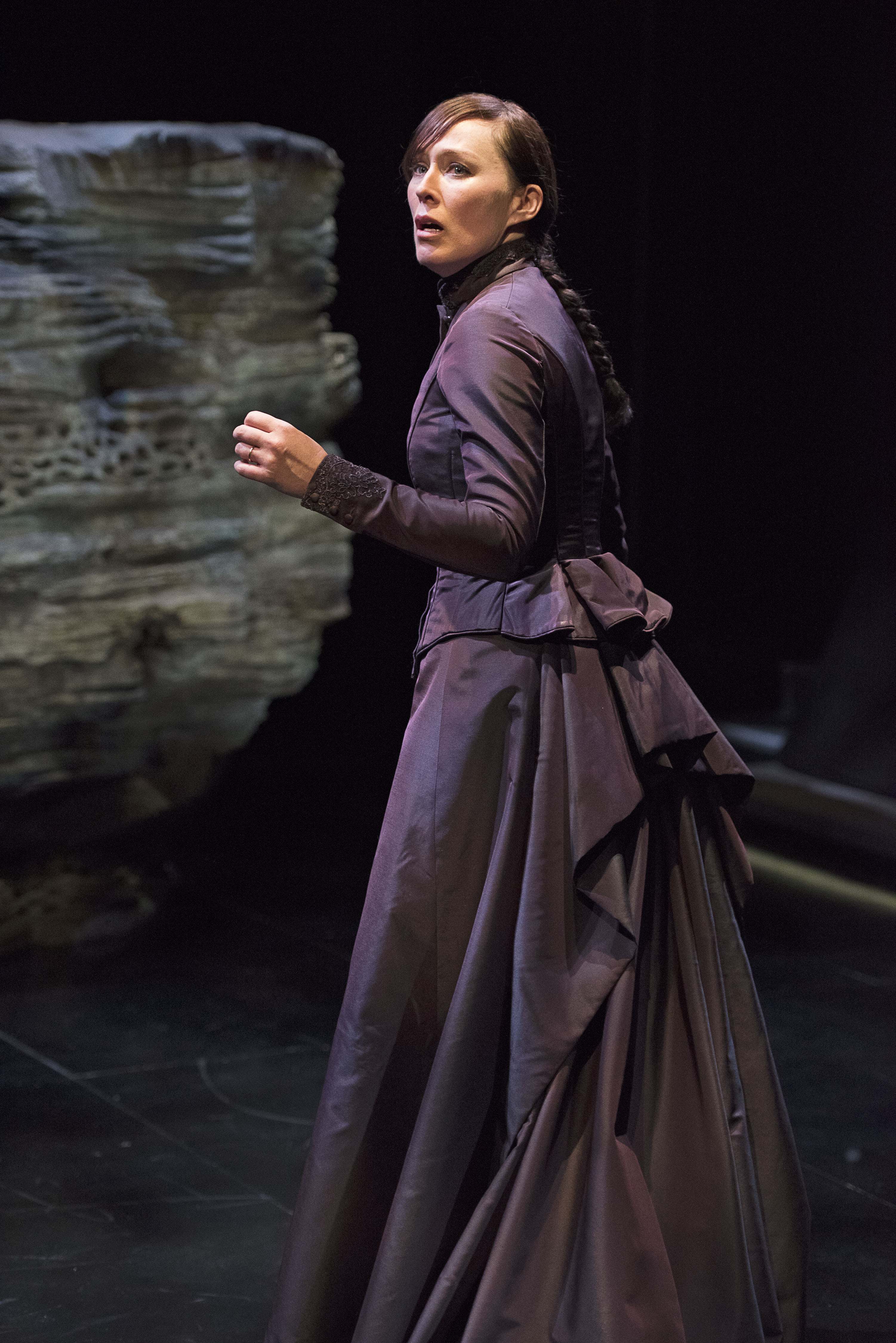
IBSEN’S THE LADY FROM THE SEA AT THE SHAW FESTIVAL: ANOTHER MUST-SEE GEM IN THE COURTHOUSE THEATRE

A naked woman lies atop a solitary, eroded, but commanding rock formation. A duet of female voices is gradually consumed by an electronic soundscape. The woman turns away from the spirit-dominating darkness around her and, looking toward us, seems consumed by her own heavy breathing from fatigue—or is it from the desperation of anxiety? – and silence comes. In the fade out of light, she is alone, with eyes hollowed out by some distance within her, a naked body among elements — maybe earthly, maybe cosmic — she cannot control. She is naked to them.

We come to realize, not too slowly, that we share her solitude. And whatever domesticity ensues in Ibsen’s play The Lady from the Sea, it now can never be taken for granted, it can never be the same. Most in our culture use habit and diversion to escape solitude. Some are forced into courage and become such solitude, as it ennobles them and those who must know the depths within them. Ibsen, in this unforgettable production of his play, shows how the weight of social convention is too heavy for human spirit to bear. She shows one life at a breaking point.

And what follows this symbolically weighty and unsettling introduction? We meet a painter with a canvas on a portable easel before him. The sea he paints is no longer an inner dimension of the woman, the Lady, but a pleasing vista seen safely from afar. There is easy banter between the artist, played welcomingly gregarious by Neil Barclay, and Kyle Blair’s Lyngstrand, played self-indulgent and confident as insecure men tend to be before the world awakens them to their own posturing.

The woman to whom they refer turns out to be Ellida Wangel who loves to swim because “she loves the sea” and it “always brightens her spirits”. Indeed, she is “faithful to the sea,” but an undercurrent of tension arises when, in reference to herself, she notes that we must be “civilized”. Meanwhile, also now before us we have the pleasingly animated and securely assertive daughters of widower Dr. Wangel, a man who is brilliantly underplayed in unspoken self-awareness by Ric Reid. In Wangel’s ongoing and dignified attempt to understand, keep, and ultimately liberate his wife, Reid shows the essence of poignant and surprisingly casual understatement.

Ellida’s voice almost breaks when telling friend Professor Arnholm, played quietly vulnerable and meta-mild by Andrew Bunker, that “I need to tell someone.” We already sense a woman confined in herself, but also note that a very easy flow of banter is achieved in director Meg Roe’s perceptive direction with nothing too heavy, though implied, at this early stage of the play. Indeed, we join in tolerating the young artist’s romanticized notions and keep attentive to the overlapping exchanges in dialogue that remind one of such method in the films of Orson Welles. But each of the play’s three females is here a unique force, and the seething resentment in daughter Hilde is potent and verging on mean as, say, when she goads the incapacitated Lyngstrand.

Ellida, of course, is the most unsettled. “Being a second wife doesn’t suit you,” she is told and we believe her words, “I can’t help it if I ache for the sea”. Ellida denies her husband a sexual bed and is bound to a sailor she symbolically married long ago before he fled the law. This sailor, inseparable in all ways from the sea, has a “terrifying power” over her -“I see him all the time” she declares- and she is drawn to him in their cosmic-existential-sexual bond. She must “come freely” to him even as she fears “the temptation to surrender myself to the sea.” Meanwhile, she “struggles to breathe inland.”

Thus, married to Wangel, Ellida must choose to remain with him, uncemented as their bond might be, or submit herself and her vague passions to the seduction of the unknown, to the sailor, to the sea. “It has to be my choice,” she declares. “But it isn’t your choice,” responds Wangel, for this is Ibsen turf with its unquestioned and woman-stultifying institution of marriage at stake. “I’m anchorless here in your house,” she tells Wangel and indeed she needs no traditional bond to anchor her but, as we later find, a marriage that allows each partner the freedom to be what they are.

There are compelling parallels with the somewhat bitchy Hilde’s “longing” for one word of love from her remote stepmom, because she too needs a supportive intimate relationship. Daughter Bolette, for her part, declares, “I just want my life to start” and, owing to the poignant poise and heartfelt sparkle of Jacqueline Thair’s endearing performance, we already wonder about her future life. She is insightful and naturally mature, and we like her.

But such is the subtle potency of this humane and profound production that we are affected by all these characters as they suggest what they want and what they need, even as, in truth, we don’t really know who they are. And isn’t that the essence of a fruitful marital bond, that, as in theatre, the mate or the characters must be who they are so we ourselves can resonate with them and become more human than we have been. One hopes that viewers allow themselves to grow, to mature, as they watch a rich production such as this.

As with many productions over Jackie Maxwell’s tenure as Artistic Director of the Shaw Festival, The Lady from the Sea is of an exceptional quality and one hopes that many people will see it. It serves as an insightful look at human need, at the risky possibilities in a marital bond, at the psychological reconfigurations that are crucial to human connections, and at the mythical dimension of human existence that is too often made trite and easily accessible in popular media.

There are numerous subtly focused aspects here in this fine production that, in Erin Shields’ easy-flowing but substantial take on Ibsen’s play, ring with a no-nonsense relevance to our many facades of happiness and success. The most memorable, to me at least, is how Moya O’Connell as Ellida, contained by convention as she is but bound to an unknown that only she can know, tightens ever so slightly, more and more, with each word she speaks. A silence surrounds us all as we watch these fleeting moments when a human spirit tries precariously to survive, and it is very scary.

Posted in shaw festival, Uncategorized | Tagged , , , , , , , , | Leave a comment

LAUGHTER UNCONFINED: SHAW’S YOU NEVER CAN TELL AT THE SHAW FESTIVAL TO OCTOBER 25

A few seconds of animation footage of a boat directed full speed ahead at the audience, a floating inflated fish and bubbles ascending merrily, and one feels present here the spirit, perhaps, of Terry Gilliam of Monty Python days. And then a music track that is playfully percussive and hip-tossing friendly, with a set and costumes designed in rich hues of inviting and quite light-hearted absurdity. And then an often erratic movement of bodies, much in high gear and spiked sometimes with the vigor of farce. Some characters are tripping out while others seem bent psychologically askew and wanting out of what they presently are.

And is that not William the butler who enters blowing a kazoo? Does he not have a twinkle in his eye? And doesn’t director Jim Mezon’s production of Shaw’s You Never Can Tell follow suit and have its own, well, twinkle? Are we not being asked to lighten up and put habitual expectation of Shaw aside so we might feel the unspoken heart of his characters in their diverting world that never diverts quite enough? Appropriately, the lawyers and the father, those who advocate rules, end up with ridiculous masks to wear while William, with his sagacious sense of place, proves the world-wise heart of this production. He knows his place well, nd he wants it to remain undisturbed, while the others often don’t know where to place themselves and are conspicuously disturbed.

There’s a telling moment in the fourth act when William, played by Festival treasure Peter Millard, re-enters a situation of hostilities and general upset. All the participants in this noisy scene pause into quiet, as if their servant’s efficient deference is conferring upon all an identity, one above his station to be sure, that demands a dignity they can’t seem to muster. William is an age-brewed butler who by his presence implies the roles that others are expected to play. He is also a beneficent presence who manages each conversation as he wishes and when he says “Sir” -which is often- he hits home the fact that the others are unworthy of such respect. He is adept at getting in his subtle barbs too, at speaking the truth without giving too much offence and if he claims, “being a waiter is born in the character” he is, in turn, considered, “the most thoughtful of men.”

Tara Rosling is Mrs. Clandon, a mother of three who declares, “I married before I knew what I was doing and have never been in love.” Rosling’s animated voice and physicality are certainly a delight to behold, mixed as they are with an almost regal poise, motherly authority, and vulnerability too. We sense in her a life, long lived but still on hold, with much of her heart unrealized, unknown, yet always, it seems, vaguely present in what seems a quiet longing. Patrick McManus is Fergus Crampton, the husband from whom she long ago took flight with the kids. Crampton is a man of grumbly bitterness who snarls and quietly snorts but is not too explosive. As a self-proclaimed “properly hardened man,” he feels he should endure the pulling of teeth without gas, walks slightly bent with self-consuming bitterness, and fears to present a bad image in public and with his family. He seems much an ordinary guy on the verge of breakdown. His skin is too tight. This Crampton is a ton of cramp, thank you, GBS.

The twins, Dolly and Philip, will annoy some, I’m sure, with their hyper, unstoppable, skit on a dime, and very with it manner, but they are having a fun time and –how dare they?- they are getting away with it. To the adults, they are “clever children” who can’t “hold their tongues” and “barbarian children” according to their mother. These twins, played by Jennifer Dzialoszynski and Stephen Jackman-Torkoff, are dotty in high drive, their spoken delivery revved up a notch, their animated bodies quite pleasantly extravagant with gestures in all directions. These twins are precisely synchronized to each other and they prefer to improvise scenes imbued with a sense of delighted self- mockery and hyper chatty dramatics. They may play the game of life, when needed, but certainly delight in games as they feed any lunacy –this along with an attitude of not taking “this island seriously.” Did I mention that he is black and tall while she is neither? Both, in their imaginative self-indulgence, are a lot of fun to watch.
,
Also delightful are Peter Krantz as Finch and Jeff Meadows as Bohun. Finch is paunchy in manner if not in belly, a man of premature stuffiness and a voice that seems to moan from afar. As we see in this production, humans play roles, play games, and Finch seems to ascend and descend in the role of authority like a wave on the shore of this “seaside town.” He fumes and he is snickered at, his voice glides with implied judgement on others, and he is a man who is easily vexed and hurt. He is deemed as “old- fashioned” and admits that he is “indulged as an old fogey.” Meanwhile, Jeff Meadows’ Bohum is a self-propelling super-wiz lawyer whose father is William the butler. If the latter reflects the class system and is a butler and man who almost craves the societal confines of his position, his expansive son is much otherwise. When allowed to serve, William is content. But enter his son, now a prestigious lawyer of society’s prestigious echelons, one who stands impossibly tall, takes thrusting steps, and is garbed in black, and we have –what is it?- a Svengali to the multitudes who seems, as played by Meadows, on the verge of a vaudeville dance. Or is he a societal Ubermensch,, given to bombastic authority in voice and grand gestures, a man with penetrating understanding whom others heed. In any case, Meadows-Bohum here is funny as hell.

The odd love angle of You Never Can Tell involves Gray Powell’s Valentine, a dentist whose “business is to hurt people” but -since we meet him with just his first patient- he hasn’t really had much such business thus far. Over time, we find that he is a game player, a self- indulgent pursuer of women who now finds one in Gloria who won’t play such a game because she never learned how -or did she? He is also a self-confessed fortune hunter who is much attuned to ‘the duel of sex,” a man who calls himself a “butterfly” and who “plays with women’s affections.” Almost as soon as we meet him, his first outburst is animated and pointed towards hysteria. Later we see how, as he tries to gain the trust of Julia’s mother, he reveals a busy seducer’s past by saying, “You’re very different to all the other mothers that have interviewed me.”

If Valentine does a lousy job of concealing who he is –or is it that he conceals himself best by apparently revealing himself so much?- Gloria seems an unreachable severity wrapped and concealed at first in a coat from neck to toe. Gloria, played by Julia Course, seems a dehumanized robot of her mother’s making and her mother echoes in Julia’s annoyed indignation, defiance even, at all the artificiality that women are supposed to be. “How I love the name of mother,” she exclaims. She finds love “vulgar” and has no intention of getting married in this “convention ridden world.” However, in Act 4, she enters red gowned with long gloves and finally we can see she does have a woman’s hips. She still agonizes about “my miserably cowardly womanly feelings” but it is also revealed that she did have her list of guys back in Madeira. Valentine may say, “You are a clever girl, but you have not been awakened yet” but when she reverses roles and becomes the aggressor, he is rather wiped out and unsettled. If he is unprepared for this Gloria, so are we.

Valentine and Gloria are funny in their remoteness from each other. She doesn’t seem to possess an undercurrent of human heart beneath her imposed, and maybe accepted, party line, but this absence adds to the farcical element of Valentine’s attraction to her. Powell’s Valentine is decidedly mercurial, a man who changes tactics as needed, and we can’t even pin his self-awareness on him as a constant truth about the guy. Gloria seems immovable while he is movement itself, and both are very much in the head, cerebral. We wonder if his male attraction to females is a male self-indulgence, since all the chemistry is concocted in his own head, no matter who or what she might be. So it’s interesting that Gloria, who seems to have no passion other than the one that mirrors her mom’s beliefs, does cough up a past of some kind with men in Madeira and is quite adept at coming on to Valentine. Or is she an innocent gone wild? After all, when Gloria was kissed, “she appeared to like it.” And does this all seem rather arbitrary? Or is life itself, over and over, a farce of arbitrariness as depicted here? You never can tell.

This good time had by all production is designed by Leslie Frankish, with lighting by Kimberly Purtell, projections by Cameron Davis, movement by Jane Johanson, and original music and sound designed by John Gzowski, each one with imaginative clout and beach ball seats included.
According to director Jim Mezon’s notes, this production is dedicated to the memory of actor Jack Medley who worked at the Shaw Festival between the years of 1964 and 1995 and, yes, we all do miss his presence there very much.

Posted in shaw festival, Uncategorized | Tagged , , , , , , , | Leave a comment

VALERIE HARMS: AN INTERVIEW WITH AN AUTHOR-CONSULTANT CALLED “A MOST REMARKABLE WOMAN” BY THE UNITED NATIONS

Valerie Harms’ ten books include Your Soul at a Crossroads, Dreaming of Animals, The Inner Lover, Tryin’ To Get To You/ The Story of Elvis Presley, National Audubon Society Almanac of the Environment/ The Ecology of Everyday Life, Stars In My Sky/ Nin, Montessori, Steloff, Unmasking: Ten Women in Metamorphosis, Celebration with Anais Nin, and –for children under ten- Frolic’s Dance. She has worked with a number of publishers including Putnam, Random House, Atheneum, W.W. Norton, and Shambhala. As co-founder and publisher of Magic Circle Press, a press intended to publish works by women, she produced a number of award-winning books. As a journalist Harms has appeared in a number of publications including The New York Times and at present she edits Distinctly Montana Magazine. A longtime scholar of Carl Jung, James Hillman, Joseph Campbell, and others, Harms has been an Intensive Journal consultant and given workshops for several decades. This interview took place in May of 2015.

James Strecker: In total and in its many intriguing parts, your rich and varied life is almost too abundant to discuss in a brief interview, but let’s bravely proceed to condense it, if we can. To begin, you are an Intensive Journal Consultant in a method created by depth psychologist Ira Progoff, so let’s ask you to describe five “stepping stones” -as Ira called them- of your own life and their importance to your developing existence in this world.

Valerie Harms: 1. Growing up in Chicago where I learned about horseback riding and rode in shows. My parents divorce.
2. Going to Smith College. Exposed to hard work, living in a house in which I had my own room. Wrote and read till early morning.
3. Married Larry Sheehan, also a writer. Had two children. Constituted family life. Challenges.
4. National Audubon Society (more about this later)
5. Move to Montana. At first I traveled to great places: Galapagos, Bali, Costa Rica, Morocco. I was part of the Montana Wilderness Association and film society. Now I don’t travel and connections are dwindling.

JS: What have you done as a “scholar” of Carl Jung, James Hillman, and Joseph Campbell? Why do these thinkers appeal to you and why are they important for people in today’s world?

VH: All three churn my depths and imagination though in different ways. I became a Jung scholar back in the 1970s, only 20 years after he died, and now 45 years later still resonate with his work. When I worked in New York City, the C. G. Jung Center at 39th and Madison was my place of restoration. There was a great library of psychological and philosophical works, but even better was ARAS (Archive of Research in Archetypal Symbolism), a photo library of the world’s art, sculpture, and spiritual icons. I spent many hours poring over pictures. I gave workshops at the Center. I researched my books there.
When I moved to Montana in 1995, I joined a newly formed Montana Friends of Jung organization and soon became president of both the local and state boards. We sponsored programs with Jung analysts and we slowly read Jung’s works, including the difficult Mysterium Coniunctionis and more recently The Red Book, Jung’s journal.
James Hillman is an archetypal psychologist whom I heard lecture many times in NYC and Montana (he came here at elk rutting season because he liked to watch them in Yellowstone Park). He did not like the term “psychologist” or “therapist”; he was a theorist of the imagination. His method was philosophical. His books made thoughtful contributions — from the soul of cities to people’s fascination with the trimmings of war.
Joseph Campbell, of course, specialized in the world’s mythologies, all of which are related to the spiritualism of cultures.
These three men are important to the world because they emphasized the images that came from a person’s life, dreams, fantasies, thoughts. These images are the basis for one’s personal meaning and unique spiritual life.

JS: One of my favourite books of yours is The Inner Lover, a wise volume I have shared with many others. In it, as with other of your books, you make substantial reference to your own life and I find this a courageous thing to do. Please explain the intention of this book and also, as an honest writer and therapist, if you feel that it is your duty to use psychological self-exposure as one of your underpinnings.

VH: This book arose from a deluge of realizations made during my private therapy and passions. I felt I had to use my life in order to illustrate my points. I knew no other life as thoroughly. I wanted to document how our ideals in love objects evolve as we mature — from parent to teenage crushes and so on. I especially wanted to show how the love we feel is within us and does not belong to the other person no matter if they die, don’t love us back, or are our marriage partner. I wanted to show that we could use our grief, anger, and longing as creative nourishment. I urged people to write, draw, build something. I also wanted to show how our passions sprout spiritual buds. The most passionate spiritual poetry originates in love, regardless of its state. For instance, the oft-quoted Rumi was in love with a man whom he could not be with after a time, so he wrote to address the man and found his subject morph into a spiritual Being. When I give workshops, I often find it helps others if I share a personal anecdote.

JS: Your Dreaming of Animals is both fascinating and moving because, in part, it considers our relationship with animals and our inner psychological/spiritual existence in this connection. Please explain what this book is telling us.

VH: I am desperately concerned about the extinction and threatening of species. Ecology or the links among all species — i.e. the harmony of the spheres — means all beings are connected. Many people don’t feel that. Because of my psychological bent, I was aware of how our dreams tell us about our relationship to animals — from domestic cats to cheetahs — in our own lives or the state of the world. Sometimes dreams of animals tell us something about our behavior or attitudes and sometimes the dreams instruct us about what we can do to help them thrive better. I gave many examples of the most charismatic animals in the book — from a psychological to ecologic point of view.

JS: What impact did knowing and working with Anais Nin have on your life? Please tell us about the two books Celebration with Anais Nin and Stars In My Sky: Anais Nin, Maria Montessori, Frances Steloff and also your connection with the latter two women.

VH: I just came back from California where I talked about my relationship with Anais. Here are notes on what I said:
At a women artists Consciousness Raising group, a friend says read Diaries of Anais Nin; I was used to the diary style of Samuel Pepys, being taught that diaries weren’t literature. I read her stories first and found them daunting. Her diaries then consumed me – they focused on her desire to be a great writer (mine too), inner conflicts, art, relationships.
I wrote her & and she invited me to a book party for Vol. IV at Gotham Book Mart founded by Frances Steloff. In late 60s, she was the second oldest woman there and the loveliest – long clingy velvet dress, gold lame slippers, coppery hair swept up with ribbons braided through it. Her grace & elegance influenced me.
She invited to the apt in NYC she shared with husband Ian Hugo (former banker & filmmaker); I knew more about him more than her life in CA with Rupert.
I wore turquoise kohl for a while. I had a husband and two children, not exactly like her life. I acquired a majestic cape. My stationery letterhead was in purple ink.
My friend and I planned a Celebration weekend—Anais wanted it small. We held it in 1972 over 3 days, 30 people, highest energy. Anna Balakian (Breton, Surrealism), Frances Steloff made presentations.
I had a lot of correspondence with her. I read everything she wrote. Novel of the Future heavily underlined.
The friend & I started Magic Circle Press, based on Anais’ Gemor Press. We published a book on Celebration weekend. Party at Gotham Book Mart.
I go to Chicago and comb Northwestern U special collections. I publish a book of her early stories, Waste of Timelessness.
I wrote an essay about her relationships with analysts Allendy & Rank, both of whom broke the boundaries.
I organized a program at NY U with Anais and Ira Progoff, founder of Intensive Journal Method and a book about Otto Rank, among others. He was irritated that she got most of the attention.

Donna Ippolito in Chicago was an editor at Swallow Press and later Ohio University Press. Swallow Press published my first book called Unmasking: Ten Women in Metamorphosis – based on the consciousness raising group.
The best Web site on Anais, www.anaisnin.com, was started by two friends and I at my house on the patio. This patio was central again as after Anais’ death, the publication of Vol. VII came out and both of Anais’ husbands came – Hugo and Rupert — came to a party we gave on the patio.
I went to Bali and Fez, Morocco in her footsteps. In Bali I stayed at the same place she and Rupert stayed and talked to the owner about her.
Death ends a life but not a relationship. I still dream about her. She is a guide, now about aging. The gifts that Anais gave me were contained in her lines: “proceed from the dream outward”, “the personal life deeply lived contains truths far beyond itself. Also, her emphasis on love, nurturing creativity, beauty, literature, art, heart to heart conversations, and harmonizing relations.

Frances Steloff I knew because of Anais. Her bookstore in NYC, Gotham Book Mart (Wise Men Fish Here), was a literary hub. Poetry occupied a huge space. On the second floor literary parties were held. The James Joyce Society met there. Interested in spiritual writings, Frances held Gurdjieff audiotape listening discussions. I knew her through her 90s when she had a straggly white bun and very kind face. As a teen she had left a mean stepmother to be on her own in NYC and had grit and smarts. She lived on the third floor of the building in a one-room studio. She was a vegetarian who loved cats. “Putsy” sat on her desk downstairs. She was known for putting the book a person unknowingly needed into their hands. She died when 100. The iconic shop no longer exists.
Maria Montessori’s self-directed method of education inspired me when my children were young. I helped found a school. She had a theory of “cosmic education” which was about the unity of all cultures. She taught techniques for children to bring about peace in their everyday lives. She thought teenagers should be managing small business ventures to gain independence. She was Italy’s first woman doctor. Mussolini burned her in effigy. She was a woman with great foresight and many of her gifts have yet to be developed.
My book Stars In My Sky included long personal essays on Anais, Frances, and Montessori.

JS: Your National Audubon Society Almanac of the Environment/ The Ecology of Everyday Life is certainly relevant in our present zeitgeist of doom about our future. In what ways is this book important to us and what does it mean to you?

VH: This book shows how everything we do is linked to a nature cycle — solar, carbon, water, nitrogen, and the food web. For instance, the fibers for the clothes we wear may originate in plants. The book encourages us to look at and ask how that plant is grown, whether are pesticides used, how is it harvested, how transported and what fuel used, how processed and distributed. A big push has been to make companies responsible not only for sales but also how products are produced, who produces them, right back down to their origin as well as the cleanup after use. Same with our appliances and forms of recreation. It’s an extremely comprehensive book, bringing in all the experts I could find. It goes into ocean and land ecology as well as politics and media. It really enabled me and others to see the patterns in nature and to get a large perspective.

JS: The description of your Tryin’ To Get to You, The Story of Elvis Presley implies that there was more of substance to the man than the idol-worshipping masses know. Please tell us about your connection with Elvis and why you wrote the book.

VH: I first heard Elvis in my high school auditorium in Texas when I was 15. I had never seen nor heard anything like him. He looked like an Adonis in loose cream shirt and slacks, and buck shoes. His voice instantly excited me. I never stopped admiring what he could do with a song, especially the raunchy ones or the spirituals. I hated the movies and the sappy tunes, though I did like “Love Me Tender” and “Old Shep.” He was rock n roll to me even though I also listened to black stations in Chicago. After his performance, he stayed overnight in our town and when he and the other two band members were having breakfast, two friends and I rushed to the cafe. They invited us to sit down. He had jiggly energy and was always kind and sincere. Later after starting a fan club, he signed a bunch of membership cards and gave us photos. Until superstardom took over, he invited us backstage where he often was jamming with someone like Faron Young.
I wrote the book when Elvis died as a way to assuage the mourning process. I listened to my favorite songs all day. It was a rich time! You’ll have to read the book to find out what I thought about the rest of his life.

JS: Your latest book is Your Soul at a Crossroads, with Steps You Can Take Not to Lose It and it seems something of a compilation and summary of key elements from some of your books. Why does this book contain the material it does and what is your intention for the book as a whole?

VH: I have taught many psychological/spiritual workshops. I wanted to create a short book based on my experience with the exercises, which readers could use as a guide. So, it’s a combination of things I’ve learned and instructions.

JS: How do you like writing for children? What’s hard and rewarding about it?

VH: Two of my children’s books were done “for hire” so I felt pressure from the bosses. For both I had to do a lot of research. One was about an Arctic Hare and the neighboring animals. I had to learn all about them. One delightful fact was that the hares gather in full moons and dance around. I named the main character Frolic and called the book Frolic’s Dance. A stuffed animal was sold with it.

JS: You also provide consulting services for people wanting to be published. If people have a manuscript that they want to see in print, what do you do for them and with them? Other than payment, of course, what do you yourself derive from such work?

VH: Normally I provide evaluating, editing, and suggestions regarding publishers and/or agents. I enjoy reading what engages people and how they express their thoughts. I like seeing all the different styles.

JS: You have lived in many places including France, Connecticut, Montana now, and other places, so tell us what different geographical locations do to you and how they have impact on your psychological situation and your creativity.

VH: I lived in France when I was newly married and had my first child. I was isolated in a small farm village with only a bicycle. I had lots of time to read and write, even interacting with my daughter. We had an orchard. The rhythm of the villagers was interesting. I loved learning to cook French recipes, learning about Alsatian wines & eau de vies, and traveling about. I still yearn for cafe life, outdoor picnics, croissants, and French bread.
Connecticut, a New England state, was a hub for good friends, modern activity, getting to NYC. We raised our family there and also divorced. I absolutely loved our second home there. It was the best I’ve ever been in. Several of my books were created there.
Montana is a place where the Indians were conquered by the Anglo settlers. The landscape is largely gorgeous with the Rocky Mountain range and the big open sky. I had hoped I and my writing would become wilder —I’m still trying.

JS: In this vein, you also currently edit Distinctly Montana Magazine. What do you enjoy about your current gig as editor? How does living in Montana feed your spirit?

VH: I always say that planning and editing a quarterly magazine is like throwing a party with different people each season. I have learned more about Montana’s history than I have any other place. It’s easier to be more involved in politics too.

JS: We first met when we were both attending journal-keeping workshops in New York and training with this method’s creator, depth psychologist Ira Progoff, to be Consultants using his approach, The Intensive Journal Workshop. Please tell us concisely what the Intensive Journal is, what it involves, its distinct approaches to the psyche, and what rewards it offers a human being initially and over time.

VH: That is an impossible question. You should direct people to the book At a Journal Workshop by Ira Progoff or to Dialogue House.

JS: I know you have the manuscript of your new novel on your desk. Is there anything you might share about the novel itself and your experience of writing it?

VH: The novel has been tough because all my published work has been nonfiction and I’ve had to adapt to this other genre. This time though I’m using my imagination totally. Of course, the plot centers around what I’ve absorbed from my life, some of it here. A father-daughter bond, a romance between the daughter and a Native Indian, ranching life, a fire, dispute over water use, a murder, and an artist and baby. I’m reading it over aloud for a final edit. It’s been years that I’ve been on it. It’s much harder to get time to write now.

JS: Opportunities for writers have decreased immensely in our lifetime, so what advice would you give to anyone seeking to be a writer and any writer seeking to get published?

VH: If you can’t find a regular publisher, explore self-publishing options but first develop a marketing plan.

JS: It’s obvious that you are “a most remarkable woman” but why did the United Nations say that about you?

VH: The UN committee on the Year of the Woman honored me because of my depth psychological journal workshops.

JS: Okay, let’s imagine that you have seven essential things you can say to express what you have learned to be of most value over your lifetime. What would they be?

VH: Find a practice that enables you to stay close to your inner process; pay attention to your dreams; be comfortable in solitude. Learning to work out conflicts with other people is a must. Beauty and music are necessary for healing and joy.

JS: Please tell us briefly about the impact five key people have had on your life and what that impact was.

VH: Anais Nin — as I’ve already discussed
Ira Progoff — I have used the Intensive Journal Method for decades and been grateful for it.
Aurelie and Alex Sheehan — My daughter and son, very different people. My daughter is reasonable as a lawyer, a very funny sardonic writer of fiction, a kind teacher, and a remarkable mother. My son parents three children (two stepchildren) and is loved by all. He was athletic. It was a privilege to grow up with them. In that vein I must give credit to their father, with whom I had a 20-year relationship. It was extremely hard to part ways.
Jan Beyea — he was Senior Scientist at the National Audubon Society and hired me after my divorce when it was a tough time. I learned so much about conservation and habitats. We’d met in college and are still friends. I enjoyed his scientific mind.

JS: How can people get in touch with you?

VH: Valerie Harms, valerie@valerieharms.com. See my Web site, www.valerieharms.com

Posted in Interviews with Writers, Uncategorized | Leave a comment

ADRIANNE PIECZONKA: AN INTERVIEW WITH THE INTERNATIONALLY CELEBRATED CANADIAN SOPRANO DUE TO SING RICHARD STRAUSS AND WAGNER WITH THE TSO MARCH 11, 12, AND 14

Photograph by Bo Huang

James Strecker: First of all, best wishes for your birthday of March 2. Since you’ll be fifty-two, I wonder how the Adrianne who will be singing with the Toronto Symphony on March 11, 12, 14 is different as a person and as an artist from the Adrianne of, say, twenty years ago.

Adrianne Pieczonka: I feel more and more like the Marschallin in Der Rosenkavalier! I first sang the role when I was about 33 and back then I couldn’t fully relate to Marie Therese’s concern about aging and mortality. Two decades later I do feel much more compassion with her! I am fit and healthy which is a blessing and I continue to try to stay active and in good shape. In many ways I am much happier now and definitely more settled in life in general.

JS: You’ll be singing Four Last Songs by Richard Strauss with the TSO and I wonder how the fact that this was the composer’s last composition and the fact that he died before its premiere, with Flagstad conducted by Furtwangler, influence your interpretation.

AP: I am privileged to have sung a great deal of Strauss during my career – mostly opera but I’ve also done a fair bit of lieder as well. The Four Last Songs hold a special place in my heart. They are iconic songs, loved by so many people. The poems are very beautiful and touching and it’s even more poignant to know that Strauss died before its premiere. The last song, “Im Abendrot” is probably my favourite and again it deals with dying and mortality. One senses Strauss also sensing his own imminent death perhaps.

JS: As a composer, what does Strauss demand of a soprano and what does he uniquely offer her?

AP: We know that Strauss wrote extremely well for the soprano voice. His wife Pauline was a soprano and his devotion and love for her was channeled into many of his greatest female roles. There are a few distinctions in his soprano writing: he writes often for the high coloratura voice as with Zerbinetta and Fiakermilli), the dramatic soprano of Elektra and Salome, but he writes most prolifically for the more lyric soprano voice with Marchallin, Arabella, Ariadne, Countess Madeleine and others. For these more lyric roles, which i have done a great deal, the soprano needs to be able to spin long lines of golden tones. There are often bits of conversational vocality here and there, but, as in the vocal line of the Four Last Songs, it is the beautifully spun legato lines which make the magic.

JS: Furtwangler in his Notebooks, like some other commentators, makes references to Strauss as –how do we put this?- a composer given to style over substance, as a man of some deficiency in expressing inner depth. You have sung a lot of Strauss, so could you give us your view of the composer and the man you hear in his music?

AP: I’m afraid I don’t agree with Herr Furtwangler’s comments. I find there is a deep humanity and tenderness in many of Strauss’ operas. Sometimes he gives over to frivolity or excess, but in his music I often get a sense of deep contentment and love.

JS: You’ll also be singing a selection of Wagner with the TSO and, as with Strauss, I’d love to know what unique challenges there are to his music for a soprano. For what reasons do you enjoy singing Wagner?

AP: I don’t think I can answer this question satisfactorily. Wagner’s genius -like Strauss’ and my other two ‘faves’ Verdi and Mozart- knows no bounds. His music, like the music of Strauss, seems to fit my voice and sensibility particularly well. I have done nearly all the Wagner heroines, bar Bruennhilde and Isolde, and I am excited to try Isolde’s ‘Liebestod’ with the TSO. It’s the first step toward potentially attempting the role in its entirety.

JS: You’re coming off a season of doing Senta in Wagner’s Der Fliegende Hollander at Covent Garden and it’s a role you’ve sung a number of times including Bayreuth. Please explain to us the effect of some of the opera houses in which you have sung on your performances of roles you did there.

AP: I’ll just speak about Bayreuth if I may. It’s a very special opera house, a special festival. I remember when I first set foot on the stage in 2006 for a rehearsal of Die Walkuere. I had goose bumps to stand there and look out into the auditorium.
The acoustics are unique in that the pit is covered, basically hidden from view when you are on stage or in the audience. Wagner designed this himself to ensure that the balance between the voices and the orchestra would be perfect. There is no other house like it in the world. The people that come to Bayreuth each summer are called ‘pilger’ – pilgrims. They often make the yearly pilgrimage to Bayreuth to hear the same operas over and over again. I think this would only be the case for the operas of Wagner. They evoke such devotion and obsession to many opera goers, me included.

JS: Louis Quilico once told me that “Mr. Verdi is very smart” and that the composer pretty much indicates everything the singer should do, so please tell us your thoughts on Verdi as a composer and a man of operatic theatre. Is doing Falstaff as much fun as it seems for the singers?

AP: Very briefly Verdi composes peerlessly for the voice in every range. The art of bel canto is dying out and the great Verdian interpreters are few and far between. There is nowhere to hide singing Verdi – prima la musica. The voice is exposed and first and foremost. You have to be technically very sound to sing Verdi. Falstaff is a hoot! I loved singing this role.

JS: Please tell us about your favorite experiences with directors in the theatre.

AP: Patrice Chereau for Elektra in Aix-en-Provence. His energy, drive, humour and charm were amazing. He was very ill when we were doing the production but he was so focused, even in the face of such terminal illness. Remarkable.
My other favourite director is German Willy Decker. We did many productions together in Germany such as Katja Kabanova, Pique Dame, Eugene Onegin. I just clicked with Willy on many levels. He was very anxious, worrying that that his concept was perhaps not good and this is common I find in great artists. They are not boastful or grand. They are self-scrutinizing and often very hard on themselves. I’ve enjoyed also working with Canadian Robert Carsen many times. I’ll do his production of Capriccio in Paris in January of 2016.

JS: One often reads about mistakes that younger opera singers make in pursuing their respective careers and, since you do master classes, I wonder what advice you would give to these singers so they might best realize their potential.

AP: There’s no magic bullet for success as an opera singer. Like every other profession, one must do the work! I find it common that young singers today want to jump right to ‘being a star’ instead of doing the many steps over the years to attain this goal. You need tons of discipline as a singer. Its like being an athlete and you must train, work hard every day. Rejection is part of the process. I often was rejected at auditions, but you must move past this and keep going forward.

JS: Please describe, say, three especially memorable experiences you have had in your musical career.

AP: Working with director Patrice Chereau, shortly before his death, as Chrysothemis in Elektra in Aix-en-Provence in the summer of 2013. Having private coaching sessions with Riccardo Muti in Vienna, with him at the piano, coaching me on the recitative for the role of Donna Anna. He was infinitely patient and kind. And singing at the Milennium Gala at Roy Thomson on New Year’s eve 1999. It was a thrilling night. It was the first time I sang ‘Vissi d’arte’ and it’s great to have the recording of that night and the audience’s wonderful response afterward.

Posted in Interviews from Music, Uncategorized | Tagged , , , , , | Leave a comment